ST. PETERSBURG, Russia: Host nation Russia beat a poor New Zealand team 2-0 on Saturday to open the Confederations Cup with a win that was all but demanded by Vladimir Putin.
Russia’s president was in the $750 million new stadium in his native St. Petersburg to see forward Fyodor Smolov’s 69th minute goal add to an own goal by New Zealand defender Michael Boxall in the 31st.
Putin this week demanded better results from the 63rd-ranked Russia team and for the players to perform like warriors. They hardly needed to be in dispatching No. 95 New Zealand, which seemed to find the world stage too big.
Russia’s win eases the pressure on its second game, against Cristiano Ronaldo’s Portugal in Moscow on Wednesday. The European champion opens its Group A program on Sunday against Mexico in Kazan.
New Zealand is now without a win in four trips to the Confederations Cup, and next plays Mexico on Wednesday in Sochi.
The Kiwis threatened only with back-to-back chances in the 78th minute: A powerful Ryan Thomas shot saved by Russia captain Igor Akinfeev and Tommy Smith’s header blocked on the line.
Russia’s opening goal had an ugly finish after two pretty pieces of individual skill once the All-Whites defense needlessly lost the ball.
A chest-high pass to forward Dmitry Poloz was deftly guided into the path of Denis Glushakov who chipped the ball over onrushing goalkeeper Stefan Marinovic. A three-player race to meet the rebound off a post saw the sliding Boxall’s trailing right arm get the final touch in a bundle of bodies.
Russia deserved its first-half lead after twice having shots stopped on the line in the opening 10 minutes.
From Russia’s fourth corner, defender Viktor Vasin’s header saw the ball spin off a post and across the goalmouth before Michael McGlinchey cleared. Tommy Smith then tidied up when Poloz poked a close-range shot slowly past Marinovic.
In the 69th minute, Russia scored again when Smolov started a move on the halfway line, passed the ball wide to the right to Alexander Samedov and Smolov sprinted in to the penalty area to score from five yards.
Penalty goals among radical proposals up for debate
Penalty goals for handling the ball on the line could be a thing of the future if proposals compiled by the International Football Association Board’s (IFAB) technical director are accepted.
The proposals in a document titled ‘Play Fair’ — which also include players being able to play freekicks and corners to themselves — are to be debated over the next nine months and could be added to at a meeting of Ifab, football’s global rule making body, next month.
The intention is to increase the amount of playing time, according to The Times who have seen the document.
“It is a radical document,” Ifab technical director David Elleray told The Times.
“You could say that it is a quiet revolution aimed at getting football even better.
“My starting point was to look at the laws and say ‘what are they for?’, and if there is no particular reason then would changing them make the game better,” added Elleray, a former leading referee.
Awarding a goal for handball on the line would have probably seen Ghana reach the 2010 World Cup semifinals as Uruguay’s Luis Suarez was sent off for handling Dominic Adiyiah’s goalbound shot on the line in the dying seconds of extra-time — Asamoah Gyan failed to convert the penalty and the South American side went on to win in the penalty shootout.
Elleray also recommends that referees only be able to blow for half-time or full-time when the ball is out of play and penalties being awarded if a goalkeeper handles a backpass.
On the other hand goalkeepers will be able to play goal kicks to teammates inside the area with their opponents obliged to be outside it.


Russia eases to victory over New Zealand in Confederations Cup opener
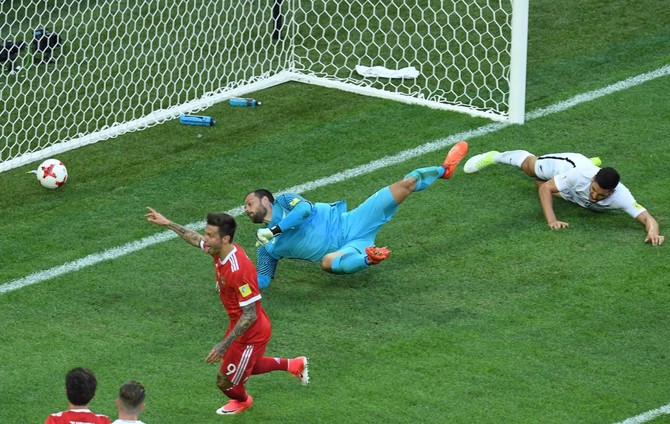
Russia eases to victory over New Zealand in Confederations Cup opener

Middle East war puts Asian Football Confederation in a tricky situation
- Asian football has long been structured around regions, with competitions split between East and West
- With conflict in the Middle East escalating on Feb. 28, the AFC was forced into emergency mode as the knockout stages of its club competitions approach
DAMMAM: Football in Asia has never been an easy task to manage. Long flights, numerous time zones, conflicting calendars, vastly different football cultures and — perhaps more than any other confederation in the world — politics.
While the war in the Middle East falls under the AFC’s umbrella, its direct effects have so far been limited to the clubs in West Asia. Asian football has long been structured around regions, with competitions split between East and West, although for a period, the second-tier AFC Cup operated in five separate regions.
As a result, AFC club competitions in East Asia continued uninterrupted in the first week of March. A crowd of 31,225 watched Johor Darul Ta’zim’s historic 3-1 victory over Sanfrecce Hiroshima in the AFC Champions League Elite round of 16. Bangkok United defeated Tampines Rovers in the AFC Champions League Two quarter-final, and an all-Cambodian clash between Phnom Penh Crown and PKR Svay Rieng in the AFC Challenge League ended in a 4-1 victory for the visitors.
The situation in West Asia, however, is vastly different.
With the conflict in the Middle East escalating on Feb. 28, the AFC was forced into emergency mode as the knockout stages of its club competitions approach.
Within 24 hours, the confederation announced that all first-leg matches involving West Asian clubs in AFC competitions would be rescheduled until further notice. The same decision was taken for the second-leg matches fixtures just 48 hours later.
Domestic football has also been heavily disrupted. Leagues in Qatar, Bahrain, Kuwait and Lebanon have been postponed indefinitely, with matches continuing behind closed doors in Jordan.
Leagues in Saudi Arabia, Oman, Iraq and Syria continue to operate, but flights in the region are limited.
With the season already compressed by the FIFA Arab Cup, FIFA Intercontinental playoffs and the upcoming FIFA World Cup, member associations throughout the Middle East now find themselves scrambling alongside the AFC to solve a problem that ultimately lies outside their control.
Another issue looms on the horizon. The AFC Champions League final stage will be hosted in Saudi Arabia next month for the second year in a row. While football has not halted in the Kingdom and the security situation is stable, it remains to be seen whether East Asian clubs will be willing to travel if the conflict continues.
What is the real solution, fans ask?
One proposal that has been circulated is to centralize the knockout rounds from the Round of 16 stage instead of the quarter-finals. That option, however, presents its own challenges. East Asian clubs have already begun their journey in the round of 16, and the idea of centralized hosting has historically not been popular across the continent.
When Saudi Arabia and Qatar were selected to host the AFC World Cup Qualifiers fourth round last year, the decision sparked backlash from Indonesia, Iraq, Oman and the UAE. More recently, journalist Ali Al-Marshoud claimed on Saudi sports program “In the 90” that the UAE’s Al-Wasl rejected a proposal for their AFC Champions League Two quarter-final against Al-Nassr as a single-leg match in Jeddah.
The AFC therefore finds itself in a difficult position. It cannot control regional geopolitics, nor can it influence government policies. At the same time, there is no guarantee that East Asian clubs will travel to the region, or that West Asian clubs will agree to surrender their right to play matches at home.
The conflict has also begun to affect international football.
With the FIFA World Cup intercontinental playoffs scheduled for later this month and Iraq facing a crucial qualifier in Mexico on March 31, uncertainty continues to grow.
In a statement released by the Iraqi Football Association, officials confirmed they were in constant contact with FIFA and the AFC regarding potential travel complications.
Head coach Graham Arnold is currently unable to leave the UAE, while several players and staff have struggled to obtain visas to Mexico due to embassy closures. All the while flights through Iraqi airspace have been suspended.
Political complications are not new to Asian football. For years, Saudi and Iranian clubs played each other at neutral grounds. Conflicts in Syria, Palestine, Iraq and Lebanon also forced the AFC to adopt special arrangements at various times. And of course, the COVID-19 pandemic, which fundamentally reshaped the state of football in Asia.
Yet the current situation presents a different scale of challenge.
For the first time in modern history, the AFC must navigate a regional conflict that touches nearly every part of the confederation. With the season entering its decisive stages and the largest World Cup in history approaching, solutions must be found quickly, or Asian football risks a crisis that could reshape the continental game.


