WASHINGTON: US Defense Secretary Jim Mattis has said that North Korea’s advancing missile and nuclear programs were the “most urgent” threat to national security and that its means to deliver them had increased in speed and scope.
“The regime’s nuclear weapons program is a clear and present danger to all, and the regime’s provocative actions, manifestly illegal under international law, have not abated despite UN’s censure and sanctions,” Mattis said in a written statement to the House Armed Services Committee.
“The most urgent and dangerous threat to peace and security is North Korea,” the statement added.
“North Korea’s continued pursuit of nuclear weapons and the means to deliver them has increased in pace and scope.”
Earlier this month, the UN Security Council expanded targeted sanctions against North Korea after its repeated missile tests, adopting the first such resolution agreed by the US and China since President Donald Trump took office.
The US focus on North Korea has been sharpened by dozens of North Korean missile launches and two nuclear bomb tests since the beginning of last year and by Pyongyang’s vow to develop a nuclear-tipped intercontinental ballistic missile capable of hitting the US mainland.
Mattis, speaking before the panel, warned of the potential losses in the case of conflict with North Korea.
“It would be a war like nothing we have seen since 1953 and we would have to deal with it with whatever level of force was necessary. It would be a very, very serious war,” Mattis said.
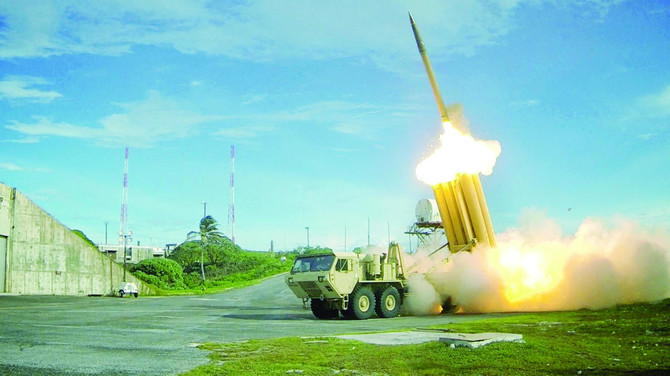
Chung Eui-yong, South Korea’s top national security adviser, said last week that Seoul did not aim to change its agreement on the deployment of a US anti-missile system to protect against North Korea, despite a decision to delay its full installation.
He called the decision to delay installation of remaining launchers of the Terminal High Altitude Area Defense, or THAAD, system, pending a review of its environmental impact, a domestic measure to ensure a democratic process.
The South Korean military said Tuesday a suspected North Korean drone had taken photographs of the THAAD system in South Korea before it crashed on its way home.
The drone, mounted with a camera, was found last week in a forest near the border with North Korea. It was similar in size and shape to a North Korean drone found in 2014 on an island near the border.
“We confirmed that it took about 10 photos,” of the anti-missile system, a South Korean Defense Ministry official said.
The drone was suspected to be from North Korea, the official added.
South Korea is hosting the anti-missile defense system in the Seongju region, about 250 km from the border with North Korea, to counter a growing missile threat from the North.
“We will come up with measures to deal with North Korean drones,” said an official at South Korea’s Office of the Joint Chiefs of Staff.
North Korean drones are known to have flown over South Korea several times.
North Korea has about 300 unmanned aerial vehicles of different types including one designed for reconnaissance as well as combat drones, the UN said in a report last year.
The North Korean drones recovered in South Korea were probably procured through front companies in China, with parts manufactured in China, the Czech Republic, Japan and the US, it added.
China strongly objects to the THAAD system saying its powerful radar can probe deep into its territory, undermining its security and upsetting a regional balance. China also says the system does nothing to deter North Korea.
South Korea and the US say the system is aimed solely at defending against North Korean missiles.


![]()
North Korea ‘most urgent’ threat to security, says Mattis
North Korea ‘most urgent’ threat to security, says Mattis
Latest updates



Recommended


© 2026 SAUDI RESEARCH & PUBLISHING COMPANY, All Rights Reserved And subject to Terms of Use Agreement.