JEDDAH: Ret. Gen. Mahmoud Mansour, the founder of Qatari Intelligence, said he believes it is impossible for Doha to implement its aim to have Iranian and Turkish soldiers deployed in its territory.
In a phone interview with Makkah newspaper, Mansour said the US will not allow fighters of other nationalities to be deployed in Qatar territories near its large base, adding that talks of foreign soldiers (to be used by Qatar) are no more than “vocal waves that will disappear.”
The statement comes in response to official and media reports about Qatar’s intention to host military personnel from Iran, Turkey and Pakistan in response to the fact that 16 Arab and Islamic countries have severed relations with it.
He said a list that named 59 individuals and 12 entities, issued jointly by Saudi Arabia, Bahrain, the UAE and Egypt, “is only the first step and will be followed by others.”
“In the coming days, many terrorist persons and entities will be added, especially those who Qatar has funded in the Arab world, Africa, Asia and Europe.”
He said it is time to bring the Qatari regime to account whether by the Gulf Cooperation Council, the Arab League or the UN.
The general said that former Qatari Emir Hamad bin Khalifa and his government executive head Hamad bin Jasim turned Doha “to a department for the execution of operations aimed at achieving the goals of previous US administrations in the region.” They supported armed and terrorist groups in Asia, Africa, the Arab world and some European regions.
He said arrogance made them (the Hamads) think they could outsmart the US and seek the creation of a huge Islamic state with Doha as its capital.
Doha looking for agents
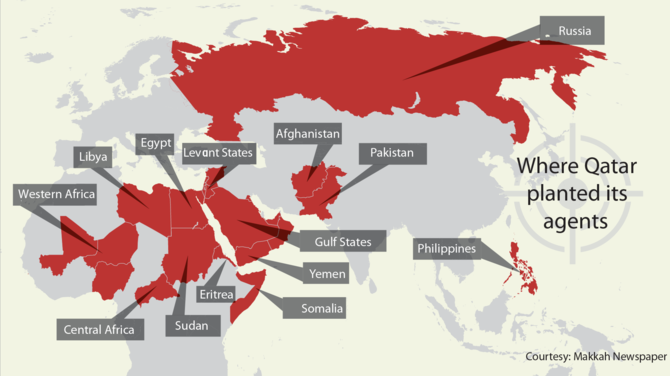
During that period (under the two Hamads), Qatar started looking for agents to recruit in Somalia, Eretria, Central and Western Africa, Egypt, some of the Gulf states “if not all of them,” in addition to the Levant region and even Russia, Pakistan, Afghanistan and the Philippines.
They started providing the funds and arms for those agents, while deceiving the Qatari people who thought the funds were for humanitarian purposes at those societies.
“The truth is, their goal was to create unrest in the countries they succeeded in penetrating using their (the then-Qatar government) vast amounts of money.”
Gen. Mansour said he was confident that the US is fully aware of the recent Qatari financial support for organizations and activities inciting against other societies.
Al-Baghdadi in Qatar?
He said he would not be surprised if Qatar was found to be hosting Daesh leader Abu Bakr Al-Baghdadi.
“Was he smuggled into Qatar? Where is he? Is he one of those who turned their countries to hell and are hosted in Doha’s large hotels?”


![]()
Founder of Qatari Intelligence: US will never allow Iranian, Turkish presence in Doha
Founder of Qatari Intelligence: US will never allow Iranian, Turkish presence in Doha



Latest updates


© 2026 SAUDI RESEARCH & PUBLISHING COMPANY, All Rights Reserved And subject to Terms of Use Agreement.