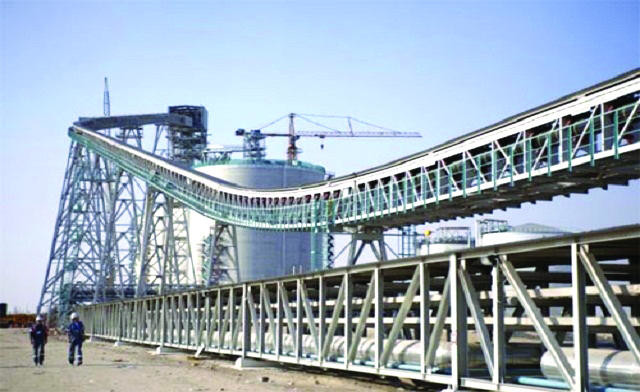
Study identifies obstacles to growth of Saudi mining industry

The study predicts that the mining sector should contribute to the creation of large numbers of jobs by 2030, while it also meets targets for the increase in contribution to the GDP. (Reuters)
Updated 11 June 2017
Follow

Study identifies obstacles to growth of Saudi mining industry

JEDDAH: Saudi Arabia’s mining sector is faced with six key obstacles to improving efficiency, according to a recent study.
The study revealed that the biggest obstacles include the industry’s focus on the export of minerals as raw materials, instead of processing or manufacturing them. Other issues include the high cost and risk of investment in the sector, as well as the limited spending on exploration operations.
The study, which was introduced during a panel discussion on increasing added value to the mineral sector, revealed other obstacles, which included a lack of manpower in the Kingdom for exploration, production, and manufacturing operations.
Meanwhile, the industry is still reliant on traditional energy sources. And investors are not easily supported, due to a lack of funding, not least because of complicated borrowing terms imposed by the banks.
The study still needs to be finalized before the recommendations are introduced. But it showed that the industry was gaining importance with the backing of the Saudi government, as the Kingdom looked to diversify its income sources.
The study also explains that the Vision 2030 and the National Transformation Program (NTP) 2020, have attached special importance to the mining sector.
One of the study’s highlights regarding the NTP 2020 was the development and support of the Saudi mining industry, as it raises its contribution to the gross domestic product (GDP) from SR64 billion ($17.06 billion) in 2015 to about SR97 billion in 2020.
The study also found that the dependence of the Saudi economy on oil resources and the exportation of crude oil presented high risks that were clearly demonstrated when crude oil prices dropped to less than $50 a barrel, having reached highs of $147 in 2008.
It also noted that the Kingdom possessed untapped mineral wealth, as well as large reserves, which if exploited, would represent a third source of income after oil products and petrochemical industries.
The recommendations follow a number of seminars held ahead of the initiatives being submitted to the royal court, following their endorsement at next November’s Riyadh Economic Forum. The study aims to develop the mining industry, optimize the exploitation of the mineral sector and activate the role of the mining sector to contribute to the balanced development and diversification of the economy.
The study predicts that the mining sector should contribute to the creation of large numbers of jobs by 2030, while it also meets targets for the increase in contribution to the GDP.
The Riyadh Economic Forum holds workshops that bring together around 300 prominent figures from the public and private sectors, as well as other sections of society, to debate and create practical proposals for discussion.


Saudi non-oil exports jump 21% as trade balance improves: GASTAT 

Updated 5 sec ago
Follow

Saudi non-oil exports jump 21% as trade balance improves: GASTAT 

RIYADH: Saudi Arabia’s non-oil exports, including re-exports, rose 20.7 percent year on year in November to SR32.69 billion ($8.72 billion), official data showed. 

According to preliminary figures released by the General Authority for Statistics, national non-oil exports, excluding re-exports, increased by 4.7 percent in November compared with the same month in 2024. 

The strong performance highlights progress under the Kingdom’s Vision 2030 strategy, which aims to diversify the economy and reduce its long-standing dependence on crude oil revenues. 

In its latest report, GASTAT stated: “The ratio of non-oil exports, including re-exports, to imports increased in November 2025, reaching 42.2 percent, compared with 34.9 percent in November 2024. This increase was driven by a 20.7 percent rise in non-oil exports, alongside a 0.2 percent decline in imports over the same period.”  

It added: “The value of re-exported goods increased by 53.1 percent during the same period, driven by an 81.9 percent increase in ‘machinery, electrical equipment and parts’, which accounted for 51.5 percent of total re-exports.”  

Machinery, electrical equipment and parts also led the non-oil export basket, making up 24.2 percent of outbound shipments and recording an 81.5 percent annual increase. This was followed by products of the chemical industries, which represented 20.3 percent of total non-oil exports and rose 0.5 percent year on year. 

The data adds to signs of resilience in Saudi Arabia’s non-oil economy, with S&P Global’s Purchasing Managers’ Index at 57.4 in December, well above the 50 threshold that separates expansion from contraction. 

Top non-oil destinations 

The UAE was the leading destination for Saudi non-oil exports in November, with shipments valued at SR10.48 billion. 

India ranked second at SR3.01 billion, followed by China at SR2.32 billion, Singapore at SR1.76 billion and Bahrain at SR900.7 million. 

Exports to Egypt totaled SR815.5 million during the month, while Turkiye and Jordan received goods worth SR799.1 million and SR773.3 million, respectively. 

GASTAT said ports and airports played a central role in facilitating non-oil shipments in November. 

By sea, Jeddah Islamic Seaport handled the largest volume of non-oil exports at SR3.57 billion, followed by King Fahad Industrial Seaport in Jubail at SR3.51 billion. 

Ras Al-Khair Seaport was the exit point for non-oil goods valued at SR2.66 billion, while Jubail Seaport and King Abdulaziz Seaport in Dammam handled outbound shipments worth SR2.32 billion and SR2.14 billion, respectively. 

By air, King Abdulaziz International Airport handled goods worth SR5.60 billion, while King Khalid International Airport in Riyadh processed exports valued at SR3.53 billion. 

Exports and imports 

Saudi Arabia’s total merchandise exports reached SR99.73 billion in November, representing a 10 percent increase compared with the same month in 2024. 

“Merchandise exports in November 2025 increased by 10.0 percent compared to November 2024, and oil exports increased by 5.4 percent. The percentage of oil exports in total exports declined from 70.1 percent in November 2024 to 67.2 percent in November 2025,” GASTAT added.  

China remained the Kingdom’s largest export destination, accounting for 13.5 percent of total exports, followed by the UAE at 11.7 percent and Japan at 9.9 percent. India, South Korea, the US, Egypt, Singapore, Bahrain and Poland were also among the top 10 destinations, which together accounted for 71.4 percent of total exports. 

Imports declined by 0.2 percent year on year in November to SR77.38 billion, while the merchandise trade surplus surged by 70.2 percent, the report showed. 

China was the Kingdom’s largest source of imports, accounting for 26.7 percent of inbound shipments, followed by the US at 10.2 percent and the UAE at 6.2 percent.  

“Germany, Japan, India, Italy, France, Switzerland, and Egypt were also among the top ten import sources, with total imports from these ten countries representing 68.6 percent of Saudi Arabia’s overall imports,” added GASTAT.  

King Abdulaziz Port in Dammam was the leading entry point for goods, handling 22.8 percent of imports in November. Jeddah Islamic Port followed with 22.6 percent, ahead of King Khalid International Airport in Riyadh at 17 percent and King Abdulaziz International Airport in Jeddah at 11.9 percent.