‘Qatar must do more to combat extremism,’ says Tillerson

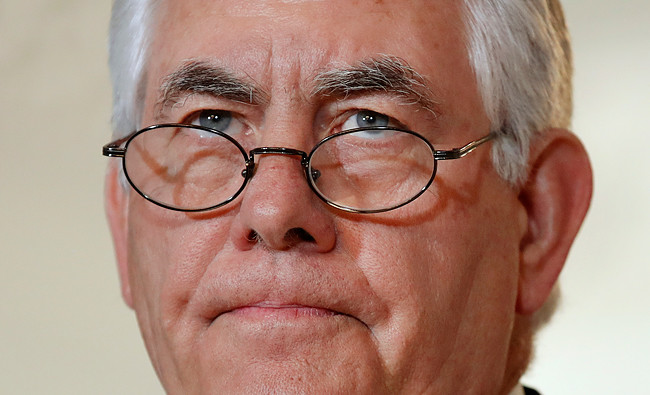
US Secretary of State Rex Tillerson. (AP)
Updated 10 June 2017
Follow

‘Qatar must do more to combat extremism,’ says Tillerson

JEDDAH: US Secretary of State Rex Tillerson said Qatar must do more, “more quickly” to combat extremism.
Delivering a short statement at the State Department in Washington on Friday, he said: “US expectation is that Gulf countries would immediately take steps to de-escalate situation in region.”
“The GCC must emerge united and stronger,” he said.
He called on Saudi Arabia, UAE, Bahrain and Egypt to ease blockade on Qatar.
Earlier, US President Donald Trump spoke to Egypt’s President Abdel-Fattah El-Sisi on the Qatari issue, according to a senior administration official.
A diplomatic crisis of unprecedented scale erupted in the Gulf and wider region Monday, as eight governments dramatically cut ties with Qatar over its alleged support for extremist groups.
Saudi Arabia, Bahrain, Egypt, the UAE and other countries announced they would withdraw diplomatic staff from Qatar.
The move saw Qatar’s only land border closed and air and sea links cut by the four Arab countries. As well as closing all transport links with Qatar, Saudi Arabia, the UAE and Bahrain also gave Qatari visitors and residents two weeks to leave.
Fifty-nine Individuals, including members of the Qatari royal family and controversial Muslim Brotherhood cleric Yusuf Qaradawi, as well as 12 Qatari entities have been listed on a new terror list announced in a Saudi, Emirati, Bahraini and Egyptian joint-statement. 


Turkish and Greek leaders set for talks on migration, maritime borders

Updated 4 sec ago
Follow

Turkish and Greek leaders set for talks on migration, maritime borders

  • Fifteen migrants died in a shipwreck off the Greek island of Chios last week after their boat collided with a Greek coast guard vessel and sank in the Aegean Sea off the Turkish coast
ANKARA: Turkish President Tayyip Erdogan ‌will host Greek Prime Minister Kyriakos Mitsotakis on Wednesday for talks likely to focus on migration and longstanding maritime disputes, as the ​NATO allies and historic rivals try to build on warming ties.
Fifteen migrants died in a shipwreck off the Greek island of Chios last week after their boat collided with a Greek coast guard vessel and sank in the Aegean Sea off the Turkish coast.
Mitsotakis will be accompanied by ministers responsible for foreign affairs, finance, ‌development and migration, ‌Greek officials said.
Developments in the Middle ​East, ‌Iran ⁠and ​Ukraine, migration, trade ⁠and organized crime are also likely to be on the agenda.
Greek Foreign Ministry spokeswoman Lana Zochiou said on Tuesday the aim was “to assess the progress of bilateral cooperation” and “to keep communication channels open to defuse any potential crises.”
Turkiye is a transit country for migrants seeking to ⁠reach the European Union via Greece. Ankara ‌says the EU has not ‌fully delivered on commitments under a ​2016 migration deal and ‌Athens wants Turkiye to do more to curb irregular ‌crossings.
Despite a thaw in rhetoric since a 2023 declaration on friendly relations, the neighbors are at odds over maritime boundaries in the Aegean, an area widely believed to hold energy resources ‌and with implications for airspace and military activity.
Ankara said last month it had issued ⁠a maritime ⁠notice urging Greece to coordinate research activities in areas of the Aegean that Turkiye considers part of its continental shelf.
Greece’s foreign minister had said Athens planned to extend its territorial waters further, including potentially in the Aegean.
In 1995, Turkiye’s parliament declared a casus belli — a cause for war — should Greece unilaterally extend its territorial waters beyond six nautical miles in the Aegean, a stance Athens says violates international maritime law. Greece says it wants ​only to discuss ​demarcation of maritime zones.