EUGENE: Inside a mosque in the college town of Eugene, a half-dozen men prostrated themselves on a carpet while another man led the midday prayers. Over their melodic recitation came a tapping sound as a locksmith installed higher-grade locks on the front door.
The worshippers at the Eugene Islamic Center are worried about their security. A man recently appeared outside the mosque and threatened to kill Muslims.
Barely two weeks later, an assailant stabbed two men to death and wounded a third on a commuter train in Portland, 110 miles (180 kilometers) to the north. The victims were trying to protect two teenage girls, one of whom was wearing a hijab, as the man shouted anti-Islamic slurs.
Looking ahead, Muslim leaders and others are concerned about anti-Sharia, or Islamic law, marches planned for Saturday in Seattle and about two-dozen other US cities, saying the marches are really anti-Muslim. They consider the incidents in Portland and Eugene, and other recent anti-Muslim crimes in America, part of an alarming trend that came to the forefront in last year’s presidential election with far-right activists portraying Islam — and all Muslims — as a threat.
“Our Muslim community is feeling a tremendous amount of stress and pressure,” said former Seattle Mayor Mike McGinn, who plans to attend a counter-rally on Saturday. “It’s important for local leaders to express solidarity and make clear we stand against bigotry, against racism and with our Muslim neighbors in the state and beyond.”
The group organizing the rallies, ACT for America, has chapters around the country and says it is focused on fighting terrorism and promoting national security. It says it condemns bias against religious groups and is “proud to stand shoulder to shoulder with peaceful Western Muslims as well as peaceful Muslims worldwide.”
Yet many Muslims and others say the group promotes a distorted and prejudiced view of Islam.
ACT for America activists portray Sharia as largely incompatible with American democracy and often warn of a stealth effort to replace US law with Islamic law. Muslims call the claims ludicrous and say Islamic law plays a role similar to Jewish law, as a guide to religious life rooted in the Qur’an.
Aneelah Afzali, who heads a Seattle-area group that works against discrimination and hate crimes, said she will be putting up an “ask a Muslim booth” near Seattle’s anti-Sharia rally, “so people can ask questions directly about Islam, and we can counter conspiracy theories, accusations and lies that come from that hate rally.”
She said she has noticed increased hostility to Muslims, evidenced by the destruction of a granite sign in front of the mosque she attends in Everett, Washington, by someone apparently wielding a sledgehammer. A temporary sign was destroyed a few weeks later.
“What was so beautiful was the outpouring of community support,” she said, explaining that many community and business leaders showed up for a ceremony and left their handprints in the concrete base that holds the new sign.
Two far-right groups, the Oath Keepers and the Three Percenters, are to provide security at some of the rallies, apparently the first simultaneous anti-Sharia rallies in the US Members of a third group also confirmed they’ll attend, according to the Southern Poverty Law Center, which monitors hate groups.
“With the recruitment of anti-government groups and the Proud Boys, the potential for violence increases,” the center said.
The marches come amid a rise in reports of anti-Muslim incidents in the US, including arson attacks and vandalism at mosques, harassment of women wearing Muslim head-coverings and bullying of Muslim schoolchildren.
“Things happen so fast, it’s so hard to keep up,” said Ibrahim Hooper, communications director for the Council on Islamic-American Relations.
Muslim leaders hear echoes of the views of groups like ACT for America in President Donald Trump’s temporary ban on entry into the US from six Muslim-majority countries — a measure currently blocked by federal courts — and in his claims of dangers posed by immigrants and Muslim refugees. Trump has said his policies are critical for protecting national security.
Those who attend the Eugene Islamic Center, in an off-white building in a lower-income neighborhood, are still coming to grips with the May 10 threat from a man who was arrested the next day while carrying a knife.
Mosque member Drew Williams said the man claimed to have killed Muslims while serving in the military in Iraq and told witnesses, “I have no problem killing you.” The man was charged with intimidation, menacing and harassment.
“Many people are worried and saddened and very shocked, but we still hope to be able to practice and to be part of the Eugene community,” Williams said as the locksmith worked next to him.
Besides installing stronger locks, the mosque is raising funds to erect a fence around the building and possibly hire a security guard for Friday prayers, when the number of worshippers peaks.


![]()
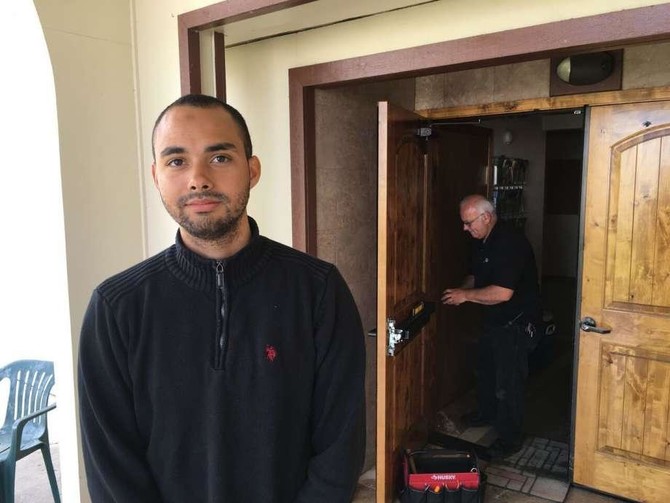

Anti-Sharia rallies this weekend worry Muslim leaders
Anti-Sharia rallies this weekend worry Muslim leaders
Greenland crisis boosts Danish apps designed to identify and help boycott US goods
- Boycott campaigns are usually short-lived and real change often requires an organized effort rather than individual consumers
COPENHAGEN: The makers of mobile apps designed to help shoppers identify and boycott American goods say they saw a surge of interest in Denmark and beyond after the recent flare-up in tensions over US President Donald Trump’s designs on Greenland.
The creator of the “Made O’Meter” app, Ian Rosenfeldt, said he saw around 30,000 downloads of the free app in just three days at the height of the trans-Atlantic diplomatic crisis in late January out of more than 100,000 since it was launched in March.
Apps offer practical help
Rosenfeldt, who lives in Copenhagen and works in digital marketing, decided to create the app a year ago after joining a Facebook group of like-minded Danes hoping to boycott US goods.
“Many people were frustrated and thinking, ‘How do we actually do this in practical terms,’” the 53-year-old recalled. “If you use a bar code scanner, it’s difficult to see if a product is actually American or not, if it’s Danish or not. And if you don’t know that, you can’t really make a conscious choice.”
The latest version of “Made O’Meter” uses artificial intelligence to identify and analyze several products at a time, then recommend similar European-made alternatives. Users can set preferences, like “No USA-owned brands” or “Only EU-based brands.” The app claims over 95 percent accuracy.
“By using artificial intelligence, you can take an image of a product … and it can make a deep dive to go out and find the correct information about the product in many levels,” Rosenfeldt told The Associated Press during a demonstration at a Copenhagen grocery store. “This way, you have information that you can use to take decisions on what you think is right.”
‘Losing an ally’
After an initial surge of downloads when the app was launched, usage tailed off. Until last month, when Trump stepped up his rhetoric about the need for the US to acquire Greenland, a strategically important and mineral-rich Arctic island that is a semiautonomous territory of Denmark.
Usage peaked Jan. 23, when there were almost 40,000 scans in one day, compared with 500 or so daily last summer. It has dropped back since but there were still around 5,000 a day this week, said Rosenfeldt, who noted “Made O’Meter” is used by over 20,000 people in Denmark but also by people in Germany, Spain, Italy, even Venezuela.
“It’s become much more personal,” said Rosenfeldt, who spoke of “losing an ally and a friend.”
Trump announced in January he would slap new tariffs on Denmark and seven other European countries that opposed his takeover calls, only to abruptly drop his threats after he said a “framework” for a deal over access to mineral-rich Greenland was reached with NATO Secretary-General Mark Rutte’s help. Few details of that agreement have emerged.
The US began technical talks in late January to put together an Arctic security deal with Denmark and Greenland, which say sovereignty is not negotiable.
Rosenfeldt knows such boycotts won’t damage the US economy, but hopes to send a message to supermarkets and encourage greater reliance on European producers.
“Maybe we can send a signal and people will listen and we can make a change,” he added.
The protest may be largely symbolic
Another Danish app, “NonUSA,” topped 100,000 downloads at the beginning of February. One of its creators, 21-year-old Jonas Pipper, said there were over 25,000 downloads Jan. 21, when 526 product scans were performed in a minute at one point. Of the users, some 46,000 are in Denmark and around 10,000 in Germany.
“We noticed some users saying they felt like a little bit of the pressure was lifted off them,” Pipper said. “They feel like they kind of gained the power back in this situation.”
It’s questionable whether such apps will have much practical effect.
Christina Gravert, an associate professor of economics at the University of Copenhagen, said there are actually few US products on Danish grocery store shelves, “around 1 to 3 percent”. Nuts, wines and candy, for example. But there is widespread use of American technology in Denmark, from Apple iPhones to Microsoft Office tools.
“If you really want to have an impact, that’s where you should start,” she said.
Even “Made O’Meter” and “NonUSA” are downloaded from Apple’s App Store and Google’s Play Store.
Gravert, who specializes in behavioral economics, said such boycott campaigns are usually short-lived and real change often requires an organized effort rather than individual consumers.
“It can be interesting for big supermarket brands to say, OK, we’re not going to carry these products anymore because consumers don’t want to buy them,” she said. “If you think about large companies, this might have some type of impact on the import (they) do.”
On a recent morning, shoppers leaving one Copenhagen grocery store were divided.
“We do boycott, but we don’t know all the American goods. So, it’s mostly the well-known trademarks,” said Morten Nielsen, 68, a retired navy officer. “It’s a personal feeling … we feel we do something, I know we are not doing very much.”
“I love America, I love traveling in America,” said 63-year-old retiree Charlotte Fuglsang. “I don’t think we should protest that way.”
The creator of the “Made O’Meter” app, Ian Rosenfeldt, said he saw around 30,000 downloads of the free app in just three days at the height of the trans-Atlantic diplomatic crisis in late January out of more than 100,000 since it was launched in March.
Apps offer practical help
Rosenfeldt, who lives in Copenhagen and works in digital marketing, decided to create the app a year ago after joining a Facebook group of like-minded Danes hoping to boycott US goods.
“Many people were frustrated and thinking, ‘How do we actually do this in practical terms,’” the 53-year-old recalled. “If you use a bar code scanner, it’s difficult to see if a product is actually American or not, if it’s Danish or not. And if you don’t know that, you can’t really make a conscious choice.”
The latest version of “Made O’Meter” uses artificial intelligence to identify and analyze several products at a time, then recommend similar European-made alternatives. Users can set preferences, like “No USA-owned brands” or “Only EU-based brands.” The app claims over 95 percent accuracy.
“By using artificial intelligence, you can take an image of a product … and it can make a deep dive to go out and find the correct information about the product in many levels,” Rosenfeldt told The Associated Press during a demonstration at a Copenhagen grocery store. “This way, you have information that you can use to take decisions on what you think is right.”
‘Losing an ally’
After an initial surge of downloads when the app was launched, usage tailed off. Until last month, when Trump stepped up his rhetoric about the need for the US to acquire Greenland, a strategically important and mineral-rich Arctic island that is a semiautonomous territory of Denmark.
Usage peaked Jan. 23, when there were almost 40,000 scans in one day, compared with 500 or so daily last summer. It has dropped back since but there were still around 5,000 a day this week, said Rosenfeldt, who noted “Made O’Meter” is used by over 20,000 people in Denmark but also by people in Germany, Spain, Italy, even Venezuela.
“It’s become much more personal,” said Rosenfeldt, who spoke of “losing an ally and a friend.”
Trump announced in January he would slap new tariffs on Denmark and seven other European countries that opposed his takeover calls, only to abruptly drop his threats after he said a “framework” for a deal over access to mineral-rich Greenland was reached with NATO Secretary-General Mark Rutte’s help. Few details of that agreement have emerged.
The US began technical talks in late January to put together an Arctic security deal with Denmark and Greenland, which say sovereignty is not negotiable.
Rosenfeldt knows such boycotts won’t damage the US economy, but hopes to send a message to supermarkets and encourage greater reliance on European producers.
“Maybe we can send a signal and people will listen and we can make a change,” he added.
The protest may be largely symbolic
Another Danish app, “NonUSA,” topped 100,000 downloads at the beginning of February. One of its creators, 21-year-old Jonas Pipper, said there were over 25,000 downloads Jan. 21, when 526 product scans were performed in a minute at one point. Of the users, some 46,000 are in Denmark and around 10,000 in Germany.
“We noticed some users saying they felt like a little bit of the pressure was lifted off them,” Pipper said. “They feel like they kind of gained the power back in this situation.”
It’s questionable whether such apps will have much practical effect.
Christina Gravert, an associate professor of economics at the University of Copenhagen, said there are actually few US products on Danish grocery store shelves, “around 1 to 3 percent”. Nuts, wines and candy, for example. But there is widespread use of American technology in Denmark, from Apple iPhones to Microsoft Office tools.
“If you really want to have an impact, that’s where you should start,” she said.
Even “Made O’Meter” and “NonUSA” are downloaded from Apple’s App Store and Google’s Play Store.
Gravert, who specializes in behavioral economics, said such boycott campaigns are usually short-lived and real change often requires an organized effort rather than individual consumers.
“It can be interesting for big supermarket brands to say, OK, we’re not going to carry these products anymore because consumers don’t want to buy them,” she said. “If you think about large companies, this might have some type of impact on the import (they) do.”
On a recent morning, shoppers leaving one Copenhagen grocery store were divided.
“We do boycott, but we don’t know all the American goods. So, it’s mostly the well-known trademarks,” said Morten Nielsen, 68, a retired navy officer. “It’s a personal feeling … we feel we do something, I know we are not doing very much.”
“I love America, I love traveling in America,” said 63-year-old retiree Charlotte Fuglsang. “I don’t think we should protest that way.”
Latest updates


Recommended


© 2026 SAUDI RESEARCH & PUBLISHING COMPANY, All Rights Reserved And subject to Terms of Use Agreement.