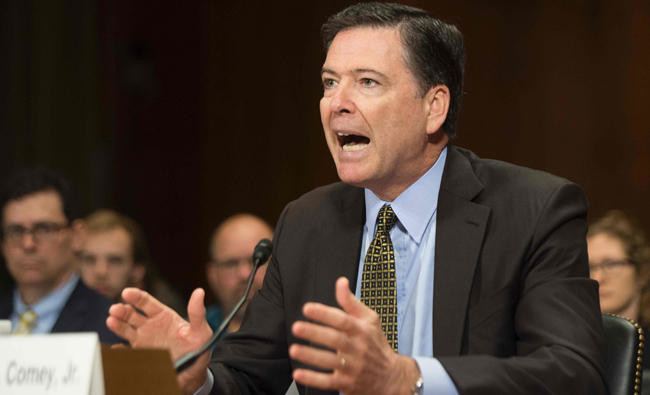
WASHINGTON: Former FBI director James Comey accused US President Donald Trump on Wednesday of asking him to drop an investigation of former national security adviser Michael Flynn as part of a probe into Russia’s alleged meddling in the 2016 presidential election.
In dramatic written testimony, Comey said Trump told him at a meeting in the White House in February, “I hope you can see your way clear to letting this go, to letting Flynn go.”
The testimony from Comey, who was fired by Trump last month, puts more pressure on the Republican whose presidency has been overshadowed by allegations that Moscow helped him win last year’s election.
Trump fired Flynn in February in a controversy over contacts between the retired general and the Russian ambassador to the United States. The FBI has been investigating Flynn as it looks into allegations of links between Russia and the Trump campaign.
Comey’s statement, posted on the Senate Intelligence Committee’s website, said Trump also called him on March 30 to say he had nothing to do with Russia and asked what “we could do to lift the cloud” of the FBI’s Russia investigation.
During that phone call, Comey said he told Trump the FBI was not investigating the president personally. “He repeatedly told me, ‘We need to get that fact out’,” Comey said.
Comey said he had told Trump on three occasions he was not being investigated, confirming an earlier account from the president.
Several congressional committees, as well as the FBI and a special counsel, are looking into reports that Russia tried to tilt the election in Trump’s favor, using means such as hacking into the e-mails of senior Democrats. Trump and the Kremlin have separately denied any collusion.
Some legal experts said that Comey’s statement could be used to show that Trump engaged in obstruction of justice.
“It shows the president was doing everything he could to shut down the Flynn investigation,” said Andrew Wright, a professor of criminal law at Savannah Law School.
’I need loyalty’
Comey said Trump told him at a one-on-one dinner on Jan. 27, a week after the president took office, that: “I need loyalty. I expect loyalty.”
Comey is to deliver his testimony in person at a much-anticipated hearing by the intelligence committee on Thursday.
During the dinner, the president asked him if he wanted to stay on as FBI director, Comey said. The former FBI head said he became concerned that Trump was trying to create “some sort of patronage relationship.”
After a Feb. 14 meeting on counter-terrorism in the Oval Office, Trump dismissed all the participants except Comey, according to the testimony.
The president then initiated a conversation about Flynn.
Comey quoted Trump as telling him: “I hope you can see your way clear to letting this go, to letting Flynn go. He is a good guy. I hope you can let this go.”
(Additional reporting by Tim Ahmann)

Ex-FBI head Comey accuses Trump of pressure on Russia probe
US NATO envoy says allies must ‘pull weight’ after Czech defense cut
PRAGUE, March 12 : The United States’ ambassador to NATO said on Thursday that all allies must “pull their weight,” after Czech lawmakers approved a 2026 budget that cuts defense outlays.
Czech Prime Minister Andrej Babis’ government, in power since December, pushed a revamped budget through the lower house on Wednesday evening which cut the defense ministry’s allocation versus a previous proposal to 154.8 billion crowns ($7.31 billion), or 1.73 percent of gross domestic product.
That is below a NATO target of 2 percent of GDP already expected before alliance members pledged last year in the Hague to raise defense spending to 3.5 percent of GDP plus 1.5 percent on other defense-relevant investments over the next decade.
The Czech Finance Ministry says total defense spending in the budget will reach 2.07 percent of GDP, but the country’s budget watchdog has warned that includes money earmarked elsewhere, like for the transport ministry for road projects, that may not be recognized by NATO.
“All Allies must pull their weight and honor The Hague Defense Commitment,” US Ambassador to NATO Matthew Whitaker said on X on Thursday with a picture of a news headline on the Czech budget approval.
“These numbers are not arbitrary. They are about meeting the moment — and the moment requires 5 percent as the standard. No excuses, no opt-outs.”
European NATO countries are under pressure to raise defense spending amid the Ukraine-Russia war and at US President Donald Trump’s urging.
Babis, whose populist ANO party won elections last year, said in February the country was “certainly not” on the path to raising core defense spending to the 3.5 percent target, saying there was a different focus, like on health care.
The budget watchdog on Thursday reiterated “strong doubts” that some spending deemed defense in this year’s budget would meet NATO’s definition.
President Petr Pavel, a former NATO official, has also said defense cuts risked a loss of trust from allies — but has signalled he would not veto the budget.
US Ambassador to Prague Nicholas Merrick said last week the Czech Republic may slip to the bottom of NATO’s defense-spending ranks.
Czech Prime Minister Andrej Babis’ government, in power since December, pushed a revamped budget through the lower house on Wednesday evening which cut the defense ministry’s allocation versus a previous proposal to 154.8 billion crowns ($7.31 billion), or 1.73 percent of gross domestic product.
That is below a NATO target of 2 percent of GDP already expected before alliance members pledged last year in the Hague to raise defense spending to 3.5 percent of GDP plus 1.5 percent on other defense-relevant investments over the next decade.
The Czech Finance Ministry says total defense spending in the budget will reach 2.07 percent of GDP, but the country’s budget watchdog has warned that includes money earmarked elsewhere, like for the transport ministry for road projects, that may not be recognized by NATO.
“All Allies must pull their weight and honor The Hague Defense Commitment,” US Ambassador to NATO Matthew Whitaker said on X on Thursday with a picture of a news headline on the Czech budget approval.
“These numbers are not arbitrary. They are about meeting the moment — and the moment requires 5 percent as the standard. No excuses, no opt-outs.”
European NATO countries are under pressure to raise defense spending amid the Ukraine-Russia war and at US President Donald Trump’s urging.
Babis, whose populist ANO party won elections last year, said in February the country was “certainly not” on the path to raising core defense spending to the 3.5 percent target, saying there was a different focus, like on health care.
The budget watchdog on Thursday reiterated “strong doubts” that some spending deemed defense in this year’s budget would meet NATO’s definition.
President Petr Pavel, a former NATO official, has also said defense cuts risked a loss of trust from allies — but has signalled he would not veto the budget.
US Ambassador to Prague Nicholas Merrick said last week the Czech Republic may slip to the bottom of NATO’s defense-spending ranks.
© 2026 SAUDI RESEARCH & PUBLISHING COMPANY, All Rights Reserved And subject to Terms of Use Agreement.