FALLUJAH, Iraq: Even as Iraqi forces in Mosul close in on the last pockets of urban territory still held by the Daesh group, residents of Fallujah in Iraq’s Sunni heartland are still struggling to rebuild nearly a year after their neighborhoods were declared liberated from the extremists.
After declaring the city liberated last June, Iraqi Prime Minister Haider Al-Abadi called the victory a major step toward unifying Iraq more than two years after nearly a third of the country fell to Daesh.
“Fallujah has returned to the nation,” he declared in a speech broadcast nationwide.
But in the months that followed, while the Iraqi government compiled databases and set up tight checkpoints on the main roads in and out of Fallujah to screen residents for suspected ties with IS, it provided little in the way of reconstruction money, local officials say.
Sheikh Talib Al-Hasnawi, the head of Fallujah’s municipal council, said international aid is what has provided electricity, repaired water pumps and built filtration systems.
“We have a real problem with Daesh sleeper cells,” he said, adding that what Fallujah needs most is a strong security force to prevent the extremists from re-establishing a foothold in the city some 65 km west of Baghdad. “Honestly the support from Baghdad has been very weak,” he added, noting that his repeated requests for more equipment and arms for the city’s local police have gone unheeded.
“So mostly we are relying on the civilians to alert us to threats,” he said. “All we can provide are the very basics.”
Dr. Mahdi Al-Alak, the Secretary-General of the Iraqi Cabinet, said the government has budgeted about $19.5 billion for stabilization-related projects in Anbar Province, where Fallujah is located.
Al-Alak said two new water plants in the Al-Baghdadi and Fallujah area have been built, with seven others “rehabilitated.” He also said some roads and bridges have been reconstructed, without elaborating.
Al-Alak acknowledged the budget does not cover health care infrastructure, for which about $39.8 million is needed to repair 22 damaged health centers in the area.
Located in the heart of the province, Fallujah has a long history of anti-government sentiment. After the US-led invasion in 2003 toppled Saddam Hussein, many of the city’s residents supported a Sunni insurgency that rose up against US forces and the Shiite-dominated government in Baghdad.
In 2014, many in Fallujah welcomed IS when the militants took over following a bloody government crackdown on thousands of protesters camped out on the city’s outskirts to challenge the increasingly sectarian rule of then-Prime Minister Nouri Al-Maliki.
After the fight to retake Fallujah from IS, the city was left a ghost town. It had been entirely emptied of its civilian population by Iraqi security forces and IS fighters had left behind hundreds of explosives rigged to kill those who tried to return.
“I had never seen anything like it and I can assure you no one else has,” said Pehr Lodhammer, a demining expert with the UN’s Mine Action Service who has worked in the field for decades. In Fallujah he said his team cleared 289 explosive remnants and 333 so-called improvised explosive devices, bombs that IS now produces on an industrial scale.
In Mosul — a city more than eight times the size of Fallujah — he said he expects neighborhoods will be littered with far more explosives.
On Fallujah’s main streets, shops and buildings are a patchwork of destruction and revival.
On a visit this week one shop owner was installing shiny new signs and tall glass storefronts on a building still stained black by smoke and punctured by artillery rounds. In nearby residential neighborhoods, families who had returned were plastering over bullet holes and repairing collapsed terraces. In the past nine months alone, more than 370,000 people have returned, but many streets remain blighted with abandoned houses, often partially destroyed or burned.
“Those houses, they have (the words) ‘Daesh house’ painted on the walls outside,” said Abdul Hassan, a blacksmith from the Al-Askari neighborhood, using the Arabic acronym for IS. He said most of the still-abandoned houses belonged to families who supported IS and fled with the fighters. “In my neighborhood we had very few Daesh families, maybe just four out of 100.”
He insisted it would be impossible for IS fighters to return because their neighbors would immediately turn them over to the police, though he acknowledged that he hasn’t brought his wife and children back yet. When asked if he was concerned about security he shrugged.
“Once there are enough schools, I’ll bring my children. Until then I’ll keep them in Baghdad,” he said.
A dozen schools have been reopened in Fallujah with help from the United Nations, along with pumping and filtration stations that now provide more than 60% of the city with running water.
“What we learned ... is you need to get people electricity and water first and fast,” said Deputy Special Representative of the United Nations Assistance Mission for Iraq Lise Grande.
“We did that in Anbar but we want to do it even more quickly,” she added, saying it was a lesson she hoped would be applied to Mosul reconstruction.
As the fight for Mosul continues — closely backed by the US-led coalition and heavily reliant on airpower to clear territory — reconstruction costs will only mount.
Rebuilding Mosul will cost between $50 billion and $100 billion, according to initial estimates from the Nineveh governor’s office and the provincial council. And as Iraq continues to battle an economic crisis exacerbated by entrenched corruption and a bloated public sector, it is unlikely the government will be in a position to provide more monetary help any time soon.
Khaldoon Ibrahim, a teacher from Fallujah’s Shurta neighborhood said he returned to the city with his family last September, the day he heard civilians were being allowed back in.
“Of course not everything is available,” he said.
“But if we waited for everything to be fixed we would never be able to come home.”


![]()
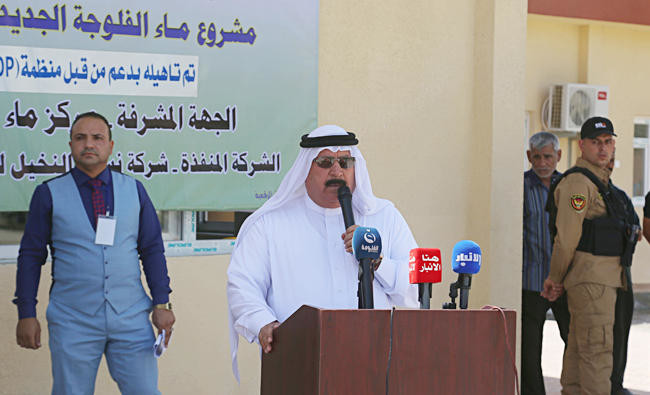
After liberation from Daesh, Fallujah struggles to rebuild
After liberation from Daesh, Fallujah struggles to rebuild


Latest updates


Recommended


© 2026 SAUDI RESEARCH & PUBLISHING COMPANY, All Rights Reserved And subject to Terms of Use Agreement.