Arab Gulf nations, Turkey condemn London attack

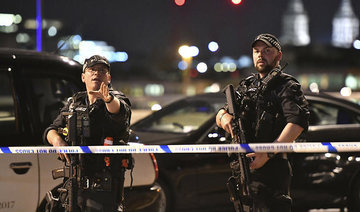
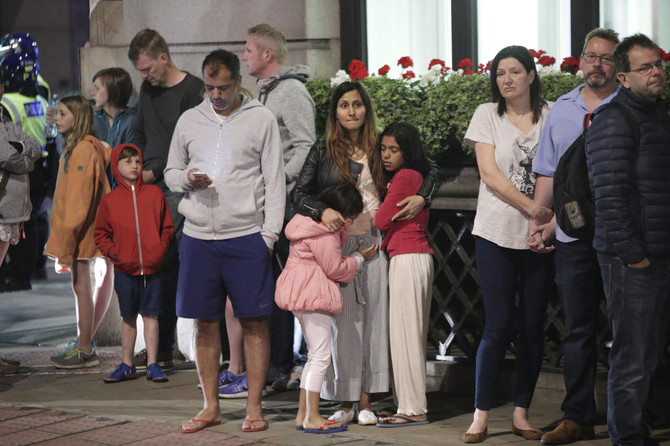
Guests from the Premier Inn Bankside Hotel are evacuated and kept in a group with police on Upper Thames Street following an incident in central London, Saturday, June 3, 2017. Terrorism struck at the heart of London, police said Sunday, after a vehicle veered off the road and mowed down pedestrians on London Bridge and gunshots rang out amid reports of knife attacks at nearby Borough Market. (AP)
Updated 04 June 2017
Follow

Arab Gulf nations, Turkey condemn London attack

LONDON: Arab Gulf countries and Turkey are condemning the attack in London that left six people dead and more than 40 others injured.
The United Arab Emirates, Qatar, Bahrain, Oman and Kuwait issued separate statements condemning such attacks and expressing their support for the British government.
The Saudi Embassy in the UK called on their citizens in London to exercise caution in crowded areas and follow police instructions.
In Turkey, the foreign ministry has expressed its “deep sadness.” The ministry says that as “Turkey and the Turkish people, who have been subjected to similar attacks many times, we understand and share the pain of the people of the United Kingdom.”
The ministry emphasized Turkey’s readiness to support the UK in its fight against extremism
The attack in London Bridge, a busy area filled with hotels and restaurants, has left many visitors and tourists stranded after police cordoned off a large area near the crime scene. Many spent the night in improvised sleeping spaces, from the floors of hotel bars or restaurants to chairs of conference rooms.
British media are reporting an armed police operation taking place in east London. Scotland Yard declined to comment about the reports of the raid, or say whether the operation was linked to Saturday’s attacks in London Bridge.
Footage from Sky News and social media show a police cordon around an apartment building in Barking, a suburb in east London.
Authorities have said officers shot dead all three attackers in Saturday night’s attack, which left seven people dead, but that the investigation is continuing.
Spain’s Foreign Ministry says that one Spaniard is among the dozens wounded in the London attack.
A ministry spokeswoman has told The Associated Press that the Spanish man has been taken to a hospital where he is being treated for wounds described as not serious. The spokeswoman spoke anonymously in line with ministry policy.
Spain’s King Felipe VI and Prime Minister Mariano Rajoy have expressed their condolences for the victims of the attacks.
The Spanish Royal Family wrote on Twitter: “The British people will overcome this barbarism and senselessness. We are united today in pain and in our tireless defense of freedom.”
Spanish Prime Minister Mariano Rajoy wrote in Spanish on his Twitter account: “I am following with great concern the attacks in London, sad news. Our solidarity and support for the British people and authorities.”
Philippine President Rodrigo Duterte has expressed his sympathies to the victims of the London attacks, even as his troops struggled to end a deadly siege of a southern city by Daesh group-aligned local militants.
Duterte’s spokesman Ernesto Abella says “acts such as these touched not only the people of London, they also touched all peace-loving people in the global community.”
Indonesia, the world’s most populous Muslim nation, also condemned the attacks and reaffirmed its support and solidarity with Britain in its efforts to combat “radicalism and terrorism.”
Indonesia too has been battling Muslim militants groups that have staged attacks across the sprawling archipelago, including in the capital Jakarta.
India’s Prime Minister Narendra Modi has condemned the attacks in London, saying they caused shock and anguish.
He says in a brief statement after returning from Europe that his thoughts are with the families of the deceased and offered prayers for the injured.
No party has yet claimed responsibility for the attack.

– With input from AP

Tug of war: how US presidents battle Congress for military powers

Updated 01 March 2026
Follow

Tug of war: how US presidents battle Congress for military powers

  • The last official declaration of war by Congress was as far back as World War II

WASHINGTON, United States: Donald Trump’s unleashing of operation “Epic Fury” against Iran has once more underscored the long and bitter struggle between US presidents and Congress over who has the power to decide on foreign military action.
In his video address announcing “major combat” with the Islamic republic, Trump didn’t once mention any authorization or consultation with the US House of Representatives or Senate.
In doing so he sidelined not only Democrats, who called for an urgent war powers vote, but also his own Republican party as he asserts his dominance over a largely cowed legislature.
A US official said Secretary of State Marco Rubio had called top congressional leaders known as the “Gang of Eight” to give them a heads up on the Iran attack — adding that one was unreachable.
Rubio also “laid out the situation” and consulted with the same leaders on Tuesday in an hour-long briefing, the US official said.
According to the US Constitution, only Congress can declare war.
But at the same time the founding document of the United States first signed in 1787 says that the president is the “commander in chief” of the military, a definition that US leaders have in recent years taken very broadly.
The last official declaration of war by Congress was as far back as World War II.
There was no such proclamation during the unpopular Vietnam War, and it was then that Congress sought to reassert its powers.
In 1973 it adopted the War Powers Resolution, passed over Richard Nixon’s veto, to become the only lasting limit on unilateral presidential military action abroad.
The act allows the president to carry out a limited military intervention to respond to an urgent situation created by an attack against the United States.
In his video address on Saturday, Trump evoked an “imminent” threat to justify strikes against Iran.

- Sixty days -

Yet under this law, the president must still inform Congress within 48 hours.
It also says that if the president deploys US troops for a military action for more than 60 days, the head of state must then obtain the authorization of Congress for continued action.
That falls short of an official declaration of war.
The US Congress notably authorized the use of force in such a way after the September 11, 2011 attacks on the United States by Al-Qaeda. Presidents have used it over the past two decades for not only the 2001 invasion of Afghanistan but a series of operations in several countries linked to the “War on Terror.”
Trump is far from the first US president to launch military operations without going through Congress.
Democrat Bill Clinton launched US air strikes against Kosovo in 1999 as part of a NATO campaign, despite the lack of a green light from skeptical lawmakers.
Barack Obama did the same for airstrikes in Libya in 2011.
Trump followed their example in his first term in 2018 when he launched airstrikes in Syria along with Britain and France.
But since his return to power the 79-year-old has sought to push presidential power to its limits, and that includes in the military sphere.
Trump has ordered strikes on alleged drug trafficking boats in Latin America without consulting Congress, and in June 2025 struck Iran’s nuclear facilities.
Perhaps the most controversial act was when he ordered the capture of Venezuelan president Nicolas Maduro in a lightning military raid on January 3.
Republicans however managed to knock down moves by Democrats for a rare war powers resolution that would have curbed his authority over Venezuela operations.
Trump has meanwhile sought to extend his powers over the home front. Democrats have slammed the Republican for deploying the National Guard in several US cities in what he calls a crackdown on crime and immigration.