Taliban will gain from ensuing chaos in Afghanistan, expert tells Arab News

1 / 3
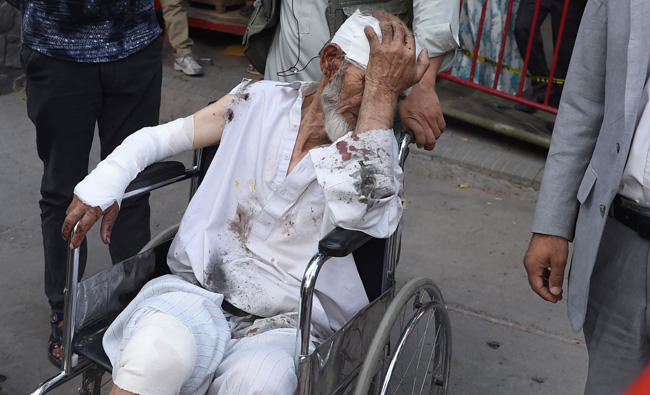
A wounded Afghan man sits on a wheelchair after receiving treatment at an Italian aid organization hospital in Kabul on Saturday following a series of explosions that targeted a funeral of a politician's son, who was killed during an anti-government protest a day earlier. (AFP / WAKIL KOHSAR)
2 / 3
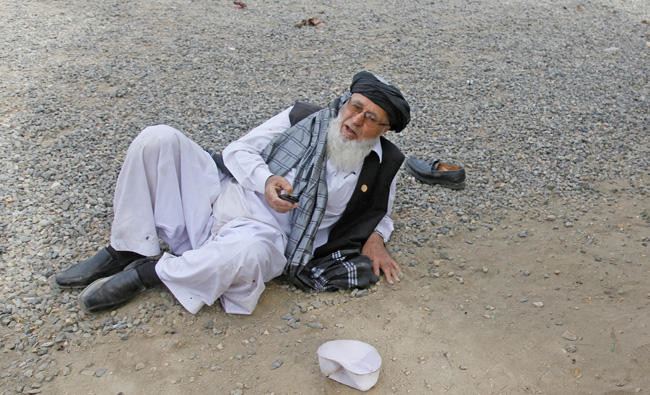
An injured Afghan man lies on the ground after a suicide attack blast in Kabul on Saturday. (REUTERS)
3 / 3
Pakistani civil society activists hold placards against the recent attacks in the Afghan capital Kabul during a protest in Peshawar on Saturday. (AFP / ABDUL MAJEED)
Updated 04 June 2017
Follow

Taliban will gain from ensuing chaos in Afghanistan, expert tells Arab News

JEDDAH/KABUL: Explosions ripped through the funeral of an Afghan anti-government protester in Kabul on Saturday, killing at least seven people and wounding dozens in fresh carnage that saw tensions rise in a city already on edge.
The latest killings, which could provoke a new cycle of bloodshed, bring the number of people killed this week to 101, with hundreds injured in one of the worst bouts of violence in the Afghan capital for years.
Witnesses reported three back-to-back blasts during the burial of Salim Ezadyar, who was among four people killed on Friday when a protest over spiraling insecurity in Kabul degenerated into street clashes with police.
The hilly, windswept cemetery was littered with human remains, with one witness telling AFP that “people were blown to pieces” due to the impact of the blasts.
“So far seven dead bodies and 119 wounded people have been brought to Kabul hospitals,” Waheed Majroh, a spokesman for the Health Ministry, told AFP.
The funeral of Ezadyar, the son of an influential Afghan senator, was attended by senior government figures including Chief Executive Abdullah Abdullah and Foreign Minister Salahuddin Rabbani, but they escaped unharmed.
No group has so far claimed the attack, with the Taliban — the biggest insurgent group in Afghanistan — denying any involvement.
The fresh killings are likely to further polarize a city that has been on edge since a truck bombing on Wednesday in Kabul’s diplomatic quarter killed 90 people and wounded hundreds, in the deadliest attack on the Afghan capital since 2001.
President Ashraf Ghani made a televised appeal for national unity after the funeral bombings. “The country is under attack,” he said. “We must stay strong and united.”
Baker Atyani, a veteran journalist who has covered militant groups for two decades, blamed the chaos on the power struggles within the Afghan government and the ineffective role of the international coalition led by the US.
“The Haqqani network has said it was not behind the attack; Daesh, which goes by the name the Islamic State in Khorasan Province (ISKP), did not claim responsibility for this attack; and we have heard the denial from Taliban — all this is strange,” said Atyani.
There is chaos in Afghanistan because “of there being a state with two heads — President Ashraf Ghani and Chief Executive Abdullah Abdullah,” he added.
Ghani is a Pashtun while Abdullah is of mixed Pashtun-Tajik heritage but is often seen as having supported the latter group more strongly. Atyani said the rivalry between the two ethnic groups is very well known.
He added that there has been uncertainty and a deep struggle for power in Afghanistan ever since Abdullah refused to accept the results of the last presidential elections. “It was the former US Secretary of State John Kerry who came up with this weird equation through which he created a slot for a chief executive when there was no such provision in the Afghan constitution,” said Atyani.
“If you look at the larger picture in Afghanistan, this is the failure of all those foreign countries who came into Afghanistan under the US leadership. They could not deliver what they promised to the Afghan people. The international coalition has, in the last 13 years, spent over $1 trillion and yet they failed to bring peace and development to the war-ravaged country,” said Atyani.
“Today, a mere 10 percent of the Afghans have access to electricity,” he added.
The government has blamed the Taliban-allied Haqqani network for the attack.
Atyani said he did not believe in the allegations leveled against Pakistan by the Afghan government. “There is no love lost between the NDS (National Directorate of Security of Afghanistan) and the ISI (Inter-Services Intelligence of Pakistan). As an observer, I do not think someone should take the NDS allegations leveled against Pakistan seriously."
According to Atyani, the chaos in Kabul would directly benefit the Taliban. “In any case the writ of the Afghan government does not run large in many districts and towns. In some, there are shadow governments led by the Taliban and in some others there is Daesh which has added to the confusion. There has been no method in Daesh’s madness. All their attacks have been directed against the civilians.”


Trump says Iran ‘want to negotiate’ after reports of hundreds killed in protests

Updated 4 sec ago
Follow

Trump says Iran ‘want to negotiate’ after reports of hundreds killed in protests

  • US President Donald Trump said Sunday that Iran’s leadership had called him seeking “to negotiate” after he repeatedly threatened to intervene militarily if Tehran killed protesters
WASHINGTON: US President Donald Trump said Sunday that Iran’s leadership had called him seeking “to negotiate” after he repeatedly threatened to intervene militarily if Tehran killed protesters.
For two weeks, Iran has been rocked by a protest movement that has swelled in spite of a crackdown rights groups warn has become a “massacre.”
Initially sparked by anger over the rising cost of living, the demonstrations have evolved into a serious challenge of the theocratic system in place since the 1979 revolution.
Information has continued to trickle out of Iran despite a days-long Internet shutdown, with videos filtering out of capital Tehran and other cities over the past three nights showing large demonstrations.
As reports emerge of a growing protest death toll, and images show bodies piled outside a morgue, Trump said Tehran indicated its willingness to talk.
“The leaders of Iran called” yesterday, Trump told reporters aboard Air Force One, adding that “a meeting is being set up... They want to negotiate.”
He added, however, that “we may have to act before a meeting.”
The US-based Center for Human Rights in Iran (CHRI) said it had received “eyewitness accounts and credible reports indicating that hundreds of protesters have been killed across Iran during the current Internet shutdown.”
“A massacre is unfolding,” it said.
The Norway-based NGO Iran Human Rights (IHR) said it confirmed the killing of at least 192 protesters but that the actual toll could be much higher.
“Unverified reports indicate that at least several hundreds, and according to some sources, more than 2,000 people may have been killed,” said IHR.
More than 2,600 protesters have been arrested, IHR estimates.
A video circulating on Sunday showed dozens of bodies accumulating outside a morgue south of Tehran.
The footage, geolocated by AFP to Kahrizak, showed bodies wrapped in black bags, with what appeared to be grieving relatives searching for loved ones.
- Near paralysis -
In Tehran, an AFP journalist described a city in a state of near paralysis.
The price of meat has nearly doubled since the start of the protests, and many shops are closed. Those that do open must close at around 4:00 or 5:00 pm, when security forces deploy en masse.
There were fewer videos showing protests on social media Sunday, but it was not clear to what extent that was due to the Internet shutdown.
One widely shared video showed protesters again gathering in the Pounak district of Tehran shouting slogans in favor of the ousted monarchy.
The protests have become one of the biggest challenges to the rule of supreme leader Ayatollah Ali Khamenei, 86, coming in the wake of Israel’s 12-day war against the Islamic republic in June, which was backed by the United States.
State TV has aired images of burning buildings, including a mosque, as well as funeral processions for security personnel.
But after three days of mass actions, state outlets were at pains to present a picture of calm returning, broadcasting images of smooth-flowing traffic on Sunday. Tehran Governor Mohammad-Sadegh Motamedian insisted in televised comments that “the number of protests is decreasing.”
The Iranian government on Sunday declared three days of national mourning for “martyrs” including members of the security forces killed.
President Masoud Pezeshkian also urged Iranians to join a “national resistance march” Monday to denounce the violence.
In response to Trump’s repeated threats to intervene, Iran’s parliament speaker Mohammad Bagher Ghalibaf said Iran would hit back, calling US military and shipping “legitimate targets” in comments broadcast by state TV.
- ‘Stand with the people’ -
Reza Pahlavi, the US-based son of Iran’s ousted shah, who has emerged as an anti-government figurehead, said he was prepared to return to the country and lead a democratic transition.
“I’m already planning on that,” he told Fox News on Sunday.
He later urged Iran’s security forces and government workers to join the demonstrators.
“Employees of state institutions, as well as members of the armed and security forces, have a choice: stand with the people and become allies of the nation, or choose complicity with the murderers of the people,” he said in a social media post.
He also urged protesters to replace the flags outside of Iranian embassies.
“The time has come for them to be adorned with Iran’s national flag,” he said.
The ceremonial, pre-revolution flag has become an emblem of the global rallies that have mushroomed in support of Iran’s demonstrators.
In London, protesters managed over the weekend to swap out the Iranian embassy flag, hoisting in its place the tri-colored banner used under the last shah.