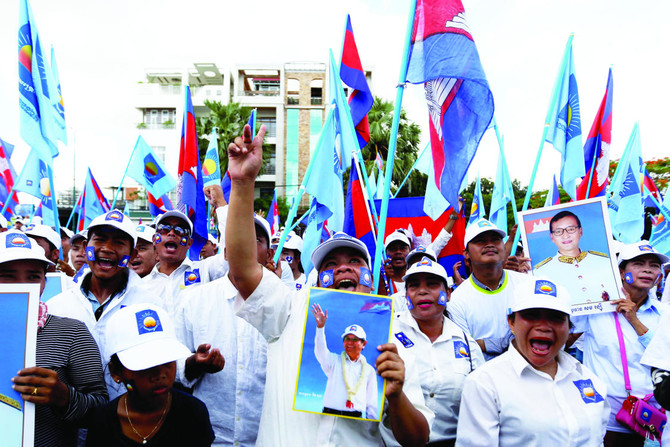
PHNOM PENH: Cambodia’s longtime ruler warned opposition parties on Friday not to challenge the result of Sunday’s local elections or they could be dissolved.
Prime Minister Hun Sen made a rare appearance on the last day of rallies before the vote to drum up support for his ruling Cambodian People’s Party.
He has repeatedly warned of civil war if his party loses. It has been accused of using violence or the threat of violence against opponents, but in recent years has stalked its foes mostly in courts.
The polls could have a major impact on Cambodia’s political landscape ahead of 2018 national elections.
Hun Sen’s iron grip on power was shaken four years ago when the opposition Cambodia National Rescue Party won 55 of the 123 national assembly seats in the last general election.
The opposition claimed it had actually won but was cheated out of its victory and says it is confident it will sweep Sunday’s polls for seats in 1,646 communes — or clusters of villages — throughout the country.
The prime minister, appearing at a rally apparently for the first time in around 20 years, appealed to all political parties to accept the outcome rather than make accusations of irregularities, saying courts can dissolve any party if it challenges the result of the vote.
This week, Amnesty International accused Cambodia’s government of using its grip on the judiciary system to intimidate political activists.
It said in a report that since the 2013 general election, Hun Sen’s government has used the courts as a tool to imprison at least 27 prominent opposition officials, human rights defenders and land activists.
Riding at the head of a motorcade procession of tens of thousands of his supporters, Hun Sen waved to crowds and addressed them through loudspeakers as the convoy made rounds in Phnom Penh.
Several hours later, opposition leader Kem Sokha addressed tens of thousands of supporters in the streets of Phnom Pehn, promising to reduce corruption and the use of illegal drugs in the country if his Cambodia National Rescue Party wins.
Hun Sen and some of his top ministers have frequently used strong rhetoric leading up to the vote, warning of dire consequences should the opposition win, in what has been seen as an attempt to intimidate voters into supporting him.
Also early this month, the State Department said the US was urging Cambodia’s government to “guarantee a political space free from threats or intimidation” and respect freedom of expression for all its citizens.
In the last communal elections in 2012, Hun Sen’s party received 60 percent of the vote compared to the Cambodia National Rescue Party’s 30.6 percent.
The ruling party could also take some credit for bringing modest economic growth and stability in a country devastated by the communist Khmer Rouge’s regime in the 1970s. Hun Sen left the movement that was responsible for the deaths of some 1.7 million people from starvation, disease and executions before it was toppled in 1979.

Cambodia’s PM warns opposition not to challenge vote
EU leaders to reassess US ties despite Trump U-turn on Greenland
- Diplomats stressed that, although Thursday’s emergency EU talks in Brussels would now lose some of their urgency, the longer-term issue of how to handle the relationship with the US remained
BRUSSELS: EU leaders will rethink their ties with the US at an emergency summit on Thursday after Donald Trump’s threat of tariffs and even military action to acquire Greenland badly shook confidence in the transatlantic relationship, diplomats said.
Trump abruptly stepped back on Wednesday from his threat of tariffs on eight European nations, ruled out using force to take Greenland, a semi-autonomous territory of NATO ally Denmark, and suggested a deal was in sight to end the dispute.
German Chancellor Friedrich Merz, welcoming Trump’s U-turn on Greenland, urged Europeans not to be too quick to write off the transatlantic partnership.
But EU governments remain wary of another change of mind by a mercurial president who is increasingly seen as a bully that Europe will have to stand up to, and they are focused on coming up with a longer-term plan on how to deal with the United States under this administration and possibly its successors too.
“Trump crossed the Rubicon. He might do it again. There is no going back to what it was. And leaders will discuss it,” one EU diplomat said, adding that the bloc needed to move away from its heavy reliance on the US in many areas.
“We need to try to keep him (Trump) close while working on becoming more independent from the US It is a process, probably a long one,” the diplomat said.
EU RELIANCE ON US
After decades of relying on the United States for defense within the NATO alliance, the EU lacks the needed intelligence, transport, missile defense and production capabilities to defend itself against a possible Russian attack. This gives the US substantial leverage.
The US is also Europe’s biggest trading partner, making the EU vulnerable to Trump’s policies of imposing tariffs to reduce Washington’s trade deficit in goods, and, as in the case of Greenland, to achieve other goals.
“We need to discuss where the red lines are, how we deal with this bully across the Atlantic, where our strengths are,” a second EU diplomat said.
“Trump says no tariffs today, but does that mean also no tariffs tomorrow, or will he again quickly change his mind? We need to discuss what to do then,” the second diplomat said.
The EU had been considering a package of retaliatory tariffs on 93 billion euros ($108.74 billion) on US imports or anti-coercive measures if Trump had gone ahead with his own tariffs, while knowing such a step would harm Europe’s economy as well as the United States.
WHAT’S THE GREENLAND DEAL?
Several diplomats noted there were still few details of the new plan for Greenland, agreed between Trump and NATO Secretary General Mark Rutte late on Wednesday on the sidelines of the World Economic Forum in Davos, Switzerland.
“Nothing much changed. We still need to see details of the Greenland deal. We are a bit fed up with all the bullying. And we need to act on a few things: more resiliency, unity, get our things together on internal market, competitiveness. And no more accepting tariff bullying,” a third diplomat said.
Rutte told Reuters in an interview in Davos on Thursday that under the framework deal he reached with Trump the Western allies would have to step up their presence in the Arctic.
He also said talks would continue between Denmark, Greenland and the US on specific issues.
Diplomats stressed that, although Thursday’s emergency EU talks in Brussels would now lose some of their urgency, the longer-term issue of how to handle the relationship with the US remained.
“The approach of a united front in solidarity with Denmark and Greenland while focusing on de-escalation and finding an off-ramp has worked,” a fourth EU diplomat said.
“At the same time it would be good to reflect on the state of the relationship and how we want to shape this going forward, given the experiences of the past week (and year),” he said.