South Sudan: 15 children die in botched vaccine campaign

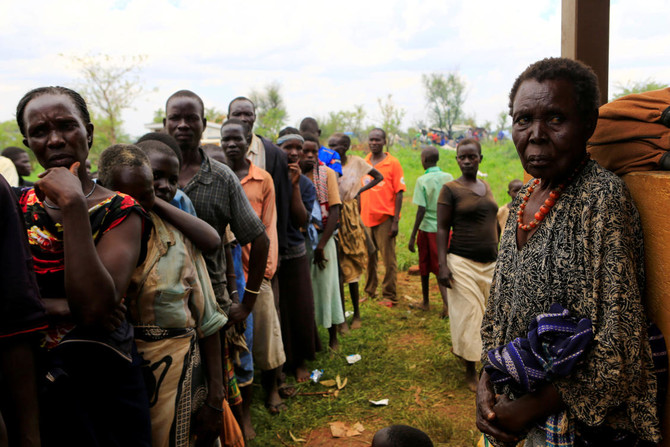
South Sudanese families displaced by fighting queue for vaccination in Lamwo after fleeing fighting in Pajok town across the border in northern Uganda. (REUTERS)
Updated 02 June 2017
Follow

South Sudan: 15 children die in botched vaccine campaign

NAIROBI: Fifteen young children have died in a botched measles vaccination campaign that saw people as young as 12 years old administering the vaccines, South Sudan’s government announced Friday.
The health ministry blamed the deaths on human error. One syringe was used for all the children, and the vaccine was not stored properly.
Measles is yet another challenge facing the desperately poor country that already has been devastated by more than three years of civil war and a recently declared famine, as well as a cholera outbreak.
The government said all of the children who died were under the age of 5. It is setting up a commission to determine who is responsible and whether victims’ families will be compensated.
The measles vaccination campaign is targeting more than 2 million children across the country. About 300 children were targeted in the area where the children’s deaths occurred.
The children died in the town of Kapoeta in early May, and other children have become gravely ill after vaccination campaign.
Abdulmumini Usman, the South Sudan country director for the World Health Organization, told The Associated Press earlier this week that even after the organization became aware of the deaths, the measles campaign continued across the country except in Kapoeta.
“This campaign is lifesaving,” Usman said.
WHO provides some training to South Sudan’s health officials and the UN children’s agency provides the vaccines to the government. It was not immediately clear whether any UN officials were present at the time of the botched vaccinations.
Dr. Samson Baba, an immunization official in the ministry of health, refused to comment on the deaths earlier this week, instead demanding the source of the information.
South Sudan’s government on Friday said vaccinations are not being denied to any part of the country, including those held by opposition forces.
The civil war has killed tens of thousands and sent more than 1.8 million people fleeing the country, creating the world’s fastest-growing refugee crisis.
In 2016, South Sudan had at least 2,294 measles cases and 28 people died, according to UN data.


Hegseth says US ‘can’t stop everything’ that Iran fires even as he asserts air dominance

Updated 11 sec ago
Follow

Hegseth says US ‘can’t stop everything’ that Iran fires even as he asserts air dominance

WASHINGTON (AP): Defense Secretary Pete Hegseth acknowledged Wednesday that some Iranian air attacks may still hit their targets even as he asserted that US military superiority is quickly giving it control of the Islamic Republic’s airspace.
The US has spared “no expense or capability” to enhance air defense systems to protect American forces and allies in the Middle East, Hegseth told reporters at the Pentagon days after the US and Israel attacked Iran in a war that has widened throughout the region.
“This does not mean we can stop everything, but we ensured that the maximum possible defense and maximum possible force protection was set up before we went on offense,” he said.
The acknowledgement that additional drone or missile strikes in the region could cause damage and harm to troops comes as President Donald Trump and top defense leaders have warned that additional American casualties were expected in a conflict that could last months.
US service members “remain in harm’s way, and we must be clear-eyed that the risk is still high,” Gen. Dan Caine, chairman of the Joint Chiefs of Staff, said at the same press conference.
Six soldiers were killed when an Iranian drone strike hit an operations center Sunday in the heart of a civilian port in Kuwait, miles away from the main Army base. The husband of one of the slain soldiers, who was part of a supply and logistics unit based in Iowa, says the center was a shipping container-style building and had no defenses.
Hegseth also signaled a possible longer time frame for the conflict than has previously been floated by the Trump administration, saying it could last eight weeks but that the US has the munitions and the equipment to beat Iran in a war of attrition. He declined to set a specific time range, saying the specific duration of the war would depend on how it unfolds.
“You can say four weeks, but it could be six, it could be eight, it could be three,” he said. “Ultimately, we set the pace and the tempo. The enemy is off balance, and we’re going to keep them off balance.”
More forces continue to arrive in the region, including jet fighters and bombers, Hegseth said, and the US “will take all the time we need to make sure that we succeed.”
Tehran has vowed to completely destroy the Middle East’s military and economic infrastructure — signaling the war was nowhere near over and could expand further.
President Donald Trump said this week the campaign are likely to last four to five weeks but that he was prepared “to go far longer than that.”