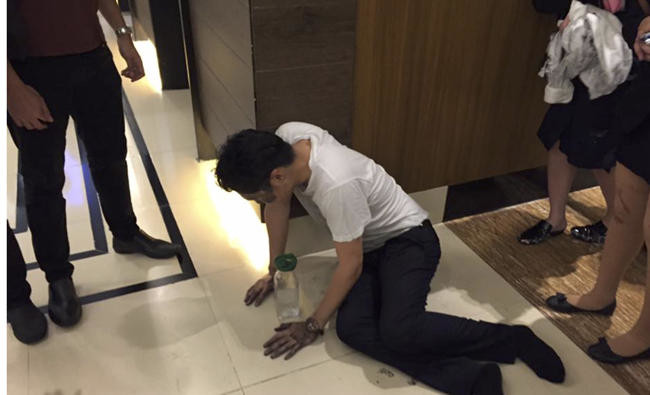
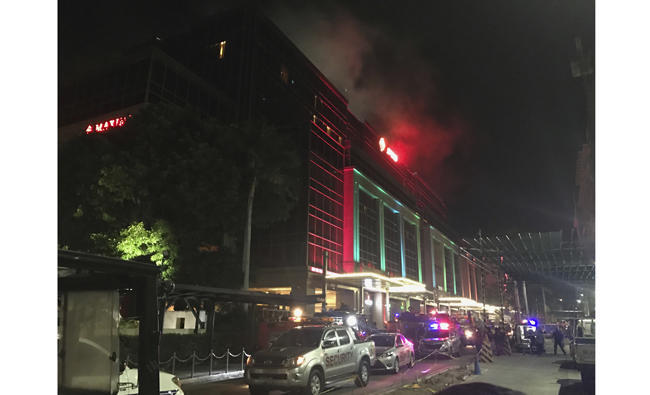
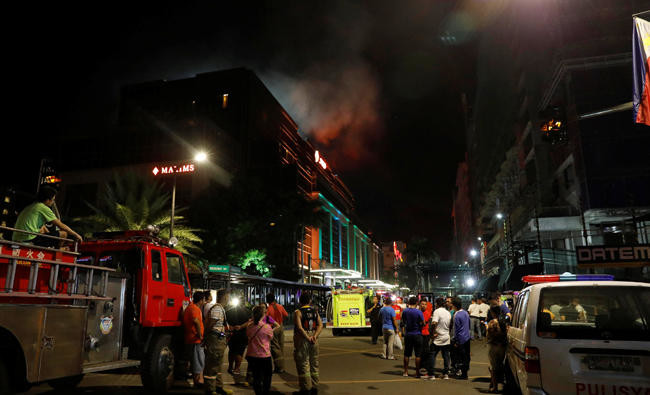
MANILA, Philippines: Gunshots and explosions erupted after midnight in a hotel and casino complex near Manila’s airport, sending hundreds fleeing into darkened streets early Friday in what police said was an attack by a lone gunman with no apparent links to terrorism.
A Filipino operative for the Daesh group, in a quick communique, immediately took responsibility for the attack. But police cast doubt on any such links and suggested robbery as a possible motive.
It was not immediately clear if anyone was killed in the attack or even if it had concluded.
Shots and loud bangs rang out shortly after midnight (1600 GMT) in the buildings close to Terminal Three of Ninoy Aquino International Airport and an air force base, prompting fears that a militant attack was under way.
Medical officials said at least 25 people were hurt, some seriously, as they rushed to escape.
The violence unfolded as Muslim militants aligned with the Daesh group fended off government forces for a 10th day in the southern city of Marawi. That unrest had sparked fears that the militants might attack elsewhere to divert the focus of thousands of troops trying to quell the siege.
But Director General Ronald Dela Rosa, national police chief in the Philippines, said there was no concrete evidence that the attack was terrorism. He said one gunman was behind the attack and was still at large more than two hours after it began.
“Don’t panic, this is not a cause for alarm. We cannot attribute this to terrorism,” he said.
“We are looking into a robbery angle because he did not hurt any people and went straight to the casino chips storage room. He parked at the second floor and barged into the casino, shooting large TV screens and poured gasoline on a table setting it on fire.”
Police were in the complex searching for the gunman, whom dela Rosa described as “foreign-looking, a Caucasian, about six feet tall.” The suspect may have escaped because smoke had obscured footage for CCTV cameras, he added.
It was not clear how the gunman smuggled enough gasoline into the crowded casino to cause explosions and what prompted Dela Rosa to rule out terrorism so quickly.
About 90 minutes after the attack began, Resorts World Manila said in its Facebook account that it was “currently on lockdown following reports of gunfire from unidentified men,” adding, “the company is working closely with the Philippine National Police to ensure that all guests and employees are safe.”
“We ask for your prayers during these difficult times,” the company said.
Philippine police cordoned off the area near the Ninoy Aquino International Airport.
“I heard many, many gunshots,” Julio Silva, a casino player who managed to dash out of the mall complex amid the gunfire, told DZMM radio network.
Silva said he saw a SWAT member who was shouting: “I was hit, I was hit.”
A DZMM radio reporter on the scene said she saw two ambulances ferrying two people away, one with a bandage on the leg and another in wheelchair.
As news of the attack spread, US President Donald Trump offered the thoughts and prayers of the American people to the Philippines.
“It is really very sad as to what’s going on throughout the world with terror,” he said from the White House Rose Garden. Trump said he was “closely monitoring the situation” and would continue to provide updates.
The SITE Intelligence Group, a US terrorism monitor, said an Islamic State-linked Filipino operative who provides daily updates on the ongoing clashes in Marawi claimed “lone wolf soldiers” of the Daesh group were responsible for the attack.
An English message by the operative was distributed across several pro-IS Telegram chat groups, SITE said. According to SITE, he wrote: “The lone wolf soldiers of Khilafah attack the heart of Kufar the city of Manila in Resort World.”
President Rodrigo Duterte sent soldiers to the southern Philippines to end the siege by about 500 militants. Officials say 120 militants and at least 25 soldiers, five policemen and two dozen civilians have been killed in the fighting since early last week.
Duterte declared martial law in the Mindanao region, the southern third of the Philippines, to crush the insurrection and poured in troops backed by airstrikes, artillery fire and armored vehicles.
The unrest has boosted fears that the Daesh group’s violent ideology is gaining a foothold in the country’s restive southern islands, where Muslim separatist rebellions have raged for nearly half a century.
___
Associated Press journalists Joeal Calupitan and Alberto Marquez in Manila contributed to this report.

Terror doubted in Manila casino attack, robbery angle eyed
Trump takes unconventional approach to communicating to the public about war in Iran
- The communications strategy opened Trump to criticism that he hadn’t done enough to explain the rationale and objectives of the war
Typical of an unconventional presidency, the Trump administration waited more than 48 hours to make any live, public communication to the American people about why it had decided to go to war with Iran.
President Donald Trump discussed why he launched the attack prior to a White House ceremony honoring military heroes on Monday but took no questions from reporters. Earlier in the day, Defense Secretary Pete Hegseth and Joint Chiefs of Staff Chairman Dan Caine briefed journalists at the Pentagon.
The two days previous, Trump delivered two pretaped statements that were released on Truth Social, the social media site owned by the president’s media company, and granted telephone interviews to more than a dozen journalists — several of which produced fragmented responses that, to some, clouded as much as they cleared up.
The communications strategy opened Trump to criticism that he hadn’t done enough to explain the rationale and objectives of the war, even as the American military suffered its first casualties. By contrast, Israeli Prime Minister Benjamin Netanyahu, who has teamed with the US against Iran, delivered two statements the day the war began and addressed reporters Monday at the site of a missile attack that killed nine people. The Israeli military has held multiple press briefings each day.
“The American people need a commander in chief, and he has been absent in that role,” Rahm Emanuel, White House chief of staff under President Barack Obama, said on CNN Monday. Emanuel, a Democrat, is contemplating a run for the presidency in 2028.
An unconventional strategy leads to criticism
Peter Baker, chief White House correspondent for The New York Times, wrote on social media that “after Trump launched a new war on Iran, he did not rush back to the White House to make an Oval Office address to rally the nation as other presidents have done. He stayed at Mar-a-Lago to attend a glitzy political fundraiser.”
That post provoked a response from Steven Cheung, White House communications director. “Imagine being a reporter so consumed with Trump Derangement Syndrome that he wants President Trump to mimic the failed policies of the past. The truth is that President Trump spent the majority of his time monitoring the situation in a secure facility, in constant contact with world leaders, and made multiple addresses to the nation that garnered hundreds of millions of views. He also took dozens of calls with reporters.”
The calls included one with Baker’s colleague at The Times, Zolan Kanno-Youngs. Trump’s mobile phone number is known to many of the reporters who cover him, and the president often takes their calls for on-the-spot interviews. Besides The Times, he spoke in the aftermath of the attack to journalists for ABC, CBS, NBC, CNN, CNBC, Fox News Channel, The Atlantic, The Washington Post, Axios, Politico and an Israeli television station.
Most of the calls were brief and marginally illuminating; Politico’s Dasha Burns said Trump answered but said he was too busy to talk. The public couldn’t hear what Trump said in the interviews and was dependent upon what the journalists chose to report on the conversations.
“I spoke to President Trump today and he told me that the operation in Iran is going to go very fast,” Libby Alon, a reporter for Channel 14 News in Israel, wrote about her interview on X. “It’s doing very well, and (will) make the people of Israel very happy, and the people of the world very happy.”
The Times reported that in its six-minute chat, Trump “offered several seemingly contradictory visions of how power might be transferred to a new government — or even whether the existing Iranian power structure would run that government or be overthrown.”
In one of his two conversations with Trump, ABC News’ Jonathan Karl said when he asked about the death of Iranian Ayatollah Ali Khamenei, the president said: “I got him before he got me. They tried twice. Well I got him first.” CNN’s Jake Tapper went on the air minutes after his conversation Monday, saying Trump told him “the big one is coming soon,” an apparent reference to a future attack.
Asked for comment, White House spokeswoman Anna Kelly said: “President Trump is the most transparent and accessible president in American history. The American people have never had a more direct and authentic relationship with a president of the United States than they have with President Trump.”
Hegseth briefing concentrates on friendly reporters
Pentagon reporters learned late Sunday about Hegseth’s briefing. Reporters from The Associated Press, Reuters, ABC, CBS, NBC, CNN, Fox News Channel and Stars & Stripes were permitted into the briefing room, but Hegseth did not call on them. Instead, he took questions from NewsNation and Trump-friendly outlets like the Daily Caller, Daily Wire, One America News and the Christian Broadcasting Network. Most mainstream news outlets left their regular stations at the Pentagon last fall rather than agree to Hegseth’s rules restricting their work.
Hegseth denounced the “foolishness” of people wanting to know details of the operation in advance, such as whether Americans would commit to more than air power, and said the operation would continue as long as it took to achieve objections. He initially ignored NBC News’ Courtney Kube when she called out a question: “President Trump put a four-week time limit on it. Are you saying he’s wrong?”
Later, Hegseth denounced Kube for asking “the typical NBC sort of gotcha-type question. President Trump has all the latitude in the world to talk about how long it might take — four weeks, two weeks, six weeks, it could move up, it could move back. We’re going to execute at his command the objectives he set out to achieve.”
Unlike Pentagon briefings in past administrations, reporters were given assigned seats, with the Trump-friendly outlets seated in front. Jennifer Griffin, Hegseth’s former colleague at Fox News Channel who left the Pentagon with other reporters after not accepting his new rules, was seated in the last row.