BJP leaders charged over 1992 mosque demolition

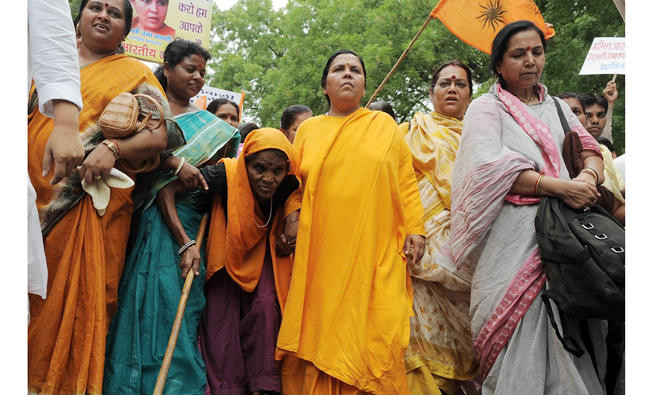
In this photograph taken on July 2, 2009, Indian BJP leader Uma Bharti (C) takes part in a rally in New Delhi. A special court on Tuesday charged three senior leaders of India's ruling right-wing party with conspiracy over the demolition of a mosque in 1992, which unleashed one of the deadliest riots across the country. (AFP / MANAN VATSYAYANA)
Updated 30 May 2017
Follow

BJP leaders charged over 1992 mosque demolition

NEW DELHI: An Indian judge charged a minister in Prime Minister Narendra Modi’s government and senior leaders from his ruling party with criminal conspiracy on Tuesday in connection with the 1992 destruction of a mosque by a Hindu mob.
The demolition of the mosque in northern Uttar Pradesh state unleashed some of the deadliest religious riots across the country since independence in 1947, killing about 2,000 people.
Water Resources Minister Uma Bharti and stalwarts of the ruling Bharatiya Janata Party led by L. K. Advani and M. M. Joshi appeared in court in the city of Lucknow to hear the charges.
All three deny any role in the razing of the mosque.
The trial of senior BJP leaders will raise fresh questions about Hindu nationalism within Modi’s party at a time when critics accuse his supporters of trying to marginalize minority groups and redefine India as a Hindu nation.
“The judge accepted our plea to charge the leaders with criminal conspiracy and the accused are already facing trial for making provocative speeches that incited Hindus to pull down the Babri mosque,” said M. R. Shamshad, a lawyer representing Muslim leaders and victims of the violence.
Bharti, entering the courtroom on Tuesday amid a crowd of reporters, rejected the charges.
“I don’t consider myself a criminal,” she said.
Lawyers representing Joshi and Advani did not respond to requests for comment.
Many Hindus believe that the mosque in the town of Ayodhya was built on top of the birthplace of their god-king Rama and the BJP is committed to the construction of a temple there.
The dispute is still at the core of tensions between Hindus and India’s Muslim minority. BJP party leaders have faced prosecution for their alleged involvement in the mosque’s destruction for more than a decade, but last month the Supreme Court ruled the party leaders must be tried and the case wrapped up within two years.
Advani, a former home minister and chief of the BJP, led Hindus on the pilgrimage that ended with the razing of the mosque. He says he tried to stop the clashes.
On Tuesday, the chief minister of Uttar Pradesh, Yogi Adityanath, a firebrand Hindu priest, met the three accused outside the court in a sign of support.


China’s top diplomat to visit Somalia on Africa tour

Updated 6 sec ago
Follow

China’s top diplomat to visit Somalia on Africa tour

  • Stop in Mogadishu provides diplomatic boost after Israel became the first country to formally recognize breakaway Somaliland
  • Tour focusses on Beijing's strategic trade ​access across eastern and southern Africa
BEIJING: China’s top diplomat began his annual New Year tour of Africa on Wednesday, focusing on strategic trade ​access across eastern and southern Africa as Beijing seeks to secure key shipping routes and resource supply lines.
Foreign Minister Wang Yi will travel to Ethiopia, Africa’s fastest-growing large economy; Somalia, a Horn of Africa state offering access to key global shipping lanes; Tanzania, a logistics hub linking minerals-rich central Africa to the Indian Ocean; and Lesotho, a small southern African economy squeezed by US trade measures. His trip this year runs until January 12.
Beijing aims to highlight countries it views as model partners of President Xi Jinping’s flagship “Belt and Road” infrastructure program and to expand export markets, particularly in young, increasingly ‌affluent economies such ‌as Ethiopia, where the IMF forecasts growth of 7.2 percent this year.
China, ‌the ⁠world’s ​largest bilateral ‌lender, faces growing competition from the European Union to finance African infrastructure, as countries hit by pandemic-era debt strains now seek investment over loans.
“The real litmus test for 2026 isn’t just the arrival of Chinese investment, but the ‘Africanization’ of that investment. As Wang Yi visits hubs like Ethiopia and Tanzania, the conversation must move beyond just building roads to building factories,” said Judith Mwai, policy analyst at Development Reimagined, an Africa-focussed consultancy.
“For African leaders, this tour is an opportunity to demand that China’s ‘small yet beautiful’ projects specifically target our industrial gaps, ⁠turning African raw materials into finished products on African soil, rather than just facilitating their exit,” she added.
On his start-of-year trip in 2025, ‌Wang visited Namibia, the Republic of Congo, Chad and Nigeria.
His visit ‍to Somalia will be the first by a Chinese foreign minister since the 1980s and is ‍expected to provide Mogadishu with a diplomatic boost after Israel became the first country to formally recognize the breakaway Republic of Somaliland, a northern region that declared itself independent in 1991.
Beijing, which reiterated its support for Somalia after the Israeli announcement in December, is keen to reinforce its influence around the Gulf of Aden, the entrance ​to the Red Sea and a vital corridor for Chinese trade transiting the Suez Canal to Europe.
Further south, Tanzania is central to Beijing’s plan to secure access to Africa’s ⁠vast copper deposits. Chinese firms are refurbishing the Tazara Railway that runs through the country into Zambia. Li Qiang made a landmark trip to Zambia in November, the first visit by a Chinese premier in 28 years.
The railway is widely seen as a counterweight to the US and European Union-backed Lobito Corridor, which connects Zambia to Atlantic ports via Angola and the Democratic Republic of the Congo.
By visiting the southern African kingdom of Lesotho, Wang aims to highlight Beijing’s push to position itself as a champion of free trade. Last year, China offered tariff-free market access to its $19 trillion economy for the world’s poorest nations, fulfilling a pledge by Chinese President Xi Jinping at the 2024 China-Africa Cooperation summit in Beijing.
Lesotho, one of the world’s poorest nations with a gross domestic product of just over $2 billion, ‌was among the countries hardest hit by US President Donald Trump’s sweeping tariffs last year, facing duties of up to 50 percent on its exports to the United States.