VERSAILLES, France: Russian President Vladimir Putin, who held his first meeting with French President Emmanuel Macron on Monday, said there was nothing to discuss about allegations of Moscow’s meddling in foreign elections, and that Macron had not raised this issue.
By meeting Macron’s presidential election rival Marine Le Pen in Moscow in March, the Kremlin did not try to influence the vote, Putin told a joint news briefing with Macron.
Referring to Le Pen’s visit, Putin said he saw nothing wrong in Moscow not pushing away foreign politicians seeking good relations with Russia. If she sought a meeting, why should Russia refuse her, Putin asked.
Fresh from talks with his Western counterparts at a NATO meeting in Brussels and a G-7 summit in Sicily, Macron was hosting the Russian president at the sumptuous 17th Century palace of Versailles outside Paris.
The 39-year-old French president and Putin exchanged a cordial, businesslike handshake and smiles when the latter stepped from his limousine for a red carpet welcome, with Macron appearing to say “welcome” to him in French.
The two men then entered the palace to start their talks.
“It’s indispensable to talk to Russia because there are a number of international subjects that will not be resolved without a tough dialogue with them,” Macron told reporters at the end of the G-7 summit on Saturday, where the Western leaders agreed to consider new measures against Moscow if the situation in Ukraine did not improve.
“I will be demanding in my exchanges with Russia,” he added.
Relations between Paris and Moscow were increasingly strained under former President Francois Hollande.
Putin, 64, canceled his last planned visit in October after Hollande accused Russia of war crimes in Syria and refused to roll out the red carpet for him.
Then during the French election campaign, the Macron camp alleged Russian hacking and disinformation efforts, at one point refusing accreditation to the Russian state-funded Sputnik and RT news outlets which it said were spreading Russian propaganda and fake news.
Two days before the May 7 election runoff, Macron’s team said thousands of hacked campaign e-mails had been put online in a leak that one New York-based analyst said could have come from a group tied to Russian military intelligence.
Moscow and RT itself rejected allegations of meddling in the election.
Putin also offered Macron’s far-right opponent Marine Le Pen a publicity coup when he granted her an audience a month before the election’s first round.
Nonetheless, Alexander Orlov, Russia’s ambassador to Paris, said on Monday that he expected this first meeting between the two men to be full of “smiles” and marking the beginning of “a very good and long relationship.”
“Many things in the future will depend on the first meeting,” Orlov told Europe 1 radio.
“It is very important that we begin to dissipate the mistrust that has built up in recent years.”
Orlov said he believed that Macron was “much more flexible” on the Syrian question.
Putin would certainly invite Macron to pay a visit to Moscow, he said.
Putin’s schedule included a trip to a newly opened Russian Orthodox cathedral in Paris — a call he had been due to make for its inauguration in October, but which was canceled along with that trip.
Macron decisively beat Le Pen, an open Putin admirer in a fraught presidential election campaign, and afterwards the Russian president said in a congratulatory message that he wanted to put mistrust aside and work with him.
Hollande’s former diplomatic adviser, Jacques Audibert, noted how Putin had been excluded from what used to be the Group of Eight nations as relations with the West soured. Meeting in a palace so soon after the G7 summit was a clever move by Macron.
“Putin likes these big symbolic things. I think it’s an excellent political opportunity, the choice of place is perfect,” he told CNews TV.
“It adds a bit of grandeur to welcome Putin to Versailles.”
The Versailles exhibition commemorates a visit to France 300 years ago by Peter the Great, known for his European tastes.
A Russian official told reporters in Moscow on Friday that the meeting was an opportunity “to get a better feel for each other” and that the Kremlin expected “a frank conversation” on Syria.
While Moscow backs President Bashar Assad, France supports rebel groups trying to overthrow him.
France has also taken a tough line on EU sanctions on Russia, first imposed when it annexed Crimea from Ukraine in 2014, and canceled a $1.3 billion warship supply contract in 2015.
During the campaign, Macron backed expanded sanctions if there were no progress with Moscow implementing a peace accord for eastern Ukraine, where Kiev’s forces have been battling pro-Russian separatists.
Since being elected, Macron appears to have toned down the rhetoric, although he noted the two leaders still had “diverging positions” in their first phone call.


![]()
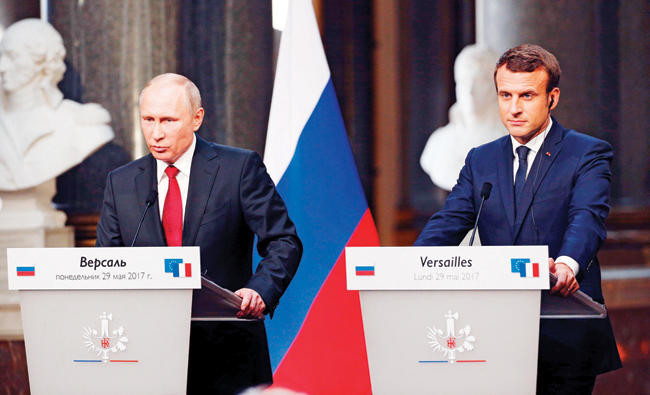
Putin rejects allegations that Russia meddled in foreign elections
Putin rejects allegations that Russia meddled in foreign elections
Latest updates


Recommended


© 2026 SAUDI RESEARCH & PUBLISHING COMPANY, All Rights Reserved And subject to Terms of Use Agreement.