Sri Lanka mudslide deaths passes 150 mark as more bodies found

1 / 2
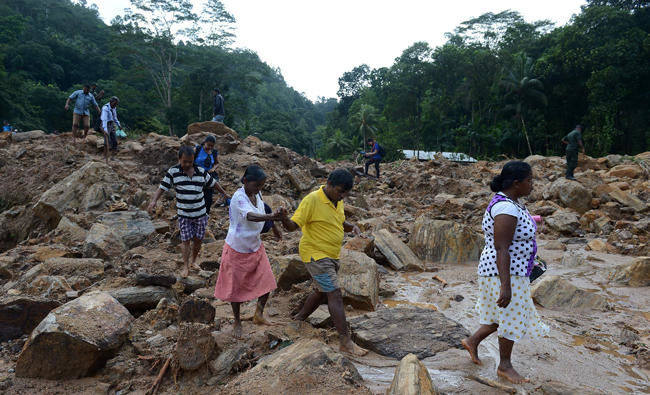
Sri Lankan villagers cross a landslide site as military rescue workers and villagers search for survivors in Athweltota village in Kalutara on Sunday. (AFP / LAKRUWAN WANNIARACHCHI)
2 / 2
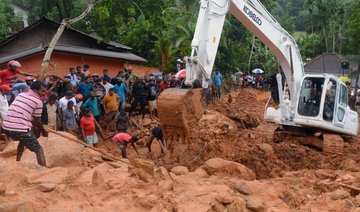
Sri Lankan villagers watch as military rescue workers search for survivors at the site of a mudslide in Bellana village in Kalutara. (AFP)
Updated 28 May 2017
Follow

Sri Lanka mudslide deaths passes 150 mark as more bodies found

COLOMBO, Sri Lanka: Sri Lankan rescuers on Sunday pulled out more bodies that were buried by enormous mudslides as the death toll in the disaster climbed to 151, with 111 others missing.
Although the weather has cleared, more rains are forecast for Monday, threatening to bring further misery to over 100,000 people displaced in western and southern regions of the island nation that were lashed by two days of torrential rains.
Taking advantage of a lull in rain, soldiers cleared road access to most of the affected areas while others were reachable by boat, said Maj. Gen. Sudantha Ranasinghe, who is heading the search and rescue mission. People waded in knee-deep floodwaters to get to army trucks transporting relief supplies and taking away those waiting to be evacuated.
Ranasinghe said he didn’t expect to find any more survivors.
Health minister Dr. Rajitha Senarathna said 102,218 displaced people were being sheltered in 339 relief centers. Special medical teams have been sent to the affected areas, while medicine has been sent by air to hospitals for which access has been cut off, he said.
Access roads are still blocked in some areas due to flooding, and fuel shortages have been reported, Senarathna said.
The UN said it was assisting in relief efforts in response to a government appeal. It also promised to donate water purification tablets, tents and other supplies for the displaced. India sent a shipload of goods, while the United States and Pakistan also promised to send relief supplies.
Sri Lanka’s Department of Meteorology warned that heavy downpours were expected in some of the affected areas.
Mudslides have become common during the monsoon season in Sri Lanka, a tropical Indian Ocean island nation, as land has been heavily deforested to grow export crops such as tea and rubber. Last May, a massive landslide killed more than 100 people in central Sri Lanka.


India accelerates free trade agreements against backdrop of US tariffs

Updated 21 December 2025
Follow

India accelerates free trade agreements against backdrop of US tariffs

  • India signed a CEPA with Oman on Thursday and a CETA with the UK in July 
  • Delhi is also in advanced talks for trade pacts with the EU, New Zealand, Chile 

NEW DELHI: India has accelerated discussions to finalize free trade agreements with several nations, as New Delhi seeks to offset the impact of steep US import tariffs and widen export destinations amid uncertainties in global trade. 

India signed a Comprehensive Economic Partnership Agreement with Oman on Thursday, which allows India to export most of its goods without paying tariffs, covering 98 percent of the total value of India’s exports to the Gulf nation. 

The deal comes less than five months after a multibillion-dollar trade agreement with the UK, which cut tariffs on goods from cars to alcohol, and as Indian trade negotiators are in advanced talks with New Zealand, the EU and Chile for similar partnerships. 

They are part of India’s “ongoing efforts to expand its trade network and liberalize its trade,” said Anupam Manur, professor of economics at the Takshashila Institution. 

“The renewed efforts to sign bilateral FTAs are partly an after-effect of New Delhi realizing the importance of diversifying trade partners, especially after India’s biggest export market, the US, levied tariff rates of up to 50 percent on India.” 

Indian exporters have been hit hard by the hefty tariffs that went into effect in August. 

Months of negotiations with Washington have not clarified when a trade deal to bring down the tariffs would be signed, while the levies have weighed on sectors such as textiles, auto components, metals and labor-intensive manufacturing. 

The FTAs with other nations will “help partially in mitigating the effects of US tariffs,” Manur said. 

In particular, Oman can “act as a gateway to other Gulf countries and even parts of Eastern Europe, Central Asia, and Africa,” and the free trade deal will most likely benefit “labor-intensive sectors in India,” he added. 

The chances of concluding a deal with Washington “will prove to be difficult,” said Arun Kumar, a retired economics professor at the Jawaharlal Nehru University.

“With the US, the chances of coming to (an agreement) are a bit difficult, because they want to get our agriculture market open, which we cannot do. They want us to reduce trade with Russia. That’s also difficult for India to do,” he told Arab News.  

US President Donald Trump has threatened sanctions over India’s historic ties with Moscow and its imports of Russian oil, which Washington says help fund Moscow’s ongoing war with Ukraine.

“President Trump is constantly creating new problems, like with H-1B visa and so on now. So some difficulty or the other is expected. That’s why India is trying to build relationships with other nations,” Kumar said, referring to increased vetting and delays under the Trump administration for foreign workers, who include a large number of Indian nationals. 

“Substituting for the US market is going to be tough. So certainly, I think India should do what it can do in terms of promoting trade with other countries.” 

India has free trade agreements with more than 10 countries, including comprehensive economic partnership agreements with South Korea, Japan, and the UAE.

It is in talks with the EU to conclude an FTA, amid new negotiations launched this year for trade agreements, including with New Zealand and Chile.  

India’s approach to trade partnerships has been “totally transformed,” Commerce and Industry Minister Piyush Goyal said in a press briefing following the signing of the CEPA with Oman, which Indian officials aim to enter into force in three months. 

“Now we don’t do FTAs with other developing nations; our focus is on the developed world, with whom we don’t compete,” he said. “We complement and therefore open up huge opportunities for our industry, for our manufactured goods, for our services.”