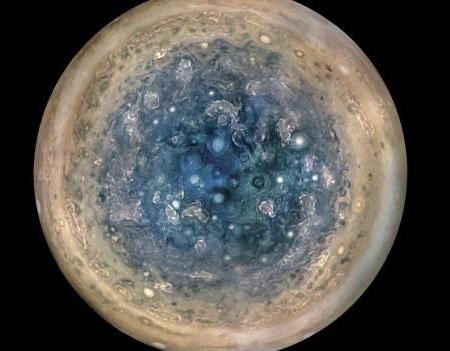
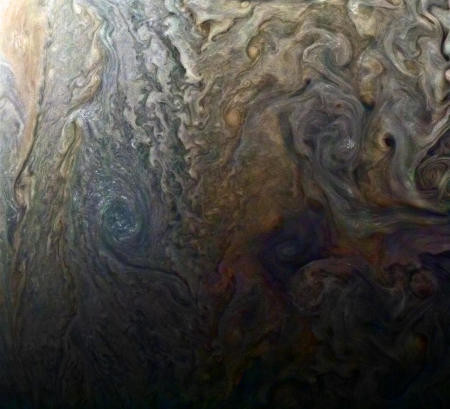
CAPE CANAVERAL: Monstrous cyclones are churning over Jupiter's poles, until now a largely unexplored region that is more turbulent than scientists expected.
NASA's Juno spacecraft spotted the chaotic weather at the top and bottom of Jupiter once it began skimming the cloud tops last year, surprising researchers who assumed the giant gas planet would be relatively boring and uniform down low.
"What we're finding is anything but that is the truth. It's very different, very complex," Juno's chief scientist Scott Bolton of the Southwest Research Institute said Thursday.
With dozens of cyclones hundreds of miles across — alongside unidentifiable weather systems stretching thousands of miles — the poles look nothing like Jupiter's equatorial region, instantly recognizable by its stripes and Great Red Spot, a raging hurricane-like storm.
"That's the Jupiter we've all known and grown to love," Bolton said. "And when you look from the pole, it looks totally different ... I don't think anybody would have guessed this is Jupiter."
He calls these first major findings — published Thursday — "Earth-shattering. Or should I say, Jupiter-shattering."
Turning counter-clockwise in the northern hemisphere just like on Earth, the cyclones are clearly clustered near the poles. The diameters of some of these confirmed cyclones stretch up to 1,700 miles (2,800 kilometers). Even bigger, though shapeless weather systems are present in both polar regions. At the same time, the two poles don't really resemble each other, which is puzzling, according to Bolton.
Scientists are eager to see, over time, whether these super cyclones are stable or dynamic. "Are they going to stay the same way for years and years like the Great Red Spot ... Of course, only time will tell," Bolton said.
Just as intriguing will be how fast these super cyclones are moving.
Launched in 2011 and orbiting Jupiter since last summer, Juno is providing the best close-up views ever of our solar system's largest planet, peering beneath the clouds for a true portrait. It's made five close passes over Jupiter so far for science collection, the most recent last week; they occur about every two months given Juno's extremely oblong orbit. The next one will be in July, with investigators targeting the Great Red Spot.
Juno is moving so fast during these chummy encounters that it takes only two hours to get from the north pole to the south.
Besides polar cyclones, Juno has spotted white ice caps on Jupiter — frozen bits of ammonia and water. Bolton refers to them as Jovian snowfall — or maybe hail.
Juno also has detected an overwhelming abundance of ammonia deep down in Jupiter's atmosphere, and a surprisingly strong magnetic field in places — roughly 10 times greater than Earth's. It's also led scientists to believe Jupiter may have a "fuzzy" core — as Bolton puts it — big but partially dissolved.
Then there are the eerie sounds of plasma waves at Jupiter — "nature's music," according to Bolton. During the teleconference, he played two minutes of the spacecraft's recording from February, adjusted for the human ear and full of percussion sounds as well as high-pitched beeps and squeals, and even flute-like notes.
Results were published in Science and Geophysical Research Letters.
Jupiter's poles appear dramatically different from neighboring Saturn's, according to the scientists, with nothing like the hexagon-shaped cloud system over Saturn's north pole.
Researchers hope to compare Juno's observations with those of NASA's Cassini spacecraft, in its final months orbiting Saturn.
Juno's findings are "really going to force us to rethink not only how Jupiter works, but how do we explore Saturn, Uranus and Neptune," Bolton said.


![]()
![]()
NASA releases never-before-seen photos of Jupiter's stormy poles
NASA releases never-before-seen photos of Jupiter's stormy poles


Latest updates


Recommended


© 2026 SAUDI RESEARCH & PUBLISHING COMPANY, All Rights Reserved And subject to Terms of Use Agreement.