


MIAMI, USA: NASA celebrated a key triumph on Tuesday as its $1.1 billion Juno spacecraft successfully slipped into orbit around Jupiter on a mission to probe the origin of the solar system.
NASA’s Jet Propulsion Laboratory in Pasadena, California, erupted in cheers as the solar observatory entered its aimed-for orbit around the biggest planet in our cosmic neighborhood at 11:53 p.m. (0353 GMT Tuesday).
“We are there. We are in orbit. We conquered Jupiter,” said Scott Bolton, NASA’s principal investigator from the Southwest Research Institute in San Antonio, Texas. “It is almost like a dream coming true.”
Juno launched five years ago from Cape Canaveral, Florida, and has traveled 1.7 billion miles (2.7 billion kilometers) since then.
Its arrival marks the start of a 20-month mission during which scientists hope to find out more about how much water Jupiter holds and the makeup of its core to figure out how the gas giant — and other planets including Earth — formed billions of years ago.
“This amazing universe that we see, how does that work and how did it begin?” asked NASA project scientist Steve Levin.
“That is one of the amazing things about working for NASA and working on big projects. You get to answer big questions.”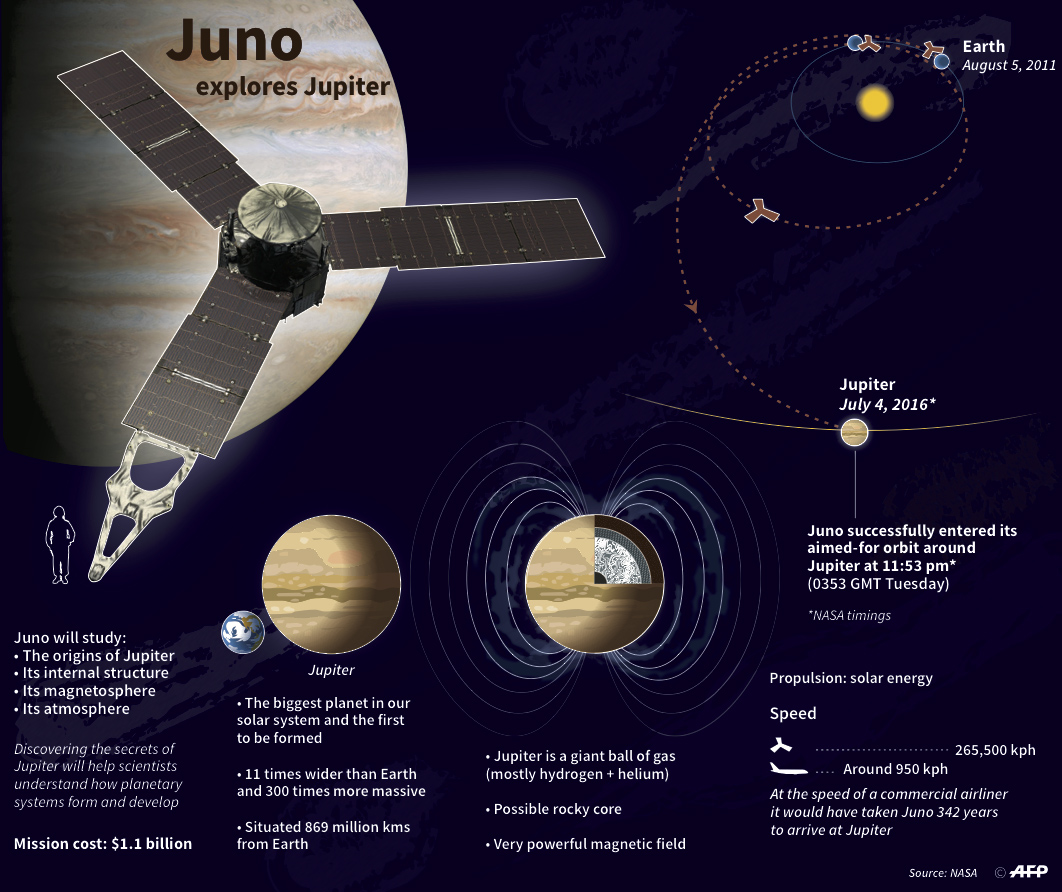
The spacecraft is equipped with nine science instruments, including a camera, which prior to orbit captured a video of Jupiter and its moons gliding around it at different speeds.
“In all of history we’ve never really been able to see the motion of any heavenly body against another,” said Bolton, after showing the video during a post-orbit press conference for the first time.
“This is the king of our solar system and its disciples going around it,” he said.
“To me, it is very significant. We are finally able to see with real video, with real pictures, this movement and we have only been able to imagine it up until today.”
All non-essential equipment was turned off for the approach, but the first post-orbit pictures from the spacecraft’s on-board camera should arrive in a few days, NASA said.
Magnetic fields and auroras
“The spacecraft worked perfectly, which is always nice when you’re driving a vehicle with 1.7 billion miles on the odometer,” said Rick Nybakken, Juno project manager from Jet Propulsion Laboratory.
Juno’s inaugural lap around the solar system’s most massive planet — the fifth from the sun — will last 53 days. Subsequent orbits will be shorter, about two weeks each.
The first mission designed to see beneath Jupiter’s clouds, Juno is named after the Roman goddess who was the wife of Jupiter, the deity of the sky in ancient mythology.
The spacecraft orbits Jupiter from pole to pole, sampling its charged particles and magnetic fields for the first time and revealing more about the auroras in ultraviolet light that can be seen around the planet’s polar regions.
Juno should circle the planet 37 times before finally making a death plunge in 2018, to prevent the spacecraft from causing damage to any of Jupiter’s icy moons, which NASA hopes to explore one day for signs of life.
Although Juno is not the first spacecraft to orbit Jupiter, NASA says its path will bring it closer than its predecessor, Galileo, which launched in 1989.
That spacecraft found evidence of subsurface saltwater on Jupiter’s moons Europa, Ganymede and Callisto before making a final plunge toward Jupiter in 2003.
Juno’s orbital track is closer than Galileo’s — this time within 3,100 miles (5,000 kilometers) above the cloud tops.
'Scariest place'
With an atmosphere of hydrogen and helium, Jupiter is known for its Great Red Spot, a storm bigger than Earth that has been raging for hundreds of years.
On Monday, Heidi Becker, senior engineer on radiation effects at NASA’s Jet Propulsion Laboratory, described the close approach as going “into the scariest part of the scariest place... part of Jupiter’s radiation environment where nobody has ever been.”
A leading concern has been radiation levels — as high as 100 million X-rays in the course of a year, she explained.
Those high-energy electrons, moving at the speed of light, “will go right through a spacecraft and strip the atoms apart inside your electronics and fry your brain if you don’t do anything about it,” she said.
“So we did a lot about it,” she added, describing the half-inch-thick layer of titanium that protects the electronics in a vault to bring the radiation dose down.


