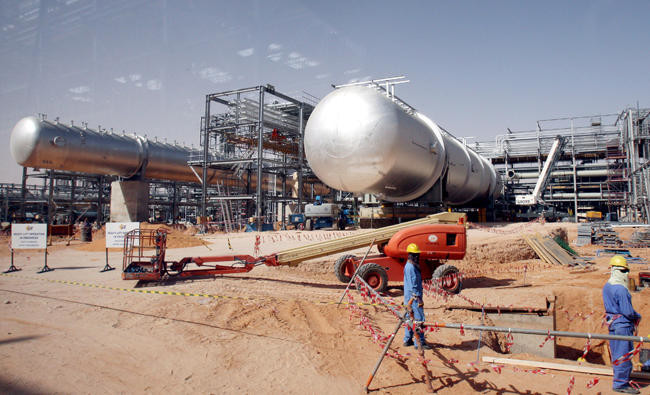
HOUSTON: US oil services companies have been doing a lot more work as recovering oil prices have lifted the shale industry from a two-year slump, but producers have been pocketing much of the new cash generated by rising output and squeezing service providers to keep costs down.
Oil service companies that provide the crews, labor and technology used to drill, construct and operate wells are lagging the recovery in US shale producers. The lopsided situation could chill the production rebound or keep it from spreading to more shale fields, executives of services companies said.
Rising demand for certain services means raising salaries to attract workers and refurbishing equipment, while often being paid under fixed contracts signed during harder times, these companies said. That has pressured margins, leading to further losses. Law firm Haynes and Boone LLP said the US oilfield sector experienced 127 bankruptcies between 2015 and April 2017.
Among the 10 largest oilfield service providers, just five were profitable last quarter, the same number as a year ago. In contrast, seven of the top shale oil producers posted a first quarter profit, up from just one a year ago.
“Both of us have to be able to earn a return and give something back to our shareholders,” David Lesar, chief executive officer of Halliburton, the world’s second-largest oilfield services company, said in an interview.
The sector is struggling to change onerous contract terms set when oil prices were much lower. Service companies agreed to those prices out of necessity; they needed cash flow to cover expenses. Those contracts, some of which extend into next year, are contributing to losses, preventing some companies from adding equipment or moving it to oil fields where it could be put to use.
The expiration of those contracts should allow prices for high-demand services to rise, oilfield services executives said.
Even so, some of the changes that shale oil producers made during the downturn are likely to stick, making it harder for service firms to drive up prices.
Oil producers have better returns today because of those cost controls, winning greater favor among investors.
“Many of (oil producers) have reduced capex spending and are increasing capital returns to investors,” said Tom Bergeron, a senior fund manager for Frost Investment Advisers.
Shale firms have demanded deals that unbundle the functions of service providers, allowing them to spread the work out among more companies, who then have less leverage to raise prices.
Those practices allowed shale producer profits to start rebounding just a few months after oil prices began to recover from the $26 a barrel nadir of February 2016. But it left services companies without a way to immediately benefit from the US crude benchmark’s return to about $50 a barrel.
Service companies hope they can raise prices by the second half of this year, but for now there is limited scope to pass along costs, Chakra Mandava, an operations executive at Nabors Drilling USA said at an energy conference this month in Houston.
Nabors blamed its first quarter loss on an inability to offset costs for new staff and equipment.
Keane Group, which supplies pressure pumping services, one of the highest demand services in the shale patch, reported a first-quarter loss due largely to long-term, fixed price contracts, despite a 59 percent jump in revenue from the fourth quarter.
One proposal that might resolve the disconnect between oil price moves and contract changes is to tie deals to the cost of crude.
Apache Corp, which plans to drill some 250 wells this year in the Permian Basin, is looking to tie what it pays for services to the US crude benchmark — converting fixed service costs to a variable cost in order to cushion the hit to earnings of future oil-price changes.
That way, if crude prices rise, Apache could afford to pay more for services, but would pay less if oil drops. Chevron also is tying some of its contracts to indexes in a bid to remain competitive, the company said at a recent security analysts meeting.
“We’re just opening up the business model to what’s possible,” Michael Behounek, a senior drilling adviser for Apache, said in May at a drilling conference in Houston. “We want to put a dampener in place.”
“They (service companies) don’t want to ride the roller coaster either. If we go down this route, it might be good for both parties.”

US oil field service firms lag shale recovery; old deals hold
Using space science to protect Saudi Arabia’s environment
- Kingdom is harnessing satellite technology to forecast disasters, boost agriculture
RIYADH: Learning space science has delivered significant environmental benefits worldwide, helping many countries better understand and manage climate challenges.
Saudi Arabia is now taking steps not only to explore the galaxy but also to invest in future generations who can apply space science to pressing environmental issues at home.
Last November, the Space Academy, part of the Saudi Space Agency, launched a series of seminars designed to enhance knowledge and develop skills in space science and technology, with a particular focus on Earth observation.
Running for nearly a month, the program formed part of a broader strategy to nurture national talent, raise scientific awareness, and build data capabilities that support innovation and research across the Kingdom.
As efforts to strengthen the sector continue, important questions remain: How can space science translate into tangible environmental benefits? And how large is the global space economy?
In an interview with Arab News, Fahad Alhussain, co-founder of SeedFord, highlighted the scale of the opportunity and its environmental impact.
“To be frank, the slogan that we always use in space is that ‘saving the Earth from the space.’ It is all about this,” Alhusain told Arab News.
“You can recall a lot of related environmental issues like global warming, related to forests, related to the damage that happens to the environment. Without space, it would be almost impossible to see the magnitude of these damages.”
According to Alhussain, satellites have transformed how experts observe environmental changes on Earth, offering a comprehensive view that was previously impossible.
He said that “the transformation of technology allows even the non-optical ways of measuring, assessing, and discovering what is going on in the environment … you can even anticipate fire before it happens in the forest.”
“You can detect the ice-melt down, you can get huge amount of information and can see it through the weather maps…there is a huge section in the economy for the environment,” Alhussain commented.
A 2022 report by Ryan Brukardt, a senior partner at McKinsey & Company, published by McKinsey Quarterly, found that more than 160 satellites currently monitor Earth to assess the impacts of global warming and detect activities such as illegal logging.
Brukardt cited NASA as an example of how advanced satellite tools are used to track environmental changes, including shifts in ocean conditions, cloud cover, and precipitation patterns. He also noted that satellite data can help governments determine when immediate action is needed, particularly in response to wildfires.
FASTFACT
Did You Know?
- Satellites collect massive amounts of data, and AI is used to help interpret this information more efficiently and predict future outcomes.
- The global space economy surpassed $600 billion in 2024 and is projected to exceed $1 trillion by 2030.
- Saudi Arabia has established three key entities: the Supreme Space Council, the Saudi Space Agency, and the Communications, Space, and Technology Commission.
Beyond disaster response, satellites offer vital insights for agriculture. According to Brukardt’s report, scientists can use space-based data to monitor crop development and anticipate threats to harvests, such as drought or insect infestations.
These wide-ranging applications explain the rapid growth of the global space economy.
According to World Economic Forum research, the sector is projected to reach $1.8 trillion by 2035, nearly tripling from $630 billion in 2023.
For Saudi Arabia, expanding space science capabilities could help address the country’s arid conditions by monitoring desertification and identifying sources of air pollution. Early detection of droughts, heatwaves, and crop stress could support more effective environmental planning and response.
Space-based data could also play a critical role in tracking environmental changes in the Red Sea and surrounding coastal ecosystems, strengthening marine conservation efforts and supporting the Sustainable Development Agenda.
As Alhussain emphasized, advancing knowledge in space science and satellite technology enables experts to measure environmental damage accurately and predict disasters before they occur, allowing for more effective responses.

By investing in space science education and research, the Kingdom can build national expertise, strengthen environmental protection policies, enhance food and water security, and contribute to global efforts to combat climate change—while also benefiting from the rapidly expanding space economy.
Ultimately, a deeper understanding of space and its applications offers Saudi Arabia, and the world, better tools to anticipate climate challenges, protect ecosystems, and safeguard biodiversity.
“By collecting data and using satellites, you can better analyze and measure so many things that help the environment,” said Alhussain.
“There will be patterns where you can warn people, scientists and decision makers to do something about it.”