KATMANDU: The Hillary Step — a rocky outcrop near the top of Mount Everest — is still intact, Nepali climbers said Wednesday, rejecting a widely reported claim by a British mountaineer that it had collapsed.
The condition of the rock face has been the source of intense speculation among the climbing community since six-time Everest summiteer Tim Mosedale declared it had crumbled.
“The Hillary Step is no more,” Mosedale wrote on Facebook the day after he made the top on May 17.
“Not sure what’s going to happen when the snow ridge doesn’t form because there’s some huge blocks randomly perched hither and thither which will be quite tricky to negotiate.”
But experienced Nepali climbers said the rock feature — named after the first climber to summit the world’s highest peak, Sir Edmund Hillary — was unchanged.
“The Hillary Step is as it was before, but a large stone above it has fallen,” said Pemba Dorje Sherpa, who reached the peak last Saturday and has summited on 15 other occasions.
“It was easier to reach the summit because of that, but perhaps that confused people into thinking that the step is no more.”
Nine-time Everest summiteer Mingma Tsiri Sherpa, who runs a climbing company and is currently at base camp, said an alternative route being used by climbers could be leading to confusion.
“The fixed lines are more to the right of the step (than before). We’re now walking on the snow whereas before we had to walk on the rocky side. That is the reason for the confusion.”
Mingma has not climbed Everest this year but nine of his Nepali guides and eight clients have made it to the top.
Questions surrounding the condition of the step — the last major obstacle before the summit — emerged last year, with some suggesting that it had been damaged in the earthquake that hit Nepal in April 2015.
The 7.8-magnitude quake triggered an avalanche that flattened base camp, killing 18, and brought the climbing season to a premature close.
Geologist Amod Mani Dixit, who heads the Katmandu-based National Society for Earthquake Technology, said it was unlikely the earthquake would have shifted rocks on Everest, which stands 450 kilometers (280 miles) east of the epicenter.
Separately, an expedition organizer said Wednesday that rescuers found bodies of four climbers on Everest, taking the season’s death toll to 10 as experts warn cut-price mountaineering outfits are putting clients at risk.
The climbers were found inside a tent at camp four — at 7,950 meters — on Tuesday by a rescue team who were there to retrieve the body of a Slovak climber who died on the mountain on Sunday.


![]()
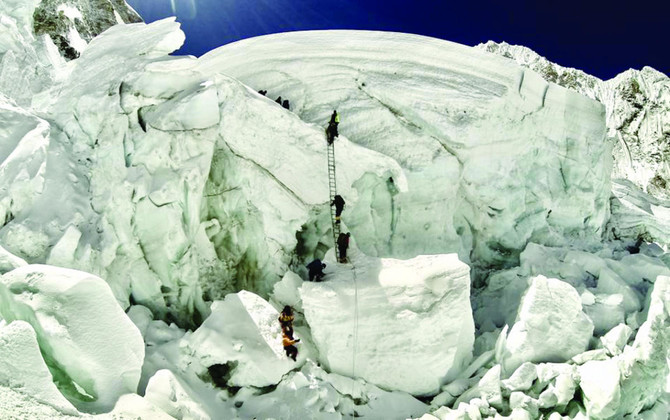
Everest’s Hillary Step intact, say climbers
Everest’s Hillary Step intact, say climbers
Latest updates


Recommended


© 2026 SAUDI RESEARCH & PUBLISHING COMPANY, All Rights Reserved And subject to Terms of Use Agreement.