JEDDAH: An outpour of criticism was unleashed via social and traditional media outlets in the Gulf after the official Qatar News Agency (QNA) carried comments attributed to the nation's Emir, Sheikh Tamim bin Hamad al-Thani, said to have been made at a graduation ceremony of the national service (military conscription) where he has endorsed Iran, Hamas and Hezbollah.
He also reportedly spoke of "tensions" with the new US administration and predicted the President Donald J. Trump will not last long, citing domestic political problems in Washington over ties with Russia.
Al-Thani also seems to have praised Iran which even the previous US administration under President Obama labeled as the "biggest state sponsor of terror" as an "Islamic power" and a source of stability in the region.
“There is no wisdom in harboring hostility towards Iran,” he said.
Despite the emir allegedly Saying that the relations with Israel are “good,” he went on to describe Hamas — which is designated as a terrorist organization by the US, EU and Israel and is condemned even by Arab countries for firing missiles towards civilians — as the "official representative of Palestinians."
Hamas — either in whole or in part — is regarded as a terrorist organization by several countries and international organizations, most notably by Israel, US and EU.
Despite this endorsement of Hamas, the Emir seems to have still refuted allegations of his country supporting terror, yet Doha is infamous for supporting both Lebanon's Hezbollah and Egypt's Muslim Brotherhood, which is designated a terrorist group by fellow GCC countries.
He reportedly also criticized the UAE, Bahrain and Egypt for waging a campaign against Doha. All three counties are fierce critics of the Muslim Brotherhood. However, he seems to have not mentioned Saudi Arabia by name.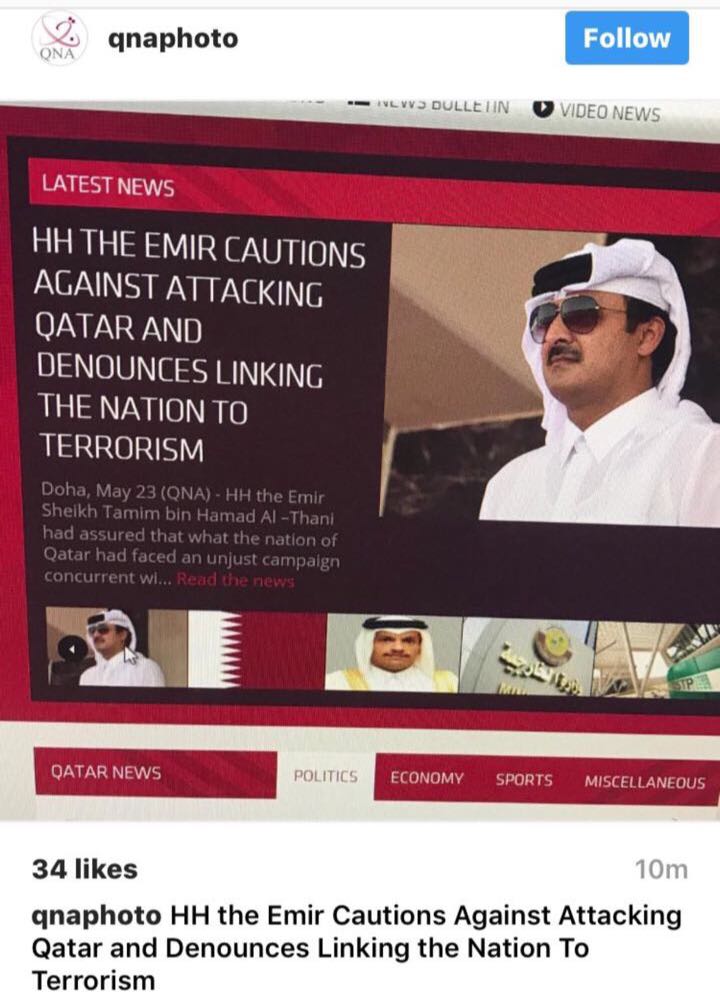
He did seem however to criticize what he described as "exaggerated" recent arms deals and said that countries should be spending that money on development projects, an apparent attack on the recent enormous Saudi-US arms deals signed in Riyadh during President Trump's visit.
The Emir is said to have credited Al-Udeid Air Base, which houses the biggest US Air Force base in the region, with protecting Doha from some neighboring countries, without mentioning any names but some experts believe he may have meant a fellow GCC country.
A few hours after the controversial statements broke on QNA, the government's communication team tried to downplay them saying that the news agency's website was hacked. However, the report was simultaneously posted in different languages and social media platforms, where they remained. The comments also go in line with recent criticism waged against the UAE, Bahrain and Saudi Arabia in other state-sponsored media outlets such as Al-Jazeera, Al-Arab and the London-based Middle East Eye.


![]()

Pro-Iran, pro-terror group's comments attributed to Qatari Emir sparks GCC outrage
Pro-Iran, pro-terror group's comments attributed to Qatari Emir sparks GCC outrage

Latest updates


Recommended


© 2026 SAUDI RESEARCH & PUBLISHING COMPANY, All Rights Reserved And subject to Terms of Use Agreement.