Manchester: A show of solidarity in the face of terror

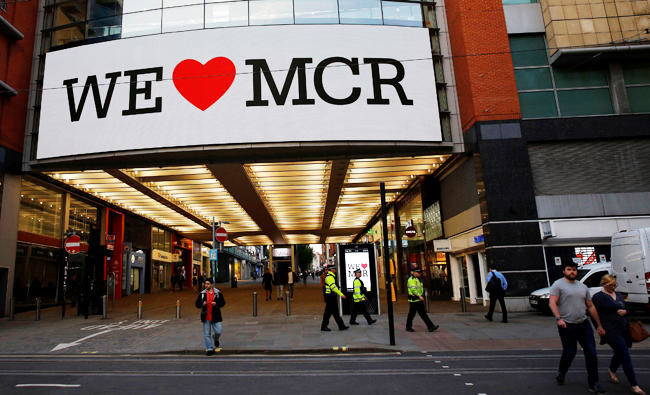
Police patrol near a sign in central Manchester, Britain on Tuesday. (REUTERS)
Updated 24 May 2017
Follow

Manchester: A show of solidarity in the face of terror

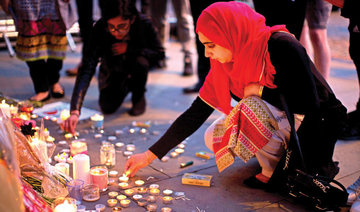
MANCHESTER: Less than 24 hours after the worst atrocity ever to hit the city, the streets of central Manchester were thronging with people on Tuesday night, as thousands turned out to pay tribute to the dead and injured in a show of defiance and solidarity in the face of terror.
Newly elected mayor Andy Burnham, a former Labour Party cabinet member, called the vigil in the city’s Albert Square. Earlier, after what was described as “Manchester’s darkest night,” Burnham praised the positive reaction of Mancunians, declaring: “Even in the minutes after the attack they opened their doors to strangers and drove them away from danger. They have the best possible response to those who seek to divide us. And it will be that spirit of Manchester that will prevail and hold us together.”
City Council leader Sir Richard Leese, in office for just three weeks when an IRA bomb struck Manchester in 1996, said: “Manchester has had some dark days in the past but I can’t think of anything that matches the horror of what happened (on Monday) night. But the community is coming together and we will not allow this to divide us just as we have not allowed events in the past to divide us.
“As the citizens of Manchester demonstrated… when they came out to give support to people whatever their needs were, this city will pull together and we will make sure the city will go on from strength to strength. A dark day yes, but something that Manchester, in its own unique way, that turns into a strength for us as a city by working together.”
Twenty-one years ago, when the biggest bomb ever detonated on the British mainland in peacetime devastated Manchester city center, the IRA had given a coded warning, which enabled police to shepherd 80,000 people to relative safety.
More than 200 people were wounded, but the fact that no-one was killed gave rise to legend of the “Miracle of Manchester.”
Last night there was no warning before the atrocious suicide bomb attack on the Manchester Arena, packed with 20,000 young pop music fans. There was no miracle. At least 22 people died — the youngest of the confirmed victims was aged just 8 — and 59 or more injured, with many children among the victims.
The contrast between the two attacks speaks volumes about how the nature of terrorism has changed. In 1996 the IRA saw fit to issue a warning, hardly gallant of them given the size of the explosive device deployed in a busy city center, but perhaps it demonstrated an intention to avoid civilian casualties, however slender.
Moreover, in the case of the IRA it was at least possible to discern a political motive for the attack, however inexcusable the tactics. Neither of those caveats apply to Monday night’s outrage. The prime intention of the suicide bomber, named as 22-year-old Manchester-born Salman Abedi, was clearly to kill as many people as possible with a bomb said to be packed with nuts, bolts and nails.
Nor is it possible to fathom any possible aim that this act of terror was supposed to assist. Like the recent attacks in London and wider world, this was pure nihilistic evil.
If there was no specific warning before the bombing of the arena, security services have long been saying it was not “if” the next atrocity was coming but “when.” There have been plots to attack the Arndale shopping center and Old Trafford football stadium — thwarted by police.
Tragically this one got through, and it seems to have been meticulously planned. The timing of the explosion, as fans were leaving the auditorium en masse, was probably entirely deliberate. And the exact spot in the foyer where the bomb was detonated would not have required the bomber to confront security and enter the arena proper.
Manchester has been here before and reacted in the same way. At the vigil people embraced each other. One said: “Love is the only thing we can do when we are facing hate.”
Dave Haslam, former DJ at Manchester's once-legendary Hacienda nightclub, tweeted: “You’ve got the wrong city if you think hate will tear us apart.” There were almost 50,000 reactions within hours.
• Ray King was a journalist at the Manchester Evening News for 34 years. His book about the IRA bombing of 1996, Detonation — Rebirth of a City, is available on Kindle.


US intel did not suggest a preemptive strike from Iran before US-Israeli attacks, AP sources say

Updated 5 sec ago
Follow

US intel did not suggest a preemptive strike from Iran before US-Israeli attacks, AP sources say

WASHINGTON: Trump administration officials told congressional staff in private briefings Sunday that US intelligence did not suggest Iran was preparing to launch a preemptive strike against the US, three people familiar with the briefings said.
The administration officials instead acknowledged there was a more general threat in the region from Iran’s missiles and proxy forces, two of the people said. The third person, however, said the administration emphasized that Iran’s missiles and proxy forces posed an imminent threat to US personnel and allies in the region.
The officials did not provide any clarity about what would happen next in Iran after the joint US-Israeli operation, the two people said. All three people insisted on anonymity to discuss details that have not been made public.
The information conveyed to the congressional staff contrasts with the message from President Donald Trump. “Our objective is to defend the American people by eliminating imminent threats from the Iranian regime. A vicious group of very hard, terrible people,” he said in a video message after launching strikes on Iran.
Senior Trump administration officials, who like others were not authorized to comment publicly and spoke on condition of anonymity, had told reporters Saturday that there were indicators that the Iranians could launch a preemptive attack.
The White House and Pentagon did not immediately reply to requests for comment on Sunday night. Details of the briefing were first reported by Politico.
On Tuesday, Secretary of State Marco Rubio, Defense Secretary Pete Hegseth, CIA Director John Ratcliffe and Gen. Dan Caine, chairman of the Joint Chiefs of Staff, will brief the full membership of Congress on the US military operation against Iran, the White House said Sunday. Rubio also was slated to brief Hill leadership Monday, the same day Hegseth and Caine are planning a press conference about the operation.
Three strikes, three locations, within a single minute
The military operation came after authorities from Israel and the US spent weeks tracking the movements of senior Iranian leaders, including Supreme Leader Ayatollah Ali Khamenei, and shared information that allowed the strikes to be carried out in a surprise daylight attack, according to an Israeli military official and another person familiar with the operation.
The eventual barrage of US-Israeli attacks on Iran came so quickly that they were nearly simultaneous — with three strikes in three locations hitting within a single minute — killing Khamenei and some 40 senior figures, including the head of the paramilitary Revolutionary Guard and the country’s defense minister, the Israeli military official said Sunday.
The official said a variety of factors created a golden opportunity to take out much of Iran’s leadership, like weeks of training and monitoring the movements of senior figures as well as intelligence in real-time before the attack began that key targets were gathered together.
Striking by day also gave an additional element of surprise, said the official, who said so many major, rapid-fire strikes were critical to keep key officials from fleeing after the first strike. The official said Israel closely cooperated with its US counterparts and had used a similar tactic at the beginning of last June’s war — which resulted in the killing of several senior Iranian figures.
The official also noted Khamenei having posted defiant tweets taunting President Donald Trump in the days before the attack.
The details about the strikes came as the conflict entered its second day, with Trump saying in a video message Sunday that he expected it would continue until “all of our objectives are achieved.” He did not spell out what those objectives were.
The Republican president also said the US military and its partners hit hundreds of targets in Iran, including Revolutionary Guard facilities, Iranian air defense systems and nine warships, “all in a matter of literally minutes.”
CIA had long tracked top Iranian leaders
Before the attacks, the CIA had for months tracked the movements of senior Iranian leaders, including Khamenei.
The intelligence was shared with Israeli officials, and the timing of the strikes was adjusted in part because of that information about the Iranian leaders’ location, according to the person familiar with the planning.
The intelligence-sharing between US and Israel reflects the preparation that went into the strikes, which threw the future of the Islamic Republic into uncertainty and raised the risk of escalating regional conflict.
The US regularly shares intelligence with allies including Israel. Those partnerships, and the accuracy of the intelligence they yield, is often critical not only to the success of a military operation but also to the public’s support for it.
Virginia Sen. Mark Warner, the senior Democrat on the committee, told The Associated Press that, historically, “our working relationship with the Mossad and Israel is really strong.” Mossad is the Israeli spy agency.
Warner said he has serious concerns about the justification for the strikes, Trump’s long-term plans for the conflict and the risks that US service members will face. The military announced Sunday that three American troops had been killed in the Iran operation.
“No tears will be shed over their leadership being eliminated, but always the question is: OK, what next?” Warner said.
Iran has signaled it’s open to talks with the US
A senior White House official said Iran’s “new potential leadership” has suggested it is open to talks with the United States. That official, who spoke on condition of anonymity to discuss internal administration deliberations, said Trump has indicated he’s “eventually” willing to talk but that for now the military operation “continues unabated.”
The official did not say who the potential new Iranian leaders are or how they made their alleged willingness to talk known. Separately, Trump told The Atlantic that he planned to speak with Iran’s new leadership.
“They want to talk, and I have agreed to talk, so I will be talking to them,” he said Sunday, declining comment on the timing.