NATO’s feel-good meeting aims to impress Donald Trump

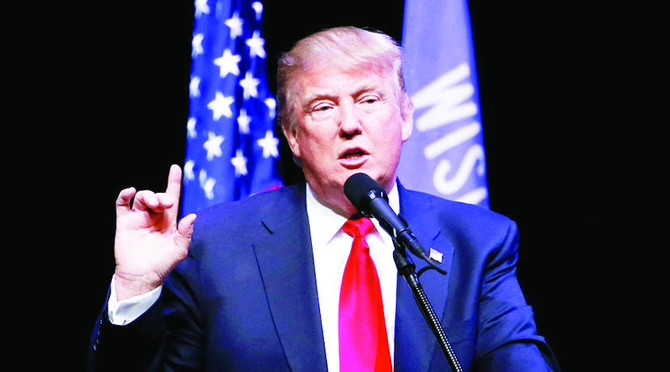
US President Donald Trump
Updated 23 May 2017
Follow

NATO’s feel-good meeting aims to impress Donald Trump

BRUSSELS: Ribbon-cutting, jets overhead and a dinner in a new, billion-dollar headquarters: Donald Trump’s first meeting at North Atlantic Treaty Organization (NATO) on Thursday is choreographed to impress a US president who called the Western alliance “obsolete.”
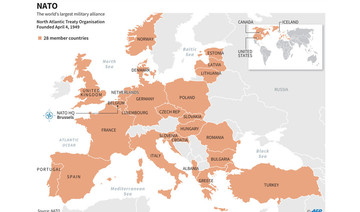
In a fortuitous twist, a series of NATO goals including a new HQ and expansion to include new member Montenegro have coalesced around Trump’s visit, which officials have kept free from the dense policy debates of their biennial summits.
“This is the moment to remind Trump that he’s the leader of the free world,” said a senior NATO diplomat involved in the preparations. “Gravitas is what the alliance does best.”
In that vein, Trump, a New Yorker, is expected to unveil a memorial to the Sept. 11, 2001 attacks, placed at the entrance to the new NATO building that has been almost two decades in the making at a cost of €1.1 billion ($1.2 billion).
NATO officials hope the steel wreckage from one of the Twin Towers will remind Trump that the only time the alliance has activated its collective defense clause was following the attacks on New York and Washington, a decision that also sent NATO into Afghanistan to fight the militants behind them.
With no final communique and a meeting consisting only of dinner with NATO allies rather than sessions including non-members partners such as Sweden and Ukraine, diplomats say the alliance is playing up the pomp rather than new policies.
It is not unique: NATO leaders welcomed new US President George W. Bush in 2001 with an informal lunch and some policy discussion, while then-President Barack Obama’s first months in office in 2009 coincided with a scheduled NATO summit.
But it will be more spectacular, with allied jets due to fly over Trump and other leaders at the opening of NATO’s new HQ.
Expectations have been set low, even after Trump last month withdrew his earlier charge that the NATO was “obsolete” because it was not “taking care of terror.”
Trump ripped into US allies during his election campaign, accusing them of not paying their fair share. After taking office, he sent his defense secretary to Brussels with an ultimatum to pay up or risking losing support.
“Europe knows Trump has a fundamentally negative view of alliances,” said Tomas Valasek, a former Slovak ambassador to NATO and now head of think-tank Carnegie Europe. “The hope is that he comes away with a more positive view of NATO, that he realizes he has allies’ time and their respect.”
Baltic allies and others alarmed by Russia’s 2014 annexation of Crimea want much more, however. They seek a public commitment from Trump to stand by NATO’s Article V defense cause that states that an attack on one ally is an attack on all, although it is not clear if they will raise the issue with Trump.
Trump’s “America First” rhetoric, his conflicting signals on Russia and his shifts on NATO have left European governments at a loss, despite support from senior officials including vice president Mike Pence, who visited the EU and NATO in January.
“There is uncertainty, there is a need to dispel some of this confusion,” said Pierre Vimont, a former head of the EU’s foreign service. “They (European leaders) want to have some reassurance,” he said.
To nudge Trump in that direction, European allies will tell Trump over dinner they agree to spend more on defense, going some way to account for the sharp drop in Europe’s military budgets since the fall of the Soviet Union.
‘Let’s make Trump happy’
At an oval table with NATO leaders, Trump is due to hear that each ally will present a plan by the end of the year explaining how they will reach a 2014 goal to spend 2 percent of economic output on defense every year by 2024.
As in most NATO meetings, a three-minute speaking rule applies and diplomats aim to keep the message from allies sharp.
“Trump will want to know what they have done for him lately. And more specifically what they have done on the hard power front,” said Anthony Gardner, who was US ambassador to the EU under Trump’s predecessor Barack Obama.
Only the US, Britain, Poland, Estonia and Greece met the NATO spending target in 2016, although the cuts have stopped; Latvia, Lithuania and Romania are close and France has broad operations underway in Africa and the Middle East.
By current standards, Washington funds about 70 percent of NATO spending, although all countries share the costs of running the alliance’s day-to-day administration and building costs.
The final part of NATO’s charm offensive hinges on its response to a plan by US officials for NATO to take a bigger role in the fight against Islamic State in Syria and Iraq, in line with calls from Trump for the alliance to do more to combat terrorism.
Not yet agreed because France and Germany have reservations, diplomats still hope to reach a compromise before the summit that would see all 28 allies agreeing for NATO as an institution to join the coalition without committing to obligations beyond those already undertaken by its members.
That would give Trump something to take back to Washington to show Americans NATO is responding.
“This is not about policy, it’s about political messaging,” said a second senior NATO diplomat. “Let’s make Trump happy.”


Somali president to Asharq Al-Awsat: Working with Saudi-led partners to void Israel’s Somaliland recognition

Updated 5 sec ago
Follow

Somali president to Asharq Al-Awsat: Working with Saudi-led partners to void Israel’s Somaliland recognition

  • Hassan Sheikh Mohamud unveils three-pronged diplomatic and legal strategy to defend Somalia’s sovereignty and territorial unity
  • Says Mogadishu coordinates with Saudi Arabia and Arab, African partners to counter what he calls a dangerous precedent

RIYADH: Somali President Hassan Sheikh Mohamud unveiled a three-pronged political and legal strategy to nullify what he described as Israeli recognition of the breakaway region of Somaliland, warning that such a move threatens Somalia’s sovereignty and regional stability.

Speaking to Asharq Al-Awsat, Mohamud said his government is acting in close coordination with partners led by Saudi Arabia to safeguard stability and shield the Horn of Africa from what he called “reckless escalation.”

Without naming specific countries, the Somali leader said some regional states may see the Israeli recognition as an opportunity to pursue “narrow, short-term interests at the expense of Somalia’s unity and regional stability.”

“I do not wish to name any particular country or countries,” he said. “But it is clear that some may view this recognition as a chance to achieve limited gains.”

Somali President Hassan Sheikh Mohamud visiting the country's soldiers in the frontline. (X)

He stressed that Somalia’s unity is a “red line,” adding that Mogadishu has taken firm positions to protect national sovereignty. “We warn against being misled by reckless Israeli adventurism,” he said.

Mohamud was referring to recognition announced by Israeli Prime Minister Benjamin Netanyahu of the self-declared Republic of Somaliland as an independent state.

“I affirm with the utmost clarity and firmness that any recognition of Somaliland as an independent state constitutes a blatant violation of the sovereignty and unity of the Federal Republic of Somalia,” he said.

He described the move as a grave breach of international law, the UN Charter, and African Union resolutions that uphold respect for inherited African borders.

On that basis, Somalia has adopted and will continue to pursue three parallel measures, he revealed.

The first involves immediate diplomatic action through the UN, African Union, and Organization of Islamic Cooperation to reject and legally and politically invalidate the recognition.

Mohamud said Somalia called for and secured a formal session at the UN Security Council to address what he termed a “flagrant Israeli violation” of Somalia’s sovereignty and territorial integrity.

The session, he said, marked a significant diplomatic victory for Mogadishu, particularly given Somalia’s current membership on the council.

He expressed “deep appreciation” for statements of solidarity and condemnation issued by the African Union, Arab League, OIC, Gulf Cooperation Council, Intergovernmental Authority on Development (IGAD), and the EU, among others.

The second step centers on coordinating a unified Arab, Islamic, and African position. Mohamud praised Saudi Arabia for being among the first to issue a clear statement rejecting any infringement on Somalia’s unity.

He said the Saudi position reflects the Kingdom’s longstanding commitment to state sovereignty and territorial integrity, reinforced by the Saudi cabinet’s “firm and principled” support for Somalia during what he described as a delicate moment.

The third step focuses on strengthening internal national dialogue to address political issues within the framework of a single Somali state, free from external interference or dictates.

Mohamud warned that if left unchecked, the recognition could set a “dangerous precedent and undermine regional and international peace and security.”

He said it could embolden separatist movements not only in the Horn of Africa but across Africa and the Arab world, citing developments in countries such as Sudan and Yemen as evidence of the high cost of state fragmentation.

“This concerns a vital global shipping artery and core Arab national security,” he said, referring to the Red Sea.

“Any political or security tension along Somalia’s coast will directly affect international trade and energy security.”

He added that instability would impact Red Sea littoral states, particularly Saudi Arabia, Egypt, Sudan, Eritrea, Yemen, and Jordan. “Preserving Somalia’s unity is a cornerstone of collective Red Sea security,” he said.

Mohamud argued that Israel’s objective goes beyond political recognition. 

“We believe the goal extends beyond a political gesture,” he told Asharq Al-Awsat. “It includes seeking a strategic foothold in the Horn of Africa near the Red Sea, enabling influence over the Bab Al-Mandeb Strait and threatening the national security of Red Sea states.”

He described the move as a test of Somali, Arab, and African resolve on issues of sovereignty and territorial unity, emphasizing that Somalia’s opposition to secession is a principled and enduring national stance supported widely in the Arab and African worlds, “foremost by Saudi Arabia.”

He rejected any attempt to turn Somalia into a battleground for regional or international rivalries. “We will not allow Somalia to become an arena for settling conflicts that do not serve our people’s interests or our region’s security,” he declared.

Regarding Saudi-Somali relations, Mohamud described the partnership as “deep-rooted and strategic, rooted in shared history, religion, and a common destiny.” Saudi Arabia, he said, “remains a central partner in supporting Somalia’s stability, reconstruction, development, and Red Sea security.”

He voiced admiration for Saudi Arabia’s Vision 2030 and the economic and development gains achieved under the leadership of Custodian of the Two Holy Mosques King Salman bin Abdulaziz and Prince Mohammed bin Salman, Crown Prince and Prime Minister.

Asked about the recent Saudi Cabinet decision rejecting any attempt to divide Somalia, Mohamud said the federal government received it with “great appreciation and relief.”

He said the position extends the Kingdom’s historic support for Somalia’s territorial unity and sovereignty, reinforces regional stability, and sends an important message to the international community on the need to respect state sovereignty and refrain from interference in internal affairs.