

Mideast youth unemployment in spotlight at Jordan WEF meeting

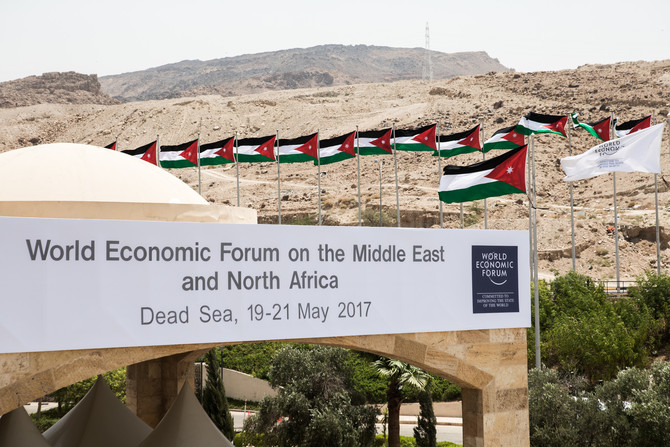
More than 1,100 delegates are expected at the World Economic Forum meeting in Jordan. (WEF)
Updated 20 May 2017
Follow

Mideast youth unemployment in spotlight at Jordan WEF meeting

AMMAN: Youth unemployment is high on the agenda at the World Economic Forum (WEF) on the Middle East and North Africa, currently taking place at the W in Jordan.


The WEF event, which officially started Friday, will today see Crown Prince Al Hussein bin Abdullah II of Jordan address more than 1,100 delegates on the theme “enabling a generational transformation.”


The 16th meeting in the region brings together a diverse group of leaders to address issues such as humanitarian crisis and the challenges presented to employment and jobs by the so-called “Fourth Industrial Revolution.”


It will also address the gender gap holding back regional competitiveness and inclusion, the future of Syria and Iraq, and the way forward through economic and political reforms, a WEF statement said.


“As 31 percent of young people in the region are unemployed, new initiatives and urgent action are needed to realize this potential. When skilled talent is present — particularly educated women — it is not being deployed effectively in the workforce,” WEF said. 


A report issued by WEF entitled “The Future of Jobs and Skills in the Middle East and North Africa” found that few of the region’s economies are fully prepared for the impending disruption brought about by technological change.


The WEF meeting, which runs until May 21, is being attended by 10 heads of state and government, more than 130 public figures and 500 global and regional business leaders. 


It will host refugees from the Zaatari camp, who will meet with the WEF’s Regional Business Council to find ways to build on the success of free trade zones, allowing refugee-made products to reach markets.


The meeting will also feature a gathering of 100 startups from the Arab world, many of which “have been founded under the most challenging circumstances,” the organizer said. These startups include an Arabic voice-recognition software developer from Syria, the first e-mobile wallet firm from Libya, and a mobile game studio run by a team from Gaza.


“The current reform momentum in the Middle East and North Africa is promising, but success is not guaranteed. Together with our long-term partner Jordan, the World Economic Forum is hosting its biggest-ever meeting of entrepreneurs and start-ups in the region. We’re inviting them to advise leaders on new growth strategies that will bring prosperity and bolster peace efforts throughout the region,” said Mirek Dusek, head of regional strategies in MENA at the World Economic Forum.


Public figures billed as attending the WEF meeting include: Fuad Masum, president of Iraq; Sherif Ismail, prime minister of Egypt; Giorgi Kvirikashvili, prime minister of Georgia; and Felipe VI, king of Spain.


Saudi non-oil trade surplus with GCC jumps 102% in November  

Updated 13 sec ago
Follow

Saudi non-oil trade surplus with GCC jumps 102% in November  

RIYADH: Saudi Arabia’s non-oil trade surplus with Gulf Cooperation Council countries more than doubled in November, driven by a surge in exports, preliminary government data showed. 

The surplus reached about SR6.6 billion ($1.76 billion), up 102 percent from SR3.3 billion a year earlier, according to the General Authority for Statistics. 

Total non-oil trade with GCC countries rose 30 percent to SR20.4 billion from SR15.7 billion, as exports outpaced import growth. Non-oil goods exports climbed to SR13.5 billion in November from SR9.5 billion a year earlier, while imports increased to SR6.9 billion from SR6.2 billion. 

Re-exports made up the bulk of outbound trade, rising to SR9.76 billion in November from SR6.56 billion a year earlier, while national exports increased to SR3.75 billion from SR2.92 billion. 

The UAE remained Saudi Arabia’s largest GCC trading partner on a non-oil basis. Exports to the Emirates totaled SR10.48 billion in November versus SR7.18 billion a year earlier, comprising SR8.38 billion in re-exports and SR2.10 billion in national exports.   

Imports from the UAE were SR4.79 billion, up from SR3.95 billion, lifting the non-oil trade surplus with the UAE to about SR5.69 billion from SR3.23 billion.  

Trade with Kuwait also expanded, with exports rising to SR769.9 million from SR610.6 million, including SR199.2 million in re-exports and SR570.7 million in national exports. Imports from Kuwait fell to SR176.4 million from SR333.3 million, pushing the trade surplus to SR593.5 million from SR277.3 million.  

With Bahrain, exports edged down to SR900.7 million from SR929.7 million, reflecting a decline in re-exports to SR380.3 million from SR572.7 million, while national exports increased to SR520.4 million from SR356.9 million. Imports rose to SR862.4 million from SR662.4 million, reducing the surplus to SR38.3 million from SR267.2 million.  

Saudi Arabia narrowed its non-oil trade deficit with Oman, as exports increased to SR666.7 million from SR356.5 million, supported by re-exports of SR259.6 million versus SR39.3 million and national exports of SR407.0 million versus SR317.3 million.   

Imports from Oman declined to SR873.2 million from SR1.11 billion, bringing the trade balance to a deficit of SR206.6 million compared with a deficit of SR749.1 million in November 2024.  

Trade with Qatar strengthened, with exports rising to SR691.1 million from SR395.8 million, including re-exports of SR536.2 million versus SR253.9 million and national exports of SR155.0 million versus SR141.9 million. Imports increased to SR199.3 million from SR148.9 million, resulting in a surplus of SR491.8 million, up from SR246.9 million.