STRASBOURG: The European Parliament condemned on Wednesday what it called a “serious deterioration” in the rule of law and fundamental rights in Hungary, at the start of a process that could theoretically lead to Budapest losing its EU voting rights.
The European Union’s rule of unanimity means the nationalist-minded government of Hungarian Prime Minister Viktor Orban is unlikely to be stripped of its voting rights as its ally Poland could veto such a move.
However, the European Parliament’s resolution, backed by 393 deputies to 221 against, sends a strong signal to Budapest that its actions are being closely monitored.
“Recent developments in Hungary have led to a serious deterioration in the rule of law, democracy and fundamental rights which is testing the EU’s ability to defend its founding values,” the resolution read.
Since coming to power in 2010, Orban has eliminated checks on his power by taking control of much of Hungary’s media, curbing the powers of the constitutional court and placing loyalists in top positions at public institutions.
The European Parliament also asked the European Commission to strictly monitor Hungary’s use of EU funds and called on Budapest to repeal laws tightening rules against asylum-seekers and non-governmental organizations.
The resolution also urged Hungary to reach an agreement with US authorities that would enable the Budapest-based Central European University (CEU), founded by US financier George Soros, to continue operating as a free institution.
Orban’s critics say new legislation endangers the continued existence of the CEU, long considered a bastion of independent scholarship in central Europe. The European Commission has started separate legal action against Hungary over the issue.
The European Parliament will now prepare a formal resolution to launch a process to determine whether there is a “clear risk of a serious breach” of EU values by Budapest.
The process would be based on article 7 of the EU Treaty, whereby EU governments can ask a member state to take specific action to end a serious breach of EU values.
If that country ignores the recommendations, the 27 other EU governments can then decide by unanimity to suspend its voting rights. The right-wing government in Poland, which is currently under the EU’s rule of law monitoring procedure over its own actions, would be expected to veto any action against Hungary.


![]()
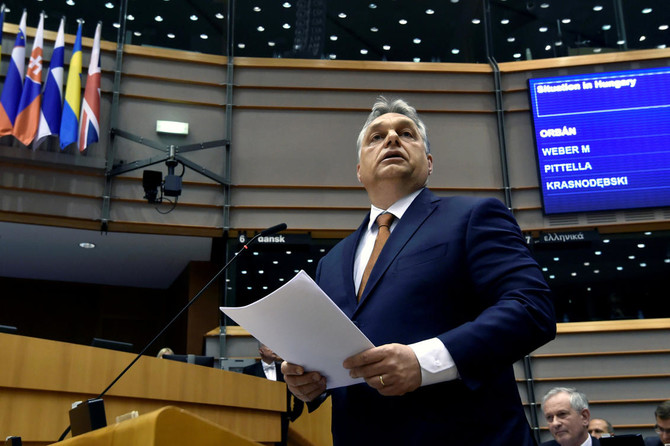
European Parliament raps Hungary on rights, eyes sanctions process
European Parliament raps Hungary on rights, eyes sanctions process
Latest updates





© 2026 SAUDI RESEARCH & PUBLISHING COMPANY, All Rights Reserved And subject to Terms of Use Agreement.