BEIRUT: A new round of Syrian peace talks opens in Geneva on Tuesday, overshadowed by a competing process in Astana and with the opposition reeling from a major setback in Damascus.
Since it broke out in March 2011, Syria’s conflict has killed more than 320,000 people, displaced millions and ravaged the country’s economy and infrastructure.
Efforts to end the war are now proceeding along two rival tracks: the formal political peace process hosted at United Nations headquarters in Geneva and, since January, parallel talks in Kazakhstan brokered by Russia, Iran and Turkey.
Observers say the UN appears to be scrambling to match Astana’s momentum after a landmark deal signed in Kazakhstan on May 4 that would create four “de-escalation” zones across some of Syria’s bloodiest battlegrounds.
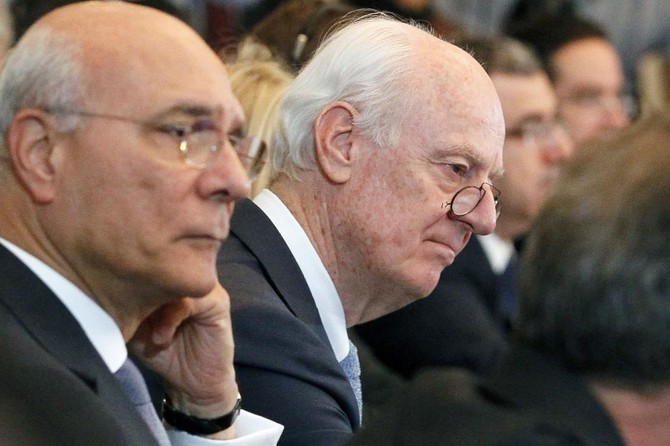
UN special envoy Staffan de Mistura however stressed to reporters on Monday that the Geneva talks were working “in tandem” with the Astana process.
He has said the upcoming talks, which are expected to last just four days, aimed to “hit the iron while it’s hot,” with the hope that de-escalation on the ground can help push forward toward “a political horizon.”
Since the Astana deal came into effect a week ago, fighting has slowed across swathes of the country.
But in Damascus, which is not included in the deal, the regime has secured the evacuation of three opposition-held districts, bringing it closer to exerting full control over the capital for the first time since 2012.
Numerous rounds of UN-backed talks have fallen short of producing concrete results, although during the last round in March the sides finally began discussing four separate “baskets” of issues: governance, a new constitution, elections and combating “terrorism” in the war-ravaged country.
Aron Lund, a fellow at The Century Foundation, said that despite Geneva’s important “symbolic value, it isn’t moving forward in any visible way.”
“In practice, the Geneva track has largely been sidelined by the Astana track, at least for now,” Lund said.
Delegations were arriving in Geneva on Monday, a day before the talks start.
The Syrian regime team will be headed once again by its UN ambassador Bashar Al-Jaafari.
The opposition delegation will be represented by the Riyadh-based High Negotiations Committee and led again by Nasr Al-Hariri and Mohammad Sabra.
The HNC has continued to call for the ouster of President Bashar Assad as part of a political transition, a demand seen as a non-starter by the Syrian regime.
“By design, the Geneva process revolves around this dead-end demand for a negotiated transition,” Lund told AFP.
“In terms of actually trying to stabilize Syria, the main effect of pegging peace to transition has been to marginalize the UN in Geneva and shift attention to Astana instead,” he said.
Opposition backer Turkey and regime allies Russia and Iran sponsored the first talks in Astana in late January to reinforce a faltering cease-fire.
They have since returned for several meetings, culminating this month in the safe zones deal.
Assad has brushed off the upcoming Geneva negotiations as “merely a meeting for the media.”
“There is nothing substantial in all the Geneva meetings. Not even one per million. It is null,” Assad said in a recent interview with Belarus’s ONT channel.
“As to Astana, the situation is different... This started to produce results,” Assad said.
De Mistura on Monday downplayed Assad’s comments, pointing out that the Syrian president had sent a large, high-level delegation to Geneva, and “they are empowered to serious discussions and they are here to work.”
He said his dealings with the regime delegation had been “much more substantive than just those general comments that are made for the cameras.”
Syrian peace efforts have also been marked in recent months by Washington’s all-but withdrawal from the process under President Donald Trump.
The previous US administration, in particular then-secretary of state John Kerry, was deeply involved in the Geneva process but since Trump took office Washington has played little apparent role.
But de Mistura said Monday he was “encouraged by the increasing engagement, the increasing interest, by the US administration in finding a de-escalation.”


![]()
Syria talks open overshadowed by rival track, opposition losses
Syria talks open overshadowed by rival track, opposition losses
Latest updates


© 2026 SAUDI RESEARCH & PUBLISHING COMPANY, All Rights Reserved And subject to Terms of Use Agreement.