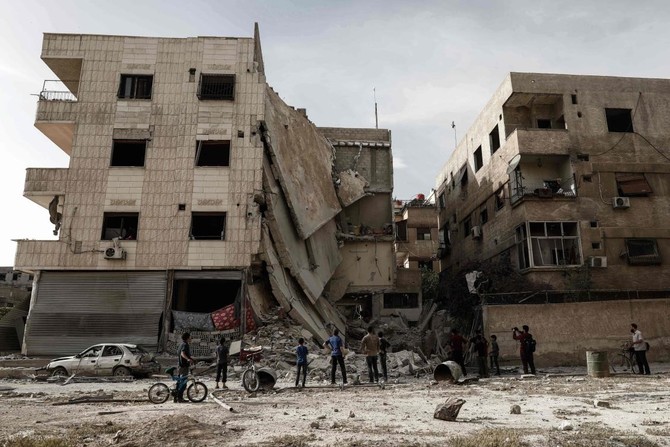
LEBANON: Syria’s regime is close to cementing its control over the entire capital under local deals with rebels after a six-year war that has ravaged suburbs of Damascus and caused population displacements.
Rebels have evacuated some of the last Damascus districts under their control, shattering their dream of one day seizing the capital and toppling a five-decade-old regime.
Over 2,000 civilians and rebels evacuated the Qabun district on Sunday, after similar departures from the Barzeh and Tishrin neighborhoods earlier last week.
“With the seizure of these three neighborhoods, the regime now controls almost all the capital,” said Rami Abdel Rahman, head of the Syrian Observatory for Human Rights monitoring group.
In the east of the capital, “the rebels now only hold a part of the Jobar district, most of which is destroyed,” he said.
In the south, the Tadamun and Hajar Al-Aswad neighborhoods as well as the Palestinian refugee camp of Yarmuk are now mostly controlled by jihadists including the Daesh group, he said.
The so-called reconciliation deals that led to the latest evacuations from the capital have dealt a heavy blow to the armed opposition, following their defeat in the northern city of Aleppo in December.
“With Aleppo retaken and Damascus about to be, the rebels no longer present a political or military alternative,” said Syria expert Fabrice Balanche.
“The regime is therefore not under any threat and doesn’t need to make any concessions,” added Balanche, a visiting fellow at The Washington Institute think-tank.
For President Bashar Assad, regaining control of the capital was vital to retain power after anti-government protests that began in 2011 before spiralling into civil war.
His fortunes have sharply reversed since July 2012, when thousands of rebels seized several of the capital’s neighborhoods before a two-week counteroffensive by elite regime troops repelled them.
More recently, in March, rebel groups and jihadists from former Al-Qaeda affiliate Fateh Al-Sham Front briefly entered Abbassid Square near the city center in a surprise assault from Jobar, before being pushed back days later.
But the capital, with its approximately 1.6 million inhabitants, has largely been insulated from the civil war and has endured far less destruction than other major hubs such as Aleppo and the city of Homs in northern Syria.
“The regime was reinforced by Russian and Iranian foreign troops at the expense of a defenseless people,” said Mohammed Alloush, head of Jaish Al-Islam, the most powerful rebel faction in the opposition-held Eastern Ghouta area outside Damascus.
He said the population displacements caused by the local reconciliation deals amounted to “crimes against humanity.”
“The regime now plans to swallow up Jobar in the next phase before setting its sights on Eastern Ghouta,” Alloush said.
He said the evacuations were a “betrayal” after backers of the regime and rebels signed a deal in the Kazakh capital earlier this month aimed at paving the way toward a lasting cease-fire in Syria.
On May 4, regime allies Russia and Iran and rebel backer Turkey inked a deal to introduce so-called “de-escalation zones” in the country.
Under the deal, four zones are to be created in the northwestern province of Idlib, parts of the central province of Homs, the south, and the opposition enclave of Eastern Ghouta near Damascus.
The capital is not included in the plan.
The regime has long touted “reconciliation deals” as the best way to end the conflict and views the latest evacuations as a success.
“It’s a turning point in the conflict,” said government adviser on national reconciliation Ahmad Munir Mohammed.
“It’s a victory for the Syrian state,” he added. “Reconciliation is a defeat for those waging war against Syria.”
He denied that the deals were changing the country’s demographics.
“Those who wanted to regularise their status (with the regime) stayed, and those who left did so at their request,” he said.
Syria analyst Joshua Landis said the evacuations underlined that “the suburbs of Damascus cannot hold out against the regime.”
He said the intervention of the Lebanese movement Hezbollah in support of the Assad regime in 2013 “doomed the Damascus rebel offensive” by severing supply routes from neighboring Lebanon.
“The regime and its allies cut the legs out from underneath the Damascene rebels,” said Landis, director of the Center for Middle East Studies at the University of Oklahoma.
Aron Lund, a fellow at The Century Foundation, said the army taking control of the three Damascus districts would weaken the armed opposition in Eastern Ghouta.
“The long-term situation of the rebels there looks very bleak,” he said.
“Qabun, Barzeh and Tishrin, which are now being retaken by the army, have contained smuggling tunnels that supplied Eastern Ghouta,” he said.
“Without those tunnels, the Ghouta rebels will be weakened and the government will have more leverage over them.”


![]()
Syria regime nears total recapture of Damascus
Syria regime nears total recapture of Damascus
Latest updates


© 2026 SAUDI RESEARCH & PUBLISHING COMPANY, All Rights Reserved And subject to Terms of Use Agreement.