

Tunisia seeks UNESCO status for Jewish pilgrimage isle

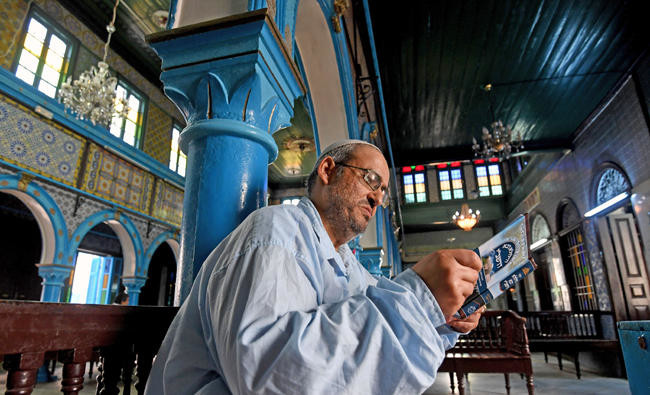
Tunisian Rabbi Daoud reads the torah at the Ghriba Synagogue on the Tunisian resort island of Djerba on May 14, 2017 during the second day of the annual Jewish pilgrimage to the synagogue thought to be Africa's oldest. (AFP / FETHI BELAID)
Updated 15 May 2017
Follow

Tunisia seeks UNESCO status for Jewish pilgrimage isle

DJERBA, Tunisia: Tunisia plans to seek UNESCO World Heritage status for the island of Djerba, site of Africa’s oldest synagogue and an annual Jewish pilgrimage, its culture minister said on Sunday.
Speaking on the last day of the pilgrimage to the Ghriba synagogue, Mohamed Zine El-Abidine said the island was important for its “cultural and religious uniqueness.”
He said the application to add Djerba to the World Heritage List would highlight the rich religious heritage of the island, which is home to centuries-old mosques, churches and synagogues.
He did not give a specific time frame for the application.
The cultural agency of the United Nations already lists eight sites in the North African country, including the old cities of Tunis and Sousse and the city of Carthage, once the capital of the Mediterranean-wide Phoenician empire.
Some 3,000 pilgrims attended this year’s Jewish pilgrimage to the island, which ended Sunday under tight security following a string of jihadist attacks in Tunisia.
“There has been a real increase compared to the past two years,” Tourism Minister Selma Elloumi said.
“It is an important sign for the start of the tourist season,” she added.
The number of pilgrims visiting the synagogue has fallen sharply since a suicide bombing claimed by Al-Qaeda struck Ghriba just before the 2002 pilgrimage, killing 21 people.
Before then the event attracted as many as 8,000 pilgrims a year.
Believed to have been founded in 586 BC by Jews fleeing the destruction of the Temple of Solomon in Jerusalem, the Ghriba synagogue has long been a destination for pilgrims, especially for Jews of Tunisian descent.

Around 1,500 Jews live in Tunisia today, down from an estimated 100,000 before the country won independence from France in 1956.
Many of today’s pilgrims came from Europe, the United States and Israel.
Prime Minister Youssef Chahed was in Ghriba on Sunday to deliver what he called “a double message.”
“Firstly... Tunisia is a country several thousand years old, with a deep-rooted history of openness to all religions,” he told AFP.
Secondly, he said, “security has come back to Tunisia.”
Rocked by instability since the fall in 2011 of longtime dictator Zine El Abidine Ben Ali, Tunisia was hit by a series of jihadist attacks in 2015 and 2016 that left dozens dead, including 59 tourists.
The country’s key tourism sector, devastated by the attacks, has since registered a rise in visitor numbers.
According to Elloumi, there has been a 34 percent rise in tourist arrivals from Europe over the past year.


Israel accused of move expanding Jerusalem borders for first time since 1967

Updated 4 sec ago
Follow

Israel accused of move expanding Jerusalem borders for first time since 1967

  • Planned development is formally a westward expansion of the Geva Binyamin, or Adam, settlement situated north-east of Jerusalem in the West Bank
  • Some 200,000 Israelis live in Israeli-annexed east Jerusalem, while more than 500,000 others live in West Bank settlements and outposts
JERUSALEM: Israeli NGOs have raised the alarm over a settlement plan signed by the government which they say would mark the first expansion of Jerusalem’s borders into the occupied West Bank since 1967.
Israel has occupied east Jerusalem since 1967 and later annexed it in a move not recognized by the international community.
Palestinians view east Jerusalem as the capital of their future state.
The proposal, published in early February but reported by Israeli media only on Monday, comes as international outrage mounts over creeping measures aimed at strengthening Israeli control over the West Bank.
Critics say these actions by the Israeli authorities are aimed at the de facto annexation of the Palestinian territory.
The planned development, announced by Israel’s Ministry of Construction and Housing, is formally a westward expansion of the Geva Binyamin, or Adam, settlement situated north-east of Jerusalem in the West Bank.
In a statement, the ministry said the development agreement included the construction of around 2,780 housing units for the settlement, with an investment of roughly 120 million Israeli shekels (around $38.7 million).
But the area to be developed lies on the Jerusalem side of the separation barrier built by Israel in the early 2000s, while Geva Binyamin sits on the West Bank side of the barrier, and the two are separated by a road.
In a statement, Israeli settlement watchdog Peace Now said there would be no “territorial or functional connection” between the area to be developed and the settlement.
“The new neighborhood will be integral to the city of Jerusalem,” Lior Amihai, Peace Now’s executive director, told AFP.
“What is unique about that one is that it will be connected directly to Jerusalem, but it will be beyond the annexed municipal border. So it will be in complete West Bank territory, but just adjacent to Jerusalem,” he said.

‘Living there as Jerusalemites’

The move comes days after Israel’s government approved a process to register land in the West Bank as “state property,” drawing widespread international condemnation and fears among critics that it would accelerate annexation of the Palestinian territory.
Days earlier, Israel’s security cabinet approved a series of measures to tighten control over areas of the West Bank administered by the Palestinian Authority under the Oslo accords.
Those measures, which also sparked international backlash, include allowing Jewish Israelis to buy West Bank land directly and allowing Israeli authorities to administer certain religious sites in areas under the Palestinian Authority’s control.
Amihai said that the current government — one of the most right-wing in Israel’s history — was “systematically working to annex the occupied territories and to prevent Palestinian statehood.”
The case of Jerusalem, he said, was particularly symbolic.
“Every change to Jerusalem is sensitive to both the Israeli public, but also to the Palestinians,” he told AFP.
Aviv Tatarsky, a researcher at Ir Amim, an Israeli NGO focusing on Jerusalem within the context of the Israeli-Palestinian conflict, said the latest planned development amounted to a de facto expansion of the city of Jerusalem.
“If it is built, and people live there, the people who will live there, they will be living there as Jerusalemites,” he told AFP.
“In all practical terms, it’s basically not the settlement that will be expanded, but Jerusalem.”

‘Facts on the ground’

The development agreement was signed by Israel’s Construction and Housing Ministry, the Finance Ministry and the Binyamin Regional Council, which represents settlements north of Ramallah in the central West Bank.
It has yet to be reviewed by the Civil Administration’s Higher Planning Committee, in a process which could take several months or years.
Tatarsky said that international pressure had so far made it difficult for recent Israeli governments to make formal declarations on annexation.
“It’s much easier to create facts on the ground, which, altogether... actually add up to annexation,” the researcher said.
The West Bank, occupied since 1967, would form the largest part of any future Palestinian state but is seen by many on the religious right as Israeli land.
Some 200,000 Israelis live in Israeli-annexed east Jerusalem, while more than 500,000 others live in West Bank settlements and outposts, which are illegal under international law.
Around three million Palestinians live in the territory.
The current Israeli government has fast-tracked settlement expansion, approving a record 52 settlements in 2025.
