

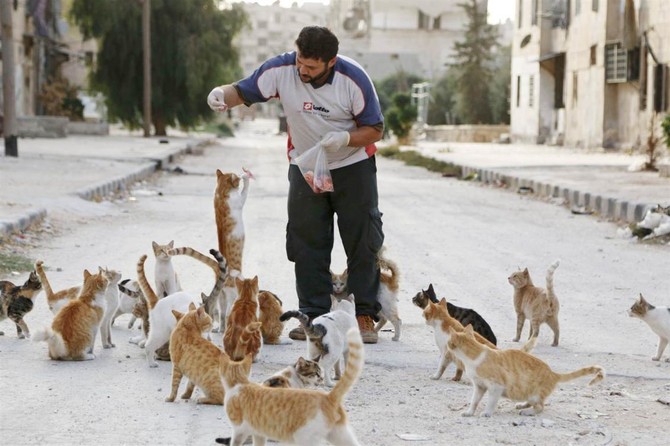
JEDDAH: Those who have little, give the most. This is the case with the Syrian “cat man” who turned his house into a shelter for stray cats in war-torn Aleppo.
Unlike many Syrian families who fled the country after war broke out, Mohammad Alaa Aljaleel, 42, chose to remain and take care of the less fortunate felines affected by the war.
“I’ll stay with them no matter what happens. Someone who has mercy in their heart for humans, has mercy for every living thing,” said Aljaleel.
Aljaleel once had six or seven hungry critters, but soon the pride grew to 170 in no time, where he built a sanctuary in 2015 and named it after his first cat “Ernesto’s House.”
Aljaleel is known as the “Cat Man of Aleppo” for caring for his feline friends, protecting, feeding and keeping them as healthy as possible.
Although cats had the lion’s share of Aljaleel’s care, children were also recipients of his kindness, as he used to open his house to schoolchildren who come to visit the sanctuary.
“All the schools and the children used to come and visit the sanctuary,” he said. “They would see the huge amount of cats that were left behind by their owners.”
Instead of abandoning their beloved pets, families who planned to flee the country would pass by his house and leave them in his good hands before their journey toward a safe haven starts.
Ernesto’s House was also targeted by bombs, which hit his town in November turning it into rubble, and most of his cats perished.
He was forced to flee the city with a handful of survivors.
But the story does not end here. Aljaleel was stubborn enough to start over and rebuild his shelter again from scratch. The entire process to move to the countryside west Aleppo took him 15 days.
Aljaleel shares his daily routine with his fur-babies on his Facebook page, which has gained followers from different countries around the world.
According to NBC News, some people in Spain and the United States have donated money and started fundraising campaigns to help him out with his new sanctuary.
Father of cats , and our cat Ernesto the Knight#specialfromHouseofcatsErnestoinAleppo pic.twitter.com/fv4GgxXtLT
— Il Gattaro D' Aleppo (@theAleppoCatman) November 14, 2016
The inspiring story of this Syrian man who, somehow, could overcome his loss to help the helpless affected his personal life. He ended up separating from his wife as the pressure grew between them as a result of his endeavor.
His family, a wife and two children, now resides in Turkey, where visits them from time to time.
“I hope my children one day will understand what their father was doing,” Aljaleel said. “And that the world will repay them with the same kindness and mercy I’ve given to these animals and humans in need.”
— Il Gattaro D' Aleppo (@theAleppoCatman) October 25, 2016
After the destruction that hit his old shelter, Aljaleel’s new house now has around 25 cats.
According to Aljaleel, the shelter is more than just a cat sanctuary.
“It seeks to erase the war from children’s minds,” he said. “Caring for the cats is a gateway to bringing good will to the country and build it around being more merciful.”


