 NEW YORK: When Palestinian President Mahmoud Abbas met with his US counterpart Donald Trump at the White House in early May, he praised the latter’s “negotiating abilities” and told him: “With you, we have hope.”
This optimism will add to the high Palestinian expectations of Trump’s upcoming visit to Israel, and his vow to achieve peace between Arabs and Israelis.
Trump fueled this optimism when he said: “We will get it done. We will be working so hard to get it done.”
He is not the first US president to want to achieve peace between Palestinians and Israelis. Countless negotiating hours have led to agreements, accords, understandings and roadmaps, but not to peace.
One of the most enduring agreements was the Oslo Accords, which led to the creation of the Palestinian Authority and was the first bilateral Israeli-Palestinian peace agreement.
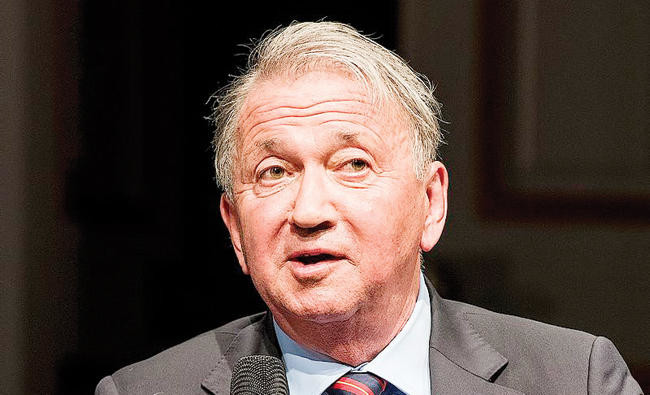
Arab News met the architect of the Oslo talks, Terje Rod-Larsen in New York and asked what the Trump negotiating team can learn from the accords.
“Parts of the model we used in Oslo in 1993 wouldn’t fit the challenges of today, because an Arab-Israeli or Palestinian-Israeli peace agreement has little chance of succeeding unless the key regional and international players are involved,” he said.
“A broker has to come to conduct bilateral negotiations with the regional players — Egypt, Jordan, Morocco and the key Gulf states — and also top international players — the US, Russia, EU and UN — to get a broad consensus on the parameters of an agreement that could lead to a major peace agreement.”
He added: “This will be critically dependent on pre-negotiations with the key players. To move straight to an international conference without pre-negotiations and clear understandings of what’s possible would lead nowhere.”
He said: “The US can’t do it alone. It must play a leading role, but it will be critically dependent on creating an alliance with other key players in the region.”
On whether the weakened Palestinian and Arab position in the region is conducive to pressuring Israel to come to the negotiating table, he said: “There’s one very important element, that the perception of Israel and some Sunni Arab countries is very similar toward Iran’s activities in various theaters of conflict in the region. This could lead, if handled correctly, to necessary compromises and a win-win situation.”
He added: “Looking at the regional picture, the lack of institutional arrangements in the region is counter-productive to conflict-resolution. In all regions of the world, countries that are adversaries are members of regional organizations where there are mechanisms for conflict-resolution and platforms to voice their disagreements and seek compromises. The MENA (Middle East and North Africa) region is the least coordinated, integrated and organized in the world. This vacuum invites conflict. There’s no organization in the region that encompasses all key Arab states, Turkey, Iran and Israel. It’s high time this is corrected.”
In answer to a question on how Arab states can sit with countries that occupy Arab land, such as Israel and Iran, he said: “The Europeans are members of the same organizations as Russia, and at the same time they have major conflicts with Russia. Conflict-prevention is based on getting enemies together, not friends.”
He added: “There’s no solution but a two-state solution, because a binational state between Jews and Palestinians is inviting eternal conflict. Many would say the two-state solution is dead, but if the regional and international parties could find a formula for a reasonable two-state solution, it would get massive support from the Israeli and Palestinian sides.”
Regarding this conflict, “you don’t need any new plans, all the plans are on the table. Everybody knows what the painful compromises are. Finding a way isn’t a great intellectual challenge, it’s a challenge of political will.”
On whether Israeli Prime Minister Benjamin Netanyahu has the political will, Rod-Larsen said: “If it goes to the table invited by Trump, and is handled in a sensible way, Netanyahu has a chance to prove what he said publicly about a two-state solution. He said it, so implement it.”
Rod-Larsen said the Arab Peace Initiative “could provide a robust platform for starting new peace talks, because the principles in it are still valid.”
On Trump’s optimism that reaching peace is easy and can be done, he said: “It’s possible to reach an agreement, but it has to be done in a skillful way. I applaud the intent and the attempt to restart negotiations. So far in this field, Trump has said and done the right things. The challenge is how to implement it, and that’s a tall order.”
Rod-Larsen’s advice to Jared Kushner, whom Trump said will oversee Palestinian-Israeli peace efforts, is: “You need an inclusive regional approach on a parallel basis, with dialogue with the parties. For a long-term solution, and to create the necessary political context for a viable and longstanding peace, you need regional institutions for conflict-resolution.” Can main obstacles such as Jerusalem and settlements be solved? “Yes they can.”


![]()
Israeli-Palestinian peace still possible, says Oslo Accords architect
Israeli-Palestinian peace still possible, says Oslo Accords architect


Latest updates


© 2026 SAUDI RESEARCH & PUBLISHING COMPANY, All Rights Reserved And subject to Terms of Use Agreement.