WASHINGTON: China will finally open its borders to US beef while cooked Chinese poultry is closer to hitting the American market as part of a US-China trade agreement.
Trump administration officials hailed the deal as a significant step in their efforts to boost US exports and narrow America’s trade gap with the world’s second-largest economy.
The US would also allow American companies to ship liquefied natural gas (LNG) to China as part of the bilateral agreement reached following President Donald Trump’s meeting with Chinese President Xi Jinping in April. The agreement covers a number of long-standing barriers in areas ranging from agriculture to energy to the operation of American financial firms in China.
Commerce Secretary Wilbur Ross hailed the agreement as “a herculean accomplishment” forged in record time.
“This is more than has been done in the whole history of US-China relations on trade,” Ross told reporters Thursday evening at the White House. “Normally trade deals are denominated in multiple years, not tens of days.”
“The key in these negotiations is specifics that are enforceable — literally the devil is in the details,” said Scott Mulhauser, the former chief of staff at the US Embassy in Beijing.
“The more these agreements include real, concrete outcomes rather than platitudes, rehashing old ground or punts to the future, the better they are. American companies, workers, farmers and more are eager for more access to Chinese markets and they will look to ensure reality matches the rhetoric of these promises,” Mulhauser said.
Under the agreement, the US would welcome Chinese companies negotiating agreements to purchase US-produced LNG. The Energy Department has already authorized the shipment of 19.2 billion cubic feet per day (bcfd) of natural gas exports to China and other interested countries, the Commerce Department said.
China is attempting to turn to natural gas as a way to reduce its dependence on coal and combat the country’s extensive air pollution. The move would allow China to diversify its supply and provide a significant market for American suppliers — though the expansion could boost prices for US consumers.
Ross downplayed the impact, pointing to the decline in natural gas prices. “If you look at it on a historical basis, there is plenty of room to go back up,” he said. “It is not as though this is going to wreck anybody’s pocketbook.”
The agreement would also ease import restrictions on agricultural goods, including ending China’s restrictions on beef imports. China imposed a ban on American beef in 2003 after a case of mad-cow disease, a ban that has remained in place despite extensive efforts by the Bush and Obama administrations to get it removed.
In exchange, the US would allow the sale of cooked Chinese poultry — a move Ross said could be done safely. “We do not intend to endanger anybody’s health or safety in the US,” he said.
The agreement would also streamline the evaluation of pending US biotechnology product applications; pave the way for allowing American-owned suppliers of electronic payment services to begin licensing processes in China; and facilitate the entrance of Chinese banks into the US banking market, among other measures.
The agreement grew out of negotiations both countries agreed to start after Trump’s meeting at his Mar-a-Lago estate in Florida with the Chinese president. The areas dealt with in the initial agreement represent export opportunities that American companies have long sought.
America’s trade deficit in goods and services with China totaled $310 billion last year, by far the largest imbalance with any country. The deficit with China represented about 60 percent of the total US deficit last year of $500.6 billion.
The two countries have also agreed to hold high-level talks this summer to be led by Ross, Treasury Secretary Steven Mnuchin and Chinese Vice Premier Wang Yang to work on a one-year plan.


China agrees to open market to US beef, gas
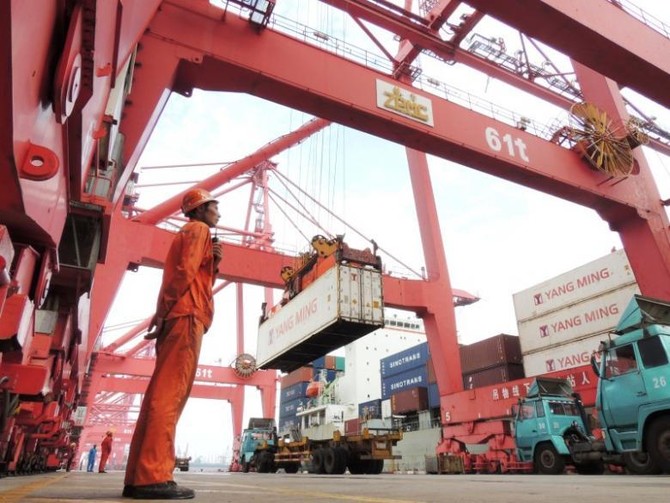
China agrees to open market to US beef, gas

New Murabba seeks contractors for Mukaab Towers fit-outs: MEED
RIYADH: Saudi Arabia’s New Murabba Development Co., a wholly owned subsidiary of the Public Investment Fund, has issued a request for information to gauge the market for modular and offsite fit-out solutions for its flagship Mukaab development, MEED reported on Wednesday.
The RFI was released on Jan. 26, with submissions due by Feb. 11. NMDC has also scheduled a market engagement meeting during the first week of February to discuss potential solutions with prospective contractors.
Sources close to the project told MEED that NMDC is “seeking experienced suppliers and contractors to advise on the feasibility, constraints, and execution strategy for using non-load-bearing modular systems for the four corner towers framing the Mukaab structure.” The feedback gathered from these discussions will be incorporated into later design and procurement decisions.
The four towers — two residential (North and South) and two mixed-use (East and West) — are integral to the Mukaab’s architectural layout. Each tower is expected to rise approximately 375 meters and span over 80 stories. Key modular elements under consideration include bathroom pods, kitchen pods, dressing room modules, panelized steel partition systems, and other offsite-manufactured fit-out solutions.
Early works on the Mukaab were completed last year, with NMDC preparing to award the estimated $1 billion contract for the main raft works. This was highlighted in a presentation by NMDC’s chief project delivery officer on Sept. 9, 2025, during the Future Projects Forum in Riyadh.
Earlier this month, US-based Parsons Corp. was awarded a contract by NMDC to provide design and construction technical support. Parsons will act as the lead design consultant for infrastructure, delivering services covering public buildings, infrastructure, landscaping, and the public realm at New Murabba. The firm will also support the development of the project’s downtown experience, which spans 14 million sq. meters of residential, workplace, and entertainment space.
The Parsons contract follows NMDC’s October 2025 agreements with three other US-based engineering firms for design work across the development. New York-headquartered Kohn Pedersen Fox was appointed to lead early design for the first residential community, while Aecom and Jacobs were selected as lead design consultants for the Mukaab district.
In August 2025, NMDC signed a memorandum of understanding with Falcons Creative Group, another US-based firm, to develop the creative vision and immersive experiences for the Mukaab project. Meanwhile, Beijing-based China Harbour Engineering Co. completed the excavation works for the Mukaab, and UAE-headquartered HSSG Foundation Contracting executed the foundation works.


