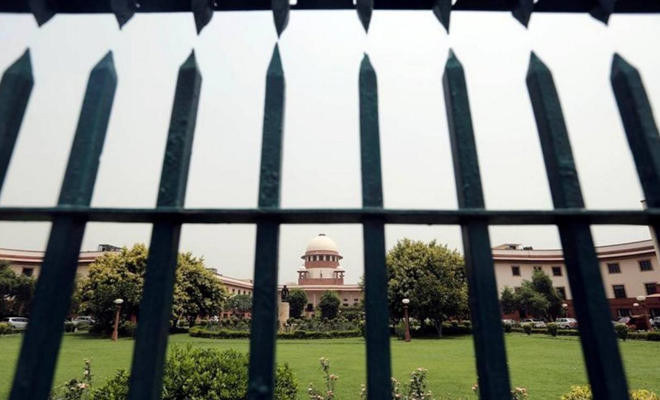
MUMBAI: India’s top court on Thursday began examining whether it was legal for a Muslim man to dump his wife by saying “I divorce you” three times, raising hopes among women campaigners of a long-awaited end to the ‘quickie’ divorce.
The practice of “triple talaq” is banned in most Muslim countries but allowed under India’s constitution that lets most religions, including Muslims — the biggest religious minority — regulate matters like marriage and divorce through civil codes.
But the Islamic instant divorce has come under increasing criticism as unconstitutional by violating the right to equality. Reports have emerged of men divorcing their wives via Skype, WhatsApp and text message, leaving families destitute.
Muslim women in India have demanded a ban to triple talaq with several women petitioning the nation’s top court, the Supreme Court, to overturn the practice.
Conservative Muslim clerics staunchly oppose any change.
At the hearing on Thursday, five multi-faith judges of the Supreme Court started to determine whether triple talaq is part of a fundamental religious right for Muslims.
“If we come to a conclusion that triple talaq is part of (the) fundamental right to religion, we would not interfere,” the judges were quoted as saying by The Times of India.
Local media said the Supreme Court has set aside six days for the hearing — half for those challenging triple talaq and half in defense — with the hearing expected to end by May 19.
The national Law Commission last year sought public views on whether to abolish the practice, triggering a debate between politicians and religious leaders.
More than 90 percent of Muslim women surveyed in 2015 by Bharatiya Muslim Mahila Andolan (BMMA), which campaigns for women’s rights, wanted an end to triple talaq and polygamy.
Noor Jehan from BMMA said they wanted the Supreme Court to rule triple talaq was illegal and unconstitutional, with many women left without support after such a divorce.
“Thousands of Muslim women have been suffering for long and they will welcome it if the court ends this practice of unilateral divorce,” she told the Thomson Reuters Foundation
The All India Muslim Personal Law Board (AIMPLB), a non-governmental body which oversees the application of Muslim personal law, opposes any ban on triple talaq and argues this is a religious matter and not for the courts.
But Prime Minister Narendra Modi disagrees and last year waded into a controversy by saying he believed it was destroying women’s lives, with Muslims making up about 13 percent of the country’s 1.2 billion people.
“It is the responsibility of the government and people of the country to give justice to Muslim women,” Modi said at a rally in Mahoba last year.

India’s top court reviews Muslim women's petition to ban instant 'triple talaq' divorce
Mexican army kills leader of powerful Jalisco New Generation Cartel during operation to capture him
- The killing of the powerful drug lord set off several hours of roadblocks with burning vehicles in Jalisco and other states
MEXICO CITY: The Mexican army killed the leader of the Jalisco New Generation Cartel, Nemesio Rubén Oseguera Cervantes, “El Mencho, ” on Sunday, decapitating what had become Mexico’s most powerful cartel and giving the government its biggest prize yet to show the Trump administration its efforts.
Oseguera Cervantes was wounded in an operation to capture him Sunday in Tapalpa, Jalisco about a two-hour drive southwest of Guadalajara and he died while being flown to Mexico City, the Defense Department said in a statement. The state is the base of the cartel known for trafficking huge quantities of fentanyl and other drugs to the United States.
During the operation, troops came under fire and killed four people at the location. Three more people, including Oseguera Cervantes, were wounded and later died, the statement said. Two others were arrested and armored vehicles, rocket launchers and other arms were seized. Three members of the armed forces were wounded and receiving medical treatment.
Roadblocks and burning vehicles
The killing of the powerful drug lord set off several hours of roadblocks with burning vehicles in Jalisco and other states. Such tactics are commonly used by the cartels to block military operations. Jalisco canceled school in the state for Monday.
Videos circulating on social media showed plumes of smoke billowing over the tourist city of Puerto Vallarta in Jalisco, and people sprinting through the airport of the state’s capital in panic. On Sunday afternoon, Air Canada announced it was suspending flights to Puerto Vallarta “due to an ongoing security situation” and advised customers not to go to their airport.
In Guadalajara, the state capital, burning vehicles blocked roads. Mexico’s second-largest city is scheduled to host matches during this summer’s soccer World Cup.
The US State Department warned US citizens in Jalisco, Tamaulipas, Michoacan, Guerrero and Nuevo Leon states to remain in safe places due to the ongoing security operations. Canada’s embassy in Mexico warned its citizens in Puerto Vallarta to shelter in place and generally to keep a low profile in Jalisco.
Jalisco Gov. Pablo Lemus told residents to stay at home and suspended public transportation.
US had offered up to $15 million for his capture
The US State Department had offered a reward of up to $15 million for information leading to the arrest of El Mencho. The Jalisco New Generation Cartel, known as CJNG, is one of the most powerful and fastest growing criminal organizations in Mexico and was born in 2009.
In February, the Trump administration designated the cartel as a foreign terrorist organization.
Mexican President Claudia Sheinbaum, like her predecessor, has criticized the “kingpin” strategy of previous administrations that took out cartel leaders only to trigger explosions of violence as cartels fractured. While she has remained popular in Mexico, security is a persistent concern and since US President Donald Trump took office a year ago, she has been under tremendous pressure to show results against drug trafficking.
Known as aggressive cartel
The Jalisco cartel has been one of the most aggressive cartels in its attacks on the military — including on helicopters — and is a pioneer in launching explosives from drones and installing mines. In 2020, it carried out a spectacular assassination attempt with grenades and high-powered rifles in the heart of Mexico City against the then head of the capital’s police force and now federal security secretary.
The DEA considers the cartel to be as powerful as the Sinaloa cartel, one of Mexico’s most infamous criminal groups, with a presence in all 50 US states. It is one of the main suppliers of cocaine to the US market and, like the Sinaloa cartel, earns billions from the production of fentanyl and methamphetamines. Sinaloa, however, has been weakened by infighting after the loss of its leaders Ismael “El Mayo” Zambada and Joaquín “El Chapo” Guzmán, both in US custody.
Oseguera Cervantes, 59, was originally from Aguililla in the neighboring state of Michoacan. He had been significantly involved in drug trafficking activities since the 1990s. When he was younger, he migrated to the US where he was convicted of conspiracy to distribute heroin in the US District Court for the Northern District of California in 1994 and served nearly three years in prison.
Following his release from custody, Oseguera Cervantes returned to Mexico and reengaged in drug trafficking activity with drug lord Ignacio Coronel Villarreal, alias “Nacho Coronel.” After Villarreal’s death, Oseguera Cervantes and Erik Valencia Salazar, alias “El 85”, created the Jalisco New Generation Cartel around 2007.
Initially, they worked for the Sinaloa Cartel, but eventually split and for years the two cartels have battled for territory across Mexico.
Indicted several times in the United States
Since 2017, Oseguera Cervantes has been indicted several times in the United States District Court for the District of Columbia.
The most recent superseding indictment, filed on April 5, 2022, charges Oseguera Cervantes with conspiracy and distribution of controlled substances (methamphetamine, cocaine, and fentanyl) for the purpose of illegal importation into the United States and use of firearms during and in connection with drug trafficking offenses. Oseguera Cervantes is also charged under the Drug Kingpin Enforcement Act for directing a continuing criminal enterprise.
Last year, people searching for missing relatives founds piles of shoes and other clothing, as well as bone fragments at what authorities later said was a Jalisco cartel recruitment and training site.