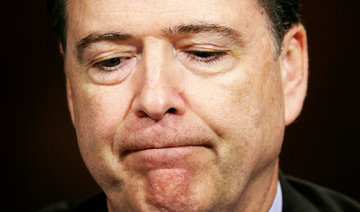
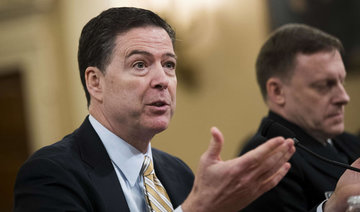
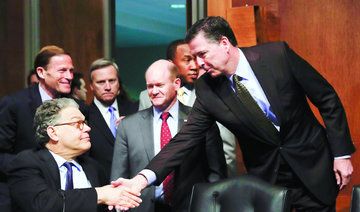
WASHINGTON: President Donald Trump defended his firing of FBI Director James Comey on Wednesday, fighting a storm of criticism that the ouster was aimed at blunting an agency probe into his presidential campaign’s possible collusion with Russia to sway the 2016 election.
The Republican president’s abrupt move on Tuesday stunned Washington and was swiftly condemned by Democrats and by some in his own party. Senior Democrats pressed for an independent investigation into the Russia issue.
In a series of posts on Twitter on Wednesday morning, Trump sought to explain his move and lambasted his critics.
“Comey lost the confidence of almost everyone in Washington, Republican and Democrat alike. When things calm down, they will be thanking me,” he said. “The Democrats have said some of the worst things about James Comey, including the fact that he should be fired, but now they play so sad!” he said.
The Trump administration said on Tuesday Comey’s firing was over his handling of an election-year FBI probe into then-Democratic presidential nominee Hillary Clinton’s use of a private e-mail server during her time as secretary of state.
Many Democrats have criticized Comey’s management of that investigation, but they sharply questioned the timing of his dismissal, given that Trump could have acted soon after taking office on Jan. 20 and that he has repeatedly criticized the FBI and congressional probes into alleged Russian involvement in the election.
Republicans control both chambers of Congress, and a growing number of Republicans also expressed doubts over Trump’s move. However, the Senate majority leader, Republican Mitch McConnell, ridiculed Democrats’ criticism, saying they were “complaining about the removal of an FBI director who they themselves repeatedly and sharply criticized.”
On the Senate floor, McConnell also dismissed Democratic calls for the Justice Department to appoint a special prosecutor to look into Moscow’s role in the 2016 election and possible ties between Trump associates and Russia. McConnell said a new investigation would “only serve to impede” existing probes such as one under way in the Senate intelligence committee.
The Senate’s minority leader, Democrat Chuck Schumer, said Deputy Attorney General Rod Rosenstein should appoint a special prosecutor, adding, “If there was ever a time when circumstances warranted a special prosecutor, it is right now.”
Schumer also called on McConnell to hold closed and potentially classified briefings with all US senators to question Attorney General Jeff Sessions and Rosenstein.
Schumer said such briefings should address why Sessions, who previously recused himself from involvement in the Russia investigation after misstating his own contacts in 2016 with Russia’s ambassador to Washington, was able to influence the firing of the man conducting the FBI’s Russia investigation.
“We know Director Comey was leading an investigation in(to) whether the Trump campaign colluded with the Russians, a serious offense. Were those investigations getting too close to home for the president?” Schumer said.
Vice President Mike Pence said Comey’s firing was unrelated to the Russia probe. Trump was in the process of evaluating candidates with “great integrity and great experience” to take over the FBI, Pence told reporters after meetings with lawmakers in the US Capitol.
US stocks were lower and Treasury benchmark yields retreated on Wednesday as Comey’s firing spurred some concern among investors that the fallout could hinder the president’s economic agenda.
'Constitutional crisis'
Some Democrats compared Trump’s move to the “Saturday Night Massacre” of 1973, in which President Richard Nixon ordered the firing of an independent special prosecutor investigating the Watergate scandal that eventually led Nixon to resign.
“What we have now is really a looming constitutional crisis that is deadly serious,” Democratic Senator Richard Blumenthal told CNN.
Trump hit back at Blumenthal in his Twitter messages, referring to him as “Richie,” calling his comments on the Comey firing “a joke” and alluding to a years-old controversy over the senator’s military service during the Vietnam War era.
Among Republicans expressing doubts about Comey’s dismissal, Senate Foreign Relations Committee Chairman Bob Corker, said, “The timing, obviously, it raises questions. I conveyed directly to the White House the need late last night to make sure they nominate someone (to replace Comey) that is absolutely beyond reproach.”
Republican Senator John McCain said on CNN he has not seen a “good explanation” for the firing, adding the Clinton e-mail investigation was not “sufficient rationale for removing the director of the FBI, and I regret that it’s happened.”
US intelligence agencies concluded in a January report that Russian President Vladimir Putin had ordered an effort to disrupt the 2016 election that included hacking into Democratic Party e-mails and leaking them, with the aim of helping Trump.
Russia has repeatedly denied any such meddling. The Trump administration denies allegations of collusion with Russia.
Lavrov visit
Russian Foreign Minister Sergei Lavrov is visiting Washington this week for high-level meetings, including one with Trump at the White House scheduled on Wednesday morning in what will be Trump’s highest-level contact with Putin’s government since he took office.
Asked by reporters at the US State Department before a meeting with Secretary of State Rex Tillerson if Comey’s firing would cast a shadow over the talks, Lavrov responded in a sarcastic tone: “Was he fired? You’re kidding. You’re kidding.”
The Kremlin said it hoped Comey’s firing would not affect Moscow’s ties with Washington, saying it believed his dismissal had nothing to do with Russia.
Legal experts said Trump’s dismissal of Comey does not mean the FBI’s Russia investigation will be disrupted or end, since career FBI staffers can continue the probe even as the search for a new director begins.
Comey’s deputy, Andrew McCabe, took over as acting FBI director while the White House looks for a new permanent director. Trump said in a tweet that Comey “will be replaced by someone who will do a far better job, bringing back the spirit and prestige of the FBI.”
(Reporting by Susan Heavey, Patricia Zengerle, David Morgan, David Alexander and Arshad Mohammed)