Jordan, US launch major military exercises

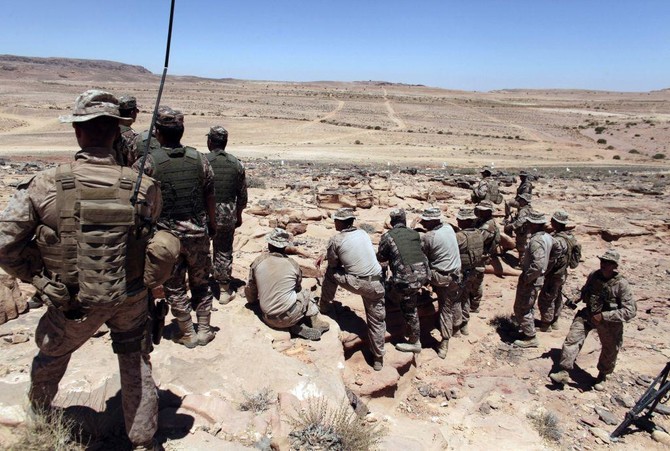
US Marines monitor Eager Lion multinational military maneuvers in Quweira, south of Amman, Jordan, on June 18, 2013. (AP)
Updated 07 May 2017
Follow

Jordan, US launch major military exercises

AMMAN: Jordan and the United States kicked off annual military exercises Sunday known as “Eager Lion,” with about 7,400 troops from more than 20 nations taking part, officials said.
US and Jordanian officials said the maneuvers would include border security, cyber defense, and “command and control” exercises, to bolster coordination in response to threats including terrorism.
“Joint efforts and coordination and the exchange of expertise... are needed at the time when the region is facing the threat of terrorism,” Jordanian Brig. Gen. Khalid Al-Shara, who will head the exercises, told reporters.
US Major General Bill Hickman, deputy commanding general for the American army in the region, said this year’s “Eager Lion” exercises — the seventh so far — are “the largest and most complex to date.”
The highlight of this year’s exercise, he said, will be that “for the first time ever a global strike mission” will be conducted by “two US Air Force B-1B bomber aircraft” — a long-range multi-mission bomber.
A statement by the Jordanian army said troops from Europe, Asia, Africa and the Arab Gulf region are taking part in the exercises which run to May 18, including from Britain, Japan, Kenya and Saudi Arabia.
About 6,000 troops from Jordan and the US took part in last year’s exercises — a joint operation first launched in 2011.
Jordan is a key recipient of US financial aid and a partner in the US-led coalition battling Daesh group jihadists in Syria and Iraq.
US forces have trained a small group of vetted Syrian rebels in Jordan, and American instructors have trained Iraqi and Palestinian security forces in Jordan as well over the past few years.
Two years ago, the United States announced its intention to increase overall US assistance to Jordan from $660 million to $1 billion annually for the 2015-2017 period.


North Korea and China to resume passenger train service after six-year gap

Updated 4 sec ago
Follow

North Korea and China to resume passenger train service after six-year gap

  • China’s railway ⁠authority said in a notice that Beijing-Pyongyang trains will operate four times a week
  • The resumption from March 12 will “further promote China-North Korea travel, trade and economic cooperation”

SEOUL/BEIJING: Tickets for the first passenger train in six years from Beijing to North Korea’s capital, Pyongyang, were sold out ahead of its March 12 departure, an official ticketing office in Beijing said on Tuesday.
The resumption of the rail service, suspended since the onset of the COVID-19 pandemic in 2020, revives a critical transport link between the largely isolated North Korea and its primary economic ally.
Tickets for ⁠the journey — restricted ⁠to travelers holding business visas — were purchased by entrepreneurs, government officials and reporters, according to the Beijing ticketing office. Tickets were still available for the next service, scheduled for March 18.

NORTH KOREA STILL LARGELY CLOSED TO TOURISTS
China’s railway ⁠authority said in a notice that Beijing-Pyongyang trains will operate four times a week in both directions on Monday, Wednesday, Thursday and Saturday while Dandong-Pyongyang trains will run daily.
The resumption from March 12 will “further promote China-North Korea travel, trade and economic cooperation, and people-to-people exchanges to enhance mutual well-being and friendship,” the notice said.
North Korea remains closed to most foreign tourism, with limited exceptions largely ⁠for Russian ⁠tour groups under restricted arrangements, according to travel agencies organizing trips to the country.
Before the pandemic, Chinese visitors made up the largest share of foreign tourists to North Korea, the agencies said. Tour organizers said on Monday that North Korea had canceled next month’s Pyongyang Marathon for unspecified reasons. The race is one of the few events that has been open to international participants in the isolated state.