The bright August sun began its descent in the sky. In the distance the sound of the Black Sea lapping against Dobrogea’s sandy coastline can be heard over the shrieks of children frolicking in its cool waters. It is summertime in Romania, and everyone is headed for the beach in Mangalia, a small town in the country’s southeast.
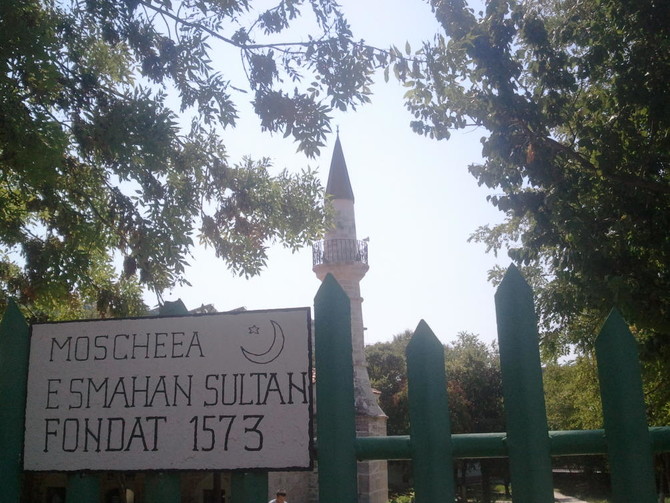
Well, not quite everyone. Elderly local Lutfi, an ethnic Turk is shuffling toward Mangalia’s historic center. His soft plimsolls move rhythmically as he nears the green gates of the Esmahan Sultan Mosque. There he lifts his wooden walking stick to greet his fellow worshippers, all local pensioners arriving for the early afternoon prayer.
They are the real-life relics of a Romanian history few travelers know.
I am a couple of hours, drive out of Romania’s bustling capital city Bucharest, where the country’s only piece of coastline meets the sea once known to the ancient Greeks and Romans as the “Hospitable Sea.” Most visitors to this former Soviet country come looking for Transylvanian Draculas or Ceausescu’s communism. I’ve come looking for Romania’s hidden Muslim heritage.
Lutfi is my first great discovery. His ancestors were brought here by the Ottomans. After the prayer, we both stand outside the mosque and he lifts his walking stick toward the brown tourist sign at the entrance, urging me to read the English text.
It tells me the small whitewashed mosque with a terracotta-roof and a single pencil-thin minaret was built in the 16th century by the Ottoman princess, Esma — daughter of Sultan Selim II and wife of the Grand Vizier Sokollu Mehmet Pasha. It also says that the region of Dobrogea was once a very tolerant place.
“In 1452, when Dobrogea got under the Ottoman domination, and the Turkish, Tatar, Bulgarian, Circassian, Gaguaz, Greek and Jewish peoples became a mixture of religious beliefs, the famous Turkish traveler, Evlia Celebi mentioned, ‘... go to Mangalia, which is the Kaaba Makkah of the wandering and poor people.’”
“Moscheee! Gooood!” Lutfi grins, seeing the look of astonishment now on my face. The sun bouncing off his tinted glasses.
Beside us, in the untidy foliage that surrounds the mosque there are a dozen or so slim tombstones in various stages of decay. The Persian script is still legible on some. Many are topped with high-ranking stone Ottoman headdresses and resemble proud soldiers refusing to wane. This had been no ordinary mosque.
Romania’s Muslim heritage stretches all the way back to the 11th century when Muslims arrived with the semi-nomadic Pecheneg Turks, who briefly ruled parts of Wallachia — the historic name for much of modern Romania. After that the influence was Tatar and Ottoman as the country became first part of the Golden Horde Khanate and then the Ottoman Empire during the Middle Ages.
Yet almost none of this heritage appears on the Romanian tourist trail. Locals head to Dobrogea in search of sun, sea and sand at the seaside resorts of Neptun-Olymp, Jupiter, Venus and Saturn, just north of Mangalia. Built during the communist 1970s, and with no further investment since, wandering around them is a nostalgic experience for a Western tourist. Their names are a nod to Romania’s attempts to align itself with ancient Roman culture.
Even in the regional capital, Constanta, the main monument by the sea is a statue of a Roman poet, Publius Ovidius Naso, known as Ovid. He was banished here by the Emperor Augustus when it was called Tomis in 8CE. Ovid reportedly despised the place, pining for his beloved Rome, but that hasn’t stopped local authorities claiming him as one of their own. The city’s main university is also named after him.
Not far from Ovid’s statue lies Romania’s most important Muslim landmark, the Grand Mosque of Constanta, built on the site of the earlier 19th century Mahmudiyye Mosque. The modern Romano-Byzantine styled building with Egyptian architectural influence was commissioned by King Carol I in 1910 and is now the seat of the country’s Grand Mufti, Murat Yusuf, leader of Romania’s 65,000 Muslims (mainly ethnic Turks and Tatars). The mosque is also home to one of Romania’s most beautiful Muslim artifacts, the largest hand-woven Persian carpet in Europe — a gift from the last Ottoman Caliph, Sultan Abdul Hamid II.
Beside the main hall is a 164-foot minaret, which offers awesome views over Constanta’s historic old town, making the Grand Mosque extremely popular with local tourists. Local Muslims prefer to pray elsewhere.
About three blocks away, in a congested part of the historic center, surrounded by open air cafes, is the less aesthetically appealing Hunchiar Mosque. Square and plain in design, it is more Methodist church then mosque from the outside. The Hunchiar was one of the last mosques built by the Ottomans in Romania. Inside, I met another descendent of the country’s ancient Muslim communities, Saleh, a local geography student of Tatar descent.
After Asr (mid-afternoon prayer), we sat inside the dimly lit prayer hall, the glaze on the mehrab’s pretty blue tiles glistening with the shards of light coming through the grilled windows. Each tile was brought here from the town of Iznik in Turkey where they are produced.
“The Mangalia mosque is probably the oldest in Romania, and a very important one, but I think there is another one in the north that might be older, I’m just not sure,” Saleh said. “There are also lots of other historical Muslim things to see in Romania, but very few of these have been written about, so it is difficult to describe them.”
Saleh is right. Just north of Constanta is the town of Babadeg, where a tomb reportedly from the 13th century is dedicated to the Muslim holy man, Sari Saltik. It is Romania’s oldest Muslim monument. The town also has original Ottoman houses, a Muslim-era fountain and a historic mosque. He was unsure of the exact details and couldn’t tell me more, but that was no surprise. The Muslim history of Romania is truly a hidden one.


![]()
![]()
![]()
![]()
![]()
![]()
![]()

Hidden Romania: The best place to find unknown Ottoman Empire landmarks




Hidden Romania: The best place to find unknown Ottoman Empire landmarks


Latest updates






© 2026 SAUDI RESEARCH & PUBLISHING COMPANY, All Rights Reserved And subject to Terms of Use Agreement.