ASTANA: Russia, Iran and Turkey on Thursday signed an agreement to set up four safe zones in Syria that the UN described as a promising step to wind down the brutal six-year war.
The US, however, gave an extremely cautious welcome, citing Iran’s role as a guarantor even as it expressed hope that the deal could set the stage for a settlement.
Several members of the opposition delegation left the room shouting in protest as the signing ceremony got underway in the Kazakh capital Astana, angry at regime ally Iran, an AFP reporter saw.
The plan for the “de-escalation zones” was discussed on Tuesday by US President Donald Trump and Russian President Vladimir Putin during a telephone conversation that the White House described as a “very good one.”
The agreement provides for a cease-fire, a ban on all flights, rapid deliveries of humanitarian aid to the designated areas and the return of refugees.
Russia and Iran, which back Syrian President Bashar Assad’s forces in the war, and Turkey, a supporter of opposition forces, hope to build on a cease-fire deal they reached in December.
The Syrian regime and opposition delegations are not signatories to the deal.
“We are not supporting this agreement. It is an agreement between the three countries,” said Usama Abu Zeid, an opposition spokesman. “We do not at all agree that Iran .. is a guarantor of this accord.”
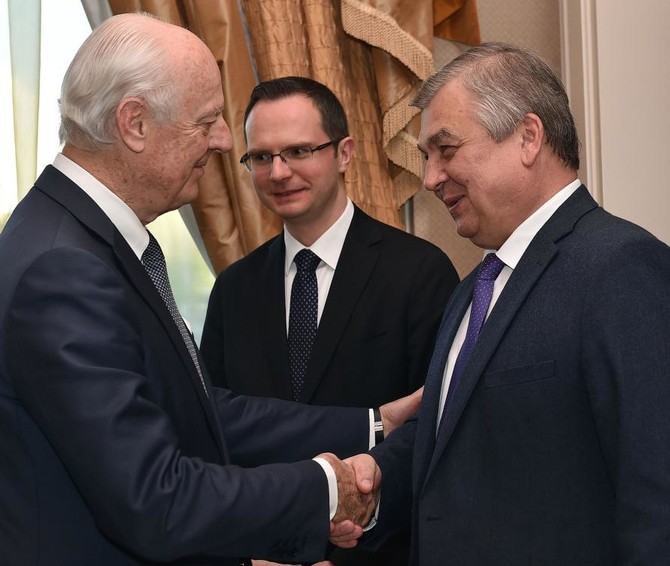
UN envoy Staffan de Mistura, who was in Astana as an observer, described the agreement as “an important promising positive step in the right direction” toward de-escalation.
A working group will be set up within two weeks to resolve technical issues and the three countries agreed to set up the four areas by June 4.
The first zone included the whole of Idlib province along with certain parts of neighboring Latakia, Aleppo and Hama provinces. The second will encompass certain parts in the north of Homs province and the third will be comprised of some areas of Eastern Ghouta, outside of Damascus.
The fourth zone will include parts of the Daraa and Quneitra provinces in southern Syria, according to the memorandum seen by AFP.
The UN envoy said the deal would be quickly put to the test and that success on the ground could pave the way to a new round of political talks in Geneva later this month.
“There will be a period not longer than two weeks in which all this will be seriously put to the test and we want that test to succeed,” he said.
In Washington, the State Department, which had dispatched an observer to the talks, said it appreciated Russian and Turkish efforts but called into doubt Iran’s role.
“We continue to have concerns about the Astana agreement, including the involvement of Iran as a so-called ‘guarantor’,” State Department spokeswoman Heather Nauert said.
“Iran’s activities in Syria have only contributed to the violence, not stopped it, and Iran’s unquestioning support for the Assad regime has perpetuated the misery of ordinary Syrians.”
“We nonetheless hope that this arrangement can contribute to a de-escalation of violence, end the suffering of the Syrian people, and set the stage for a political settlement of the conflict,” she said.
Russia’s envoy Alexander Lavrentiev said the zones would remain in place for six months, a period that could be extended.
It remained unclear whether there would be any international monitoring of the safe zones.
Putin said Wednesday that ways to monitor the zones would be an issue for separate talks. Lavrentiev said Moscow was ready to send observers to the zones.
Turkish President Recep Tayyip Erdogan said in comments published Thursday that the plan for the “de-escalation zones” would “50 percent” solve the six-year conflict.
Damascus supports the Russian plan, Syrian state news agency SANA reported.
The Syrian opposition said earlier Thursday that they had resumed participation in the talks after having suspended their involvement a day earlier over air strikes against civilians.
More than 320,000 people have been killed in Syria since the country’s war began with anti-government protests in March 2011.