

Iraqi forces open new front against Daesh in Mosul, commander says

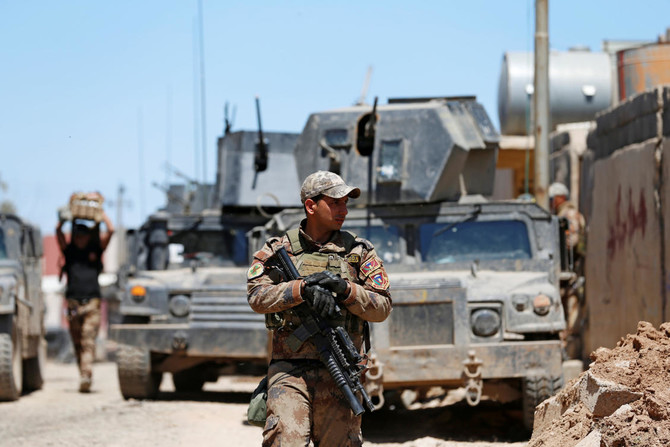
Iraqi Counter Terrorism Services (CTS) soldier is seen during a battle between CTS and Daesh militants in western Mosul, Iraq, April 25, 2017. (Reuters)
Updated 04 May 2017
Follow

Iraqi forces open new front against Daesh in Mosul, commander says

BAGHDAD: Iraqi armed forces on Thursday opened a new front against Daesh in Mosul, attacking the militants’ enclave in the city from the northwest, a military commander told Reuters.
Mosul’s wrecked roads, bridges and broader economy will take at least five years to repair and need billions of dollars of development that Iraq’s government will struggle to afford, officials returning to the battle-scarred city said.

The airport, railway station and university were all destroyed in the long fight to dislodge Daesh militants from their main Iraqi stronghold.

Iraqi government forces backed by a US-led coalition have now retaken the eastern half of the city — letting regional councilors return for the first time in 2-1/2 years to survey the damage.

“After Mosul is fully liberated, we need a working plan to restore things to the way they were before 2014 when Islamic State took over,” Noureldin Qablan, deputy chairman of the council covering the surrounding Nineveh province, told Reuters.

Nestle acknowledges delay before baby milk recall

Updated 5 sec ago
Follow

Nestle acknowledges delay before baby milk recall

  • The company in December recalled batches of its infant formula in 16 European countries
  • Nestle said routine checks at its Dutch plant at the end of November 2025 had detected “very low levels” of cereulide

GENEVA: Swiss food giant Nestle has acknowledged that it waited days for a health-risk analysis before alerting authorities after detecting a toxin in its baby milk at a Dutch factory.
But in an open letter to campaign group Foodwatch France Friday it denied accusations of negligence.
The company in December recalled batches of its infant formula in 16 European countries after detecting cereulide, a bacterial toxin that can cause diarrhea and vomiting.
French newspaper Le Monde reported Friday that traces of cereulide had been found in late November — 10 days before the first recalls of the product — because the company waited for a “health?risk analysis” before informing regulators.
Nestle said in a statement online that routine checks at its Dutch plant at the end of November 2025 had detected “very low levels” of cereulide after new equipment was installed in a factory.
It said there was no maximum limit for cereulide indicated by regulations.
The company halted production and launched further tests, which in early December confirmed minute quantities in products that had yet to leave the warehouse.
Nestle said it informed Dutch, European and other national authorities on December 10 and began a precautionary recall of all products made since the new equipment was installed — 25 batches across 16 European countries.

- Response to Foodwatch -

Friday’s open letter responded to claims by Foodwatch France, which a day earlier announced it was filing a legal complaint in the French courts against Nestle on behalf of several families whose babies had fallen ill.
Nestle denied Foodwatch’s suggestions that its product recall had been late without any reasonable excuse and that it had displayed “alarming negligence.”
They said they had acted in December and January as soon as they had identified there was an issue, said the company.
“We recognize the stress and worry that the recall has caused for parents and caregivers,” it said.
“To date, we have not received any medical reports confirming a link to illness associated with our products,” it added.
The company has said from the start of the affair that the recall stemmed from a “quality issue” and that it had seen no evidence linking its products to illness.
French authorities launched an investigation into the deaths in December and January of two babies who were thought to have drunk possibly contaminated powdered milk.
Nestle said in its statement that “nothing indicates any link between these tragic events in these two instances and the consumption of our products.”