JEDDAH: New evidence indicates that the Syrian regime used suspected nerve agents in four chemical weapons attacks since December. This includes the one in an opposition-held town on April 4 that killed nearly 100 people, a human rights group said Monday.
Human Rights Watch (HRW) said in a report that these attacks “are part of a broader pattern of Syrian regime forces’ use of chemical weapons,” which could be categorized as crimes against humanity.
The rights group said the April attack on Khan Sheikhun and the three others using suspected nerve agents all took place in areas where offensives by armed forces fighting the regime threatened military air bases.
It said witnesses had described symptoms consistent with exposure to nerve agents that they and other local residents had experienced after planes attacked northern Hama on March 30 and eastern Hama on Dec. 11-12.
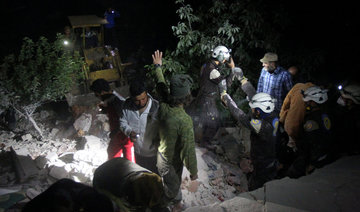
In Khan Sheikhun, HRW said 92 people, including 30 children, had been identified by residents and activists as victims of exposure to deadly chemicals. Medical personnel reported that hundreds more were injured, it said.
In at least some attacks, the rights group said, the aim appears to have been to inflict “severe suffering” on the civilian population.
“The government’s recent use of nerve agents is a deadly escalation — and part of a clear pattern,” said Kenneth Roth, executive director of Human Rights Watch.
“In the last six months, the government has used warplanes, helicopters and ground forces to deliver chlorine and sarin in Damascus, Hama, Idlib and Aleppo,” he said. “That’s widespread and systematic use of chemical weapons.”
Oubai Shahbandar, a Syrian-American analyst and fellow at the New America Foundation’s International Security Program, said: “Unimpeachable evidence continues to pile up of Bashar Assad’s complicity in directing the sarin gas attack against civilians.
“There remains an ongoing disinformation campaign on social media attempting to spread fake news and absolve the regime of this war crime,” he told Arab News on Monday.
Shahbandar said the evidence against Assad was overwhelming.
“The question is how the international community will prevent him from using his chemical stockpiles yet again,” he said.
Hamdan Al-Shehri, a Riyadh-based Saudi political analyst and international relations scholar, said the confirmation from HRW was one more clinching evidence of Assad’s savagery against his people.
“He has no qualms in killing his own people with these weapons of mass destruction,” Al-Shehri told Arab News. “Assad wants to remain in power forever. That is his only objective. He doesn’t care how many Syrians have to die in order for him to remain in power.”
He said the real problem was Russia. “(Russian President Vladimir) Putin needs to accept these findings and stop supporting the Assad regime,” he said. “But I am not hopeful that Russia will change. Putin will simply try to cover up Assad’s misdeeds.”
Al-Shehri said this overwhelming evidence will strengthen the resolve of the international community to stop “Assad’s crime against humanity.”
— With input from AP


![]()

HRW: Assad regime used nerve agents in 4 attacks
HRW: Assad regime used nerve agents in 4 attacks


Latest updates


© 2026 SAUDI RESEARCH & PUBLISHING COMPANY, All Rights Reserved And subject to Terms of Use Agreement.