KATMANDU, Nepal: A Swiss climber acclaimed for his rapid ascents — including scaling dozens of peaks in the Alps in a little more than two months — was killed Sunday in a mountaineering accident near Mount Everest in Nepal, expedition organizers said.
Ueli Steck was killed at Camp 1 of Mount Nuptse, Mingma Sherpa of Seven Summit Treks said. Steck’s body has been recovered from the site and been taken to Lukla, where the only airport in the Mount Everest area is located.
Steck’s family said the exact circumstances of his death were still unclear.
“The family is infinitely sad and asks that the media refrain from speculating about his death out of respect and consideration for Ueli,” it said in a statement on Steck’s website. “As soon as reliable information about Ueli Steck’s death becomes available, the media will be informed.”
Steck was planning to climb 8,850-meter (29,035-foot) Mount Everest and nearby Mount Lhotse next month.
He was the first casualty in the spring mountaineering season in Nepal that began in March and will end in May. Hundreds of foreign climbers are on the mountains to attempt scale Himalayan peaks in May when there are a few windows of favorable weather.
The 40-year-old Steck was one of the most-renowned mountaineers of his generation. He was best known for his speed-climbing, including setting several records for ascending the north face of the Eiger, a classic mountaineering peak in the Bernese Alps that he climbed in two hours and 47 minutes without using a rope.
In 2013, he achieved the first solo climb of the Annapurna south face in Nepal after almost losing his life in a fall there in 2007. For that he received the “Piolet d’Or” — considered the Oscar of mountaineering — the following year.
In 2015, Steck decided to climb all 82 peaks in the Alps higher than 4,000 meters (13,100 feet) traveling between mountains by foot, bike and paraglider only. He completed the feat in 62 days, helping cement his reputation as the “Swiss Machine.”
Steck once said he considered himself an “outsider” in the mountaineering scene because athletic achievement was more important to him than adventure.
In a recent post on his website, Steck mused about the transience of success in mountaineering and the inevitable decline that comes with age.
“A record is broken again and again, and the world keeps on turning,” he wrote. “You are getting older and there comes a time when you have to adjust your projects to your age.”
Steck suffered a setback during his last trip to Everest, in 2013, when he became involved in a violent altercation with a group of local guides. On his return this year, he aimed to perform a quick climb of Everest and Lhotse, including an overnight stop at more than 8,000 meters, an altitude that’s known as the “death zone” because the human body’s performance is reduced to 20 percent of its normal rate.
Asked about the upcoming expedition, Steck told Swiss daily Tages-Anzeiger in an interview last month: “When I’m on Everest I can stop at any point. The risk is therefore quite small. For me it’s primarily a physical project. Either I get through, or I don’t have the strength for the whole traversal.”
“Of course I want to climb Everest and Lhotse,” Steck told the paper when asked about his measure of success. “But that’s a very high goal. Failure for me would be to die and not come home.”
___
Frank Jordans reported from Berlin.


![]()
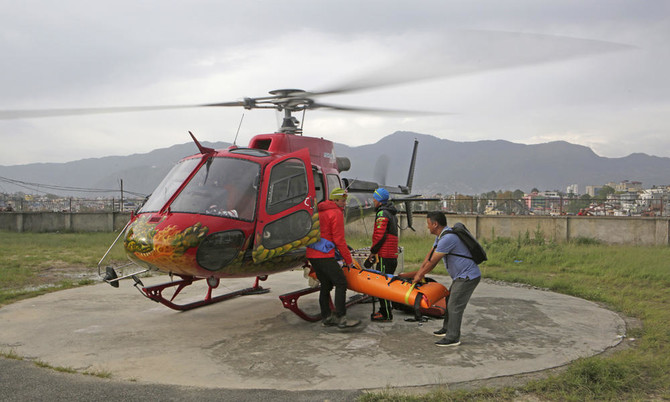
Famed Swiss climber killed near Mount Everest in Nepal
Famed Swiss climber killed near Mount Everest in Nepal

Latest updates



Recommended


© 2026 SAUDI RESEARCH & PUBLISHING COMPANY, All Rights Reserved And subject to Terms of Use Agreement.