

Afghan Taliban announce start of ‘spring offensive’

(AFP)
Updated 28 April 2017
Follow

Afghan Taliban announce start of ‘spring offensive’

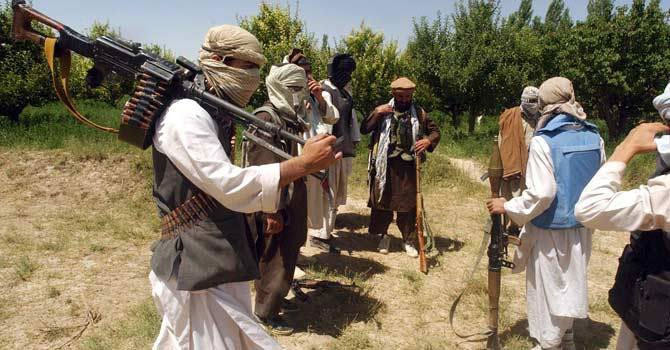
KABUL:The Afghan Taliban launched their “spring offensive” Friday, heralding fresh fighting in the drawn-out conflict as embattled security forces struggle to recover from a devastating attack on a military base one week ago.
Operation Mansouri — named after the group’s former leader, killed in a US drone strike in 2016 — will target foreign forces with “conventional attacks, guerrilla warfare, complex martyrdom attacks, insider attacks,” an insurgent statement said.
“The enemy will be targeted, harassed, killed or captured until they abandon their last posts,” it continued.
The annual spring offensive normally marks the start of the “fighting season,” though this winter the Taliban continued to battle government forces, most successfully in last week’s attack on the military base outside the northern city of Mazar-i-Sharif.
The massacre last Friday saw insurgents armed with guns and suicide bombs slaughter at least 135 young recruits, according to the official toll, though multiple sources have claimed it is much higher.
The assault is believed to be the deadliest by the Taliban on an Afghan military target since they were driven from power in 2001, and fueled fears of insider attacks — when Afghan soldiers and police turn their guns on colleagues or on international troops.
The attackers carried valid passes to the base, security sources said, and were dressed in Afghan army uniforms. The defense minister and army chief have resigned, and at least 35 soldiers have been arrested over the incident.
Already beset by killings, desertions, and struggles over leadership and morale, Afghan forces have been straining to beat back insurgents since US-led NATO troops ended their combat mission in December 2014.
They faced soaring casualties in 2016, up by 35 percent with 6,800 soldiers and police killed, according to a US watchdog.
With more than one third of Afghanistan outside of government control, civilians also continue to bear a heavy brunt, with thousands killed and wounded each year with children paying an increasingly disproportionate price, according to UN figures.
Afghanistan’s Interior Ministry shrugged off the Taliban threats Friday, saying the offensive was “not something new.”
“We will target, kill, defeat and suppress the Taliban... all across the country,” acting ministry spokesman Najib Danish told AFP.
The Taliban statement said they would focus on state-building and “establishing mechanisms for social justice and development” in the areas under their control.
Afghan and international officials have repeatedly called on the Taliban to disarm and join the political process, a call they have so far refused.
Kabul-based analyst Ahmad Saeedi said the insurgents — “emboldened” by government failures — would instead seek more territory this year.
“I believe this will be a difficult year for Afghan security forces, as they will be facing the resilient Taliban’s complex and sophisticated attacks countrywide,” he told AFP.

The Taliban announcement comes days after Pentagon chief Jim Mattis visited Kabul as the Trump administration seeks to craft a new strategy in Afghanistan.
Mattis also warned that 2017 would be “another tough year” for Afghan security forces, but would not be drawn on recent calls by NATO commander in Afghanistan General John Nicholson for “a few thousand” more troops.
The Afghan conflict is the longest in US history — US-led NATO troops have been at war there since 2001, after the ousting of the Taliban regime for refusing to hand over Osama Bin Laden following the 9/11 attacks in the United States.
The US has around 8,400 troops in the country with about another 5,000 from NATO allies.
Earlier this month, the American military dropped its largest non-nuclear bomb on Daesh group hideouts in eastern Afghanistan, killing nearly a hundred militants, according to unverified figures from Afghan officials.
The bombing triggered global shockwaves, but was criticized by observers who questioned its use against a group that is not considered as big a threat as the Taliban.
Some analysts even argued the strike could boost the Taliban, who had been fighting a turf war with IS in Nangarhar province near the border with Pakistan, where the bomb was dropped.
Two US troops were killed Wednesday while fighting IS militants near the blast-site, the Pentagon has said, highlighting the price of its continuing role in the conflict.
Sudan defense minister dismisses ‘intelligence document’ as fabrication after convoy strike

Updated 12 February 2026
Follow

Sudan defense minister dismisses ‘intelligence document’ as fabrication after convoy strike

  • Gen. Hassan Kabroun tells Arab News claims that army hid weapons in aid convoy are “completely false”

RIYADH: Sudan’s defense minister has firmly denied reports attributed to Sudanese intelligence alleging that a convoy targeted in North Kordofan was secretly transporting weapons under the cover of humanitarian aid.

Gen. Hassan Kabroun described the claims as “false” and an attempt to distract from what he called a militia crime.

The controversy erupted after news reports emerged that a document attributed to Sudan’s General Intelligence Service claimed the convoy struck in Al-Rahad on Friday was not a purely humanitarian mission, but was instead carrying “high-quality weapons and ammunition” destined for Sudanese Armed Forces units operating in the state.

The report further alleged that the convoy had been outwardly classified as humanitarian in order to secure safe passage through conflict zones, and that the Rapid Support Forces had destroyed it after gathering intelligence on its route and cargo.

Kabroun categorically rejected the narrative.

“First of all, we would like to stress the fact that this news is false,” he told Arab News. “Even the headline that talks about the security of the regions, such as Al-Dabbah, is not a headline the army would use.”

He described the document as fabricated and politically motivated, saying it was designed to “cover up the heinous crime they committed.”

The minister affirmed that the area targeted by drones is under full control of the Sudanese Armed Forces and does not require any covert military transport.

“Second, we confirm that the region that was targeted by drones is controlled by the army and very safe,” Kabroun said. “It does not require transporting any military equipment using aid convoys as decoys because it is a safe area controlled by the army, which has significant capabilities to transport humanitarian aid.”

According to the minister, the Sudanese military has both the logistical capacity and secure routes necessary to move equipment openly when needed.

“The army is professional and does not need to deliver anything to Kadugli or Dalang on board aid convoys,” he said. “The road between Dalang and Kadugli is open. The Sudanese forces used that road to enter and take control of the region. The road is open and whenever military trucks need to deliver anything, they can do so without resorting to any form of camouflage.”

Kabroun further rejected any suggestion that the military uses humanitarian operations as cover.

“Aid is transported by dedicated relief vehicles to the areas in need of this assistance,” he said. “Aid is not transported by the army. The army and security apparatus do not interfere with relief efforts at all, and do not even accompany the convoys.”

He stressed that the Sudanese Armed Forces maintains a clear institutional separation between military operations and humanitarian work, particularly amid the country’s crisis.

“These are false claims,” he said. “This fake news wanted to cover up the heinous crime they committed.”

Sudan has been gripped by conflict since April 2023, when fighting broke out between the Sudanese Armed Forces and the Rapid Support Forces, plunging the country into what the United Nations has described as one of the world’s worst humanitarian disasters.

The latest dispute over the convoy comes amid intensified fighting in South Kordofan, a strategically sensitive region linking central Sudan with the contested areas of Darfur and Blue Nile.

The false report suggested that intelligence monitoring had enabled the RSF to strike what it described as a military convoy disguised as humanitarian aid. But Kabroun dismissed that version outright.

“The intelligence agency is well aware of its duties,” he said. “The Sudanese Army has enough weapons and equipment to use in the areas of operations. These claims are completely false.”

He argued that the narrative being circulated seeks to shift blame for attacks on civilian infrastructure and humanitarian movements.

“This shows that they are trying to cover up the atrocities,” he added, referring to the militia.

Kabroun maintained that the army has regained momentum on multiple fronts and remains fully capable of sustaining its operations without resorting to deception.

“The region is secure, the roads are open, and the army does not need camouflage,” he said. “We are operating professionally and transparently.”

“These claims are completely false,” Kabroun said. “The Sudanese Army does not use humanitarian convoys for military purposes.”