ISTANBUL: A Russian naval spy ship on Thursday sank in the Black Sea off Turkey’s coast after hitting a Togo-flagged vessel packed with livestock but all of its 78 crew were rescued by Turkish coast guards.
The Russian military said the Liman — a former research ship re-fitted as an intelligence vessel — had a hole ripped out of its hull in the early afternoon incident.
The collision took place in fog outside the northwestern entrance to the Bosphorus Strait, one of the world’s biggest shipping thoroughfares that passes through Istanbul into the Sea of Marmara.
The Turkish coast guard said in a statement that the collision involved the Togo-flagged vessel Youzarsif H which was carrying a cargo of livestock.
It said that of 78 Russian personnel on board the ship, 63 were rescued by the Turkish coast guard and the other 15 by the Youzarsif H itself.
They were then transferred to a Turkish military ship, it said, without giving further details. “All the personnel were evacuated,” it said.
Turkish media said the Youzarsif suffered minor damage and went on its way after the incident.
The Russian Defense Ministry confirmed the ship had gone down and said the crew were safe and would be taken from a Turkish vessel back onto a Russian ship.
Turkish news agency Dogan said the area where the ships collided was shrouded in thick fog at the time, suggesting that the incident was accidental.
Turkish Prime Minister Binali Yildirim spoke to his Russian counterpart Dmitry Medvedev by phone over the incident, describing it as an accident and expressing his sadness, the state-run Anadolu news agency said.
It was not known where the Liman was sailing from or its destination.
The ship was built as a hydrography research vessel in 1970 but turned into a spy ship in 1989 and armed with an Igla missile launcher, according to public records.
Russian warships have traveled frequently through the Bosphorus Strait to and from the Syrian coast, where a navy presence has been deployed to bolster Russia’s air campaign in support of Syrian President Bashar Assad.
In February, military sources told Russian media that the Liman would be observing the North Atlantic Treaty Organization’s (NATO) Sea Shield exercise in the Black Sea.
Cem Devrim Yaylali, an Istanbul-based Turkish naval expert and editor of the Bosphorus Naval News website, said the Liman had previously been to the Syrian coast but it was not clear where it was headed on this occasion.
“A collision is not something that happens very frequently,” he told AFP.
He said the incident was an embarrassment for the Russian authorities as the Liman was likely carrying sensitive surveillance equipment that Moscow would want returned.
“I imagine there will be a salvage effort to raise the ship before anyone else sees it,” he said.
“If the ship cannot be salvaged then Russia surely will try to take away the sensitive equipment from on board by divers.”
Relations between Russia and Turkey hit their worst state since the Cold War in November 2015 when Turkish war planes shot down a Russian jet over the Syrian border.


![]()
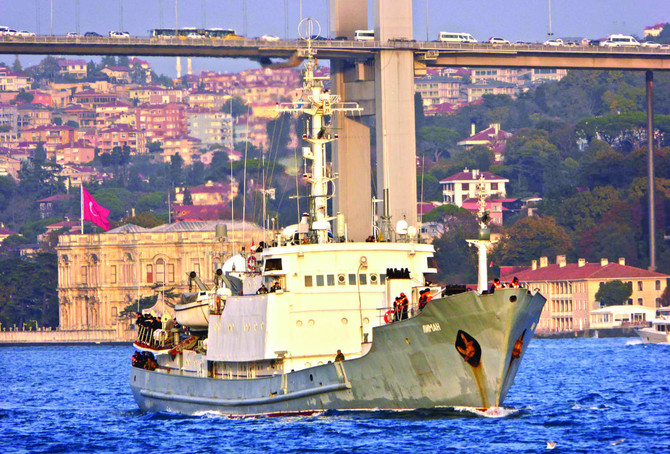
Russian spy ship sinks off Turkey after collision
Russian spy ship sinks off Turkey after collision
Latest updates


© 2026 SAUDI RESEARCH & PUBLISHING COMPANY, All Rights Reserved And subject to Terms of Use Agreement.