Turkish strikes kill Kurdish fighters in Syria, Iraq

1 / 2
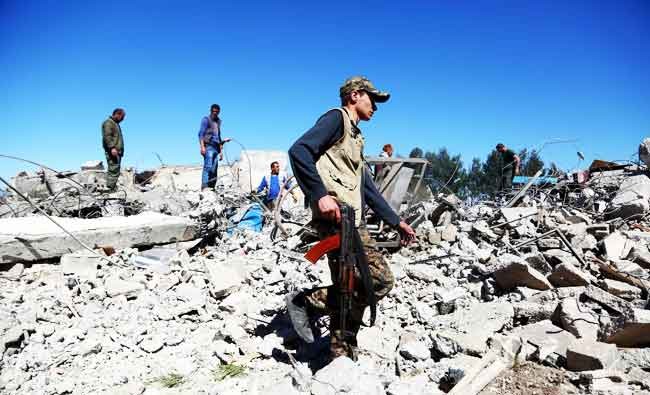
Fighters from the Kurdish People's Protection Units (YPG) visit the site of Turkish airstrikes near northeastern Syrian Kurdish town of Derik, known as al-Malikiyah in Arabic, on Tuesday. (AFP)
2 / 2
Archival picture shows a Turkish fighter jet. (AFP)
Updated 26 April 2017
Follow

Turkish strikes kill Kurdish fighters in Syria, Iraq

AL-MALIKIYAH, Syria: Turkish warplanes killed more than two dozen Kurdish fighters Tuesday in strikes in Syria and Iraq, where the Kurds are key players in the battle against Daesh.
Turkey said it had carried out the strikes in northeast Syria and northern Iraq against “terrorist havens,” vowing to continue acting against groups it links to the outlawed Kurdistan Workers’ Party (PKK).
In northeast Syria, strikes targeting the Kurdish People’s Protection Units (YPG) — who are leading the offensive against Daesh stronghold Raqqa — were reported to have killed 20 fighters.
In northern Iraq they killed six peshmerga fighters from the autonomous Kurdish government, usually allied with Ankara, in an apparent accident.
Iraqi government spokesman Saad Al-Hadithi said: “The Iraqi government condemns and rejects the strikes carried out by Turkish aircraft on Iraqi territory.”
The strikes underlined the complexities of the battlefields in Iraq and Syria, where twin US-backed offensives are seeking to dislodge Daesh from its last major urban strongholds.
They could also exacerbate tensions between Ankara and its NATO ally Washington, which leads an anti-Daesh coalition carrying out airstrikes in Syria and Iraq and sees the Kurds as instrumental in the fight against Daesh.
Turkey said its strikes aimed “to destroy terrorist havens targeting our country” and vowed to press the offensive “until the very last terrorist is neutralized.”
An army statement said the strikes “destroyed” shelter areas, ammunition warehouses and PKK communications facilities. It said 40 PKK fighters were “neutralized” in Iraq and around 30 in Syria.
The bombardment near the Syrian city of Al-Malikiyah saw “dozens of simultaneous airstrikes” overnight on YPG positions including a media center, a monitoring group said.
A commander for Kurdish forces urged the US-led coalition to prevent further Turkish strikes on their forces.
“We are asking the international coalition to intervene to stop these Turkish violations,” the commander told AFP. “It’s unthinkable that we are fighting on a front as important as (Daesh bastion) Raqqa while Turkish planes bomb us in the back,” the commander said.
“The YPG will not be silent on this blatant attack, and we reserve our right to defend ourselves and take revenge for our martyrs,” YPG spokesman Redur Xelil said.
The US-led coalition “has a huge responsibility and must carry out its duty to protect this area, because we are partners in fighting Daesh,” he said.


The UN says Al-Hol camp population has dropped sharply as Syria moves to relocate remaining families

Updated 15 February 2026
Follow

The UN says Al-Hol camp population has dropped sharply as Syria moves to relocate remaining families

  • Forces of Syria’s central government captured the Al-Hol camp on Jan. 21 during a weekslong offensive against the SDF, which had been running the camp near the border with Iraq for a decade

DAMASCUS: The UN refugee agency said Sunday that a large number of residents of a camp housing family members of suspected Daesh group militants have left and the Syrian government plans to relocate those who remain.
Gonzalo Vargas Llosa, UNHCR’s representative in Syria, said in a statement that the agency “has observed a significant decrease in the number of residents in Al-Hol camp in recent weeks.”
“Syrian authorities have informed UNHCR of their plan to relocate the remaining families to Akhtarin camp in Aleppo Governorate (province) and have requested UNHCR’s support to assist the population in the new camp, which we stand ready to provide,” he said.
He added that UNHCR “will continue to support the return and reintegration of Syrians who have departed Al-Hol, as well as those who remain.”
The statement did not say how residents had left the camp or how many remain. Many families are believed to have escaped either during the chaos when government forces captured the camp from the Kurdish-led Syrian Democratic Forces last month or afterward.
There was no immediate statement from the Syrian government and a government spokesperson did not respond to a request for comment.
At its peak after the defeat of IS in Syria in 2019, around 73,000 people were living at Al-Hol. Since then, the number has declined with some countries repatriating their citizens. The camp’s residents are mostly children and women, including many wives or widows of IS members.
The camp’s residents are not technically prisoners and most have not been accused of crimes, but they have been held in de facto detention at the heavily guarded facility.
Forces of Syria’s central government captured the Al-Hol camp on Jan. 21 during a weekslong offensive against the SDF, which had been running the camp near the border with Iraq for a decade. A ceasefire deal has since ended the fighting.
Separately, thousands of accused IS militants who were held in detention centers in northeastern Syria have been transferred to Iraq to stand trial under an agreement with the US
The US military said Friday that it had completed the transfer of more than 5,700 adult male IS suspects from detention facilities in Syria to Iraqi custody.
Iraq’s National Center for International Judicial Cooperation said a total of 5,704 suspects from 61 countries who were affiliated with IS — most of them Syrian and Iraqi — were transferred from prisons in Syria. They are now being interrogated in Iraq.