WASHINGTON: In one of largest sanctions rollouts in US history, the Donald Trump administration on Monday targeted 271 employees of Syria’s Scientific Studies and Research Center (SSRC), the government agency responsible for developing non-conventional weapons and the means to deliver them.
The designation is one more punitive measure after the US missile strikes on the Syrian regime airfield on April 7, sending a message to Assad that the US knows about and is watching his activities, according to experts.
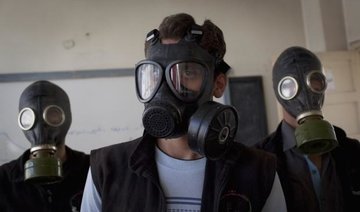
The US Department of the Treasury’s Office of Foreign Assets Control (OFAC) justified the new sanctions as “taking action in response to the April 4, 2017, sarin attack on innocent civilians” in Khan Sheikhun, Syria.
OFAC said: “These 271 SSRC employees have expertise in chemistry and related disciplines and/or have worked in support of SSRC’s chemical weapons program since at least 2012.”
US Treasury Secretary Steven Mnuchin described the sanctions as “sweeping measures that target the scientific support center for Syrian dictator Bashar Assad’s horrific chemical weapons attack on innocent civilian men, women and children.”
The message from the Trump administration is that “we will hold the entire Assad regime accountable for these blatant human-rights violations in order to deter the spread of these types of barbaric chemical weapons,” Mnuchin said.
“We take Syria’s disregard for innocent human life very seriously, and will relentlessly pursue and shut down the financial networks of all individuals involved with the production of chemical weapons used to commit these atrocities.”
In accordance with the new sanctions, “any property or interest in property of the designated persons in the possession or control of US persons or within the United States must be blocked, and US persons are generally prohibited from dealing with them.”
Analysts and Syria-watchers read the move as a form of deterrence and a sign “the US knows much more (about) what is going on inside the Assad regime than it has been wanting to admit before,” said Charles Lister, a senior fellow at the Middle East Institute in Washington.
The new sanctions are added to a list of measures that the Trump administration has taken after Assad’s alleged use of chemical weapons in an attack that killed more than 80 civilians in Khan Sheikhun.
Meanwhile, in a separate development, French-Swiss cement maker LafargeHolcim said Monday its chief executive Eric Olsen is stepping down following an internal investigation into the company’s activities in Syria.
His resignation will be effective on July 15, LafargeHolcim said in a statement, adding that its board had agreed to his departure even though an internal probe had determined he was not responsible for any wrongdoings.
Olsen’s departure follows an inquiry into the indirect financing by Lafarge of armed groups in civil war-ravaged Syria to keep one of its cement plants operational.
In a separate development, a US-backed alliance of Arab-Kurdish forces entered the key terrorist-held town of Tabqa as they pursued their campaign against Daesh in northern Syria.
The Syrian Democratic Forces (SDF) have set their sights on Tabqa and the adjacent dam as part of their broader offensive for the city of Raqqa, the Syrian heart of the terrorists’ self-styled “caliphate” since 2014.
Supported by US-led coalition airstrikes and special forces advisers, the SDF surrounded Tabqa in early April.
On Monday, they entered it for the first time, the Syrian Observatory for Human Rights monitoring group said. “They seized control of several points in the town’s south and were advancing on its western edges,” said Observatory head Rami Abdel Rahman.
He said US-led coalition warplanes were carrying out “intense” strikes in support of the offensive, but that one raid had killed three women and five children trying to flee Tabqa.
— With input from AFP


![]()

US sanctions 271 Assad regime staff over Syria chemical strike
US sanctions 271 Assad regime staff over Syria chemical strike


Latest updates


© 2026 SAUDI RESEARCH & PUBLISHING COMPANY, All Rights Reserved And subject to Terms of Use Agreement.