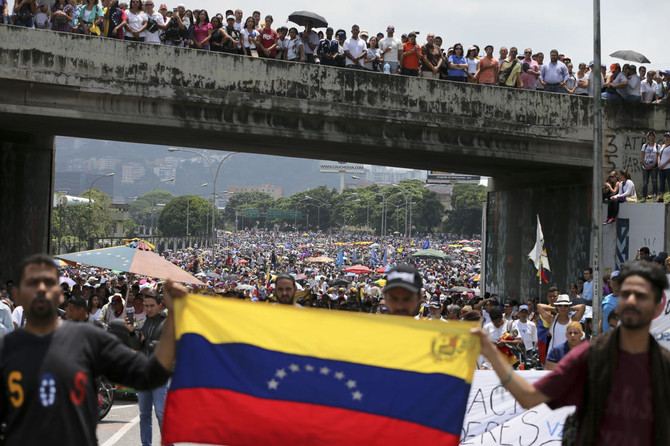
CARACAS: Protesters were planning to block Venezuela’s main roads including the capital’s biggest motorway on Monday, triggering fears of further violence after three weeks of unrest left 21 people dead.
The wife of jailed opposition leader Leopoldo Lopez started a vigil on Sunday outside the prison where he is being held, pressing for permission to visit him after he spent a month in isolation.
President Nicolas Maduro said Sunday that he wants “elections now,” referring to elections for governors which were supposed to be held last December, and those for mayors scheduled for this year. A presidential election is scheduled for 2018.
Venezuela has seen near-daily protests since the beginning of April, with opponents of Maduro demanding his ouster.
Maduro has called for local elections in Venezuela, but the government has ruled out voting this year at presidential level as opposition leaders have demanded.
The opposition blames Maduro for the unraveling of the oil giant’s once-booming economy, leaving the country with critical shortages of food, medicine and basic goods.
The spark that set off the near-daily protests was an attempt by the Supreme Court to take over the powers of the opposition-dominated Congress.
Most of the demonstrations have degenerated into riots and clashes with security forces, who dispersed them using tear gas and rubber bullets.
The government and the opposition have accused each other of fomenting the deadly violence that has also seen hundreds of people detained or wounded and businesses looted.
The latest victim, Almelina Carrillo, 47, succumbed to injuries suffered when she was struck in the head by a bottle thrown from a building during the march in Caracas.
Interior Minister Nestor Reverol called her “another victim of the Terrorist Right, which is full of hatred.”
“We will not rest until we capture those responsible for this repugnant crime,” he added.
The opposition has said it will use the momentum to keep taking to the streets demanding elections and pushing for the release of political prisoners.
Thursday marked one of the most violent days in the latest wave of protests, with the Caracas neighborhood of El Valle the scene of shootings, looting and pitched battles between demonstrators and police officers, who forced the evacuation of a maternity ward.
Eleven people died that day alone.
Maduro says he has “evidence” that opposition lawmakers Jose Guerra and Tomas Guanipa were involved in those deadly riots.
The opposition coalition Mesa de la Unidad Democratica (MUD) has denounced “a sequence of political persecution against important leaders,” lawmaker Enrique Marquez was quoted as saying by the El Encimulo news website.
Maduro is pressing the opposition to resume dialogue, frozen since last year after it accused the government of not complying with agreements which include the call for elections.
“I ask Pope Francis from here on out to continue to accompany us in the dialogue, because there is a conspiracy in Rome and here as well against dialogue in Venezuela,” he said.

Venezuela protesters plan nationwide road blocks
EU reconsidering funds for Serbia as justice laws ‘eroding trust’
BELGRADE: The European Union could withhold funds from a 1.6 billion euro allocation of loans and grants to Serbia, after Belgrade passed laws that are “eroding trust” in its commitment to the rule of law, the bloc’s enlargement commissioner said.
Reforms to centralize the judiciary that came into force this week brought criticism from judges and prosecutors who see them as bolstering President Aleksandar Vucic’s hold on power, weakening the fight against organized crime and undermining Serbia’s bid to join the EU.
“These amendments are eroding trust. It is becoming harder for those in Brussels who are willing to advance with Serbia to make their case,” EU enlargement commissioner Marta Kos said in emailed comments to Reuters late on Thursday.
Kos said the commission was reviewing funding for Serbia under the EU Growth Plan for the Western Balkans, aimed at aligning the region to EU rules and ultimately bringing countries such as Serbia into the bloc. Serbia was allocated 1.6 billion euros of loans and grants under the program.
“These (funds) contain preconditions linked to the rule of law,” she said.
Serbia began official talks to join the EU in 2014 but widespread corruption and weak institutions have slowed progress.
The judicial reforms include limiting the mandate of chief public prosecutors and granting court presidents — responsible for court administration — greater powers over judges. Critics fear the reforms will erode judges’ independence and jeopardize high-level corruption cases overseen by the Public Prosecutor’s Office for Organized Crime.
The government did not immediately respond to a request for comment on Friday. The justice ministry has said that the new laws will make the judiciary more efficient by streamlining the decision-making process.
Since the backlash, Serbia has requested the opinion of the Venice Commission, a panel of constitutional law experts of the Council of Europe, a human rights body.
“Once that opinion is issued, we expect these laws to be revised accordingly and in an inclusive manner,” Kos said.
Reforms to centralize the judiciary that came into force this week brought criticism from judges and prosecutors who see them as bolstering President Aleksandar Vucic’s hold on power, weakening the fight against organized crime and undermining Serbia’s bid to join the EU.
“These amendments are eroding trust. It is becoming harder for those in Brussels who are willing to advance with Serbia to make their case,” EU enlargement commissioner Marta Kos said in emailed comments to Reuters late on Thursday.
Kos said the commission was reviewing funding for Serbia under the EU Growth Plan for the Western Balkans, aimed at aligning the region to EU rules and ultimately bringing countries such as Serbia into the bloc. Serbia was allocated 1.6 billion euros of loans and grants under the program.
“These (funds) contain preconditions linked to the rule of law,” she said.
Serbia began official talks to join the EU in 2014 but widespread corruption and weak institutions have slowed progress.
The judicial reforms include limiting the mandate of chief public prosecutors and granting court presidents — responsible for court administration — greater powers over judges. Critics fear the reforms will erode judges’ independence and jeopardize high-level corruption cases overseen by the Public Prosecutor’s Office for Organized Crime.
The government did not immediately respond to a request for comment on Friday. The justice ministry has said that the new laws will make the judiciary more efficient by streamlining the decision-making process.
Since the backlash, Serbia has requested the opinion of the Venice Commission, a panel of constitutional law experts of the Council of Europe, a human rights body.
“Once that opinion is issued, we expect these laws to be revised accordingly and in an inclusive manner,” Kos said.
© 2026 SAUDI RESEARCH & PUBLISHING COMPANY, All Rights Reserved And subject to Terms of Use Agreement.