BEIRUT: A US-backed alliance of Arab-Kurdish forces entered the key jihadist-held town of Tabqa on Monday as they pursued their campaign against the Daesh group in northern Syria.
The Syrian Democratic Forces (SDF) have set their sights on Tabqa and the adjacent dam as part of their broader offensive for the city of Raqqa, the Syrian heart of the jihadists’ self-styled “caliphate” since 2014.
Supported by US-led coalition air strikes and special forces advisers, the SDF surrounded Tabqa in early April.
On Monday, they entered it for the first time, the Syrian Observatory for Human Rights monitoring group said.
“They seized control of several points in the town’s south and were advancing on its western edges,” said Observatory head Rami Abdel Rahman.
He said US-led coalition warplanes were carrying out “intense” strikes in support of the offensive, but that one raid had killed three women and five children trying to flee Tabqa.
“One raid killed eight civilians from a single family, including five children, who were trying to escape in their car via the town’s southwest,” Abdel Rahman said.
In an online statement, the SDF said it had captured IS-held positions in west Tabqa, including a roundabout, and part of a southern district.
“There are now clearing operations in the liberated positions,” the SDF said.
Tabqa sits on a key supply route about 55 kilometers (34 miles) west of Raqqa, and served as an important IS command base, housing the group’s main prison.
According to the Syrian Economic Task Force, a Dubai-based think tank, Tabqa is home to 85,000 people including IS fighters from other areas.
The assault on Tabqa began in late March when SDF forces and their US-led coalition allies were airlifted behind IS lines.
The ensuing fight has been intense, with IS dispatching suicide bombers daily to try to slow the offensive and coalition warplanes intensifying their raids.
“The real battle begins now,” Abdel Rahman said on Monday, adding that IS fighters had “no way” out of the town.
For months, the SDF has been advancing on Raqqa, hoping to encircle it before a final attack.
The city was home to around 240,000 residents before 2011, and more than 80,000 people have fled to it from other parts of the country.
Syria’s war has left more than 320,000 people dead since it began with protests in 2011 that were brutally repressed by the government of President Bashar Assad.
Regional and international powers have since been drawn into the complex conflict, in which internationally prohibited weapons such as cluster bombs and toxic gas have been used.
On April 4, a suspected chemical attack killed 87 civilians, including many children, in the northwestern rebel-held town of Khan Sheikhun.
Much of the international community blamed the Syrian regime, and three days later 59 US cruise missiles targeted the airbase from where the attack was launched.
Assad ally Moscow protested the US action and consistently sought to deflect blame from Damascus over the incident.
Air raids on Khan Sheikhun have continued, with seven people killed in strikes on the town market on Monday, the Observatory said.
It came as Russia’s defense ministry said the Syrian army would halt fire around Khan Sheikhun if experts were allowed in to conduct a probe.
The ministry said Damascus was “ready to declare a complete moratorium on the activities of its troops, aviation and artillery in the area” if investigators were sent in.
Syria’s government has not commented on the offer.
The Organization for the Prohibition of Chemical Weapons (OPCW) said last week that “incontrovertible” test results showed sarin gas or a similar substance had been used in Khan Sheikhun.


![]()
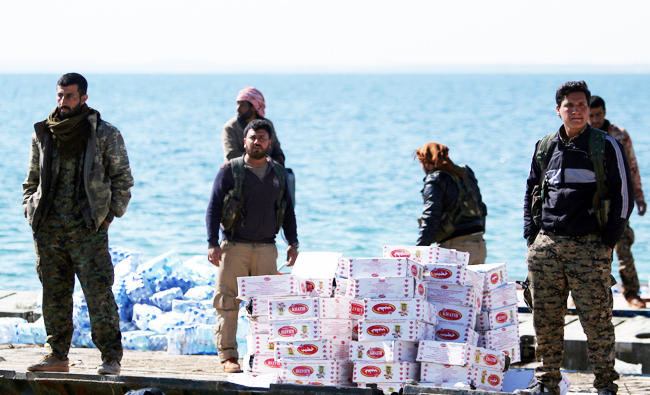
US-backed forces enter major Daesh-held Syria town
US-backed forces enter major Daesh-held Syria town
Latest updates


© 2026 SAUDI RESEARCH & PUBLISHING COMPANY, All Rights Reserved And subject to Terms of Use Agreement.