Famine fuels resurgence of Somali piracy: US general

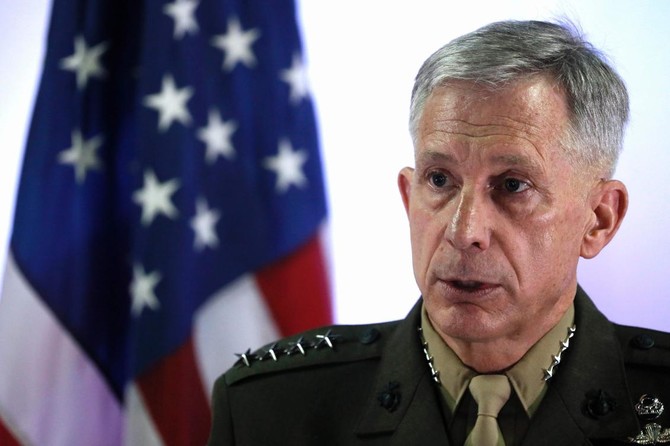
US Marine Corps General Thomas Waldhauser speaks during a press conference at Camp Lemonnier in Ambouli, Djibouti. (AFP)
Updated 23 April 2017
Follow

Famine fuels resurgence of Somali piracy: US general

DJIBOUTI: Drought and famine seem to be fueling a resurgence of piracy off the coast of Somalia, the United States’ top military chief in Africa said Sunday.
Half a dozen pirate attacks have been reported in the region over the last month, after falling to zero in recent years, said US general Thomas Waldhauser.
“Some of the reasons we see for that have to do with the drought and famine,” because some of the vessels seized have been carrying food and oil, he said.
The targeted boats have been small and “very lucrative targets for pirates,” he told a press conference with US Defense Secretary Jim Mattis in Djibouti.
The US military is advising shipping companies and ensuring they stick to security guidelines and do not lower their guard, he said.
“The bottom line is that there have been half a dozen or so” attacks but “we are not ready to say that there is a trend,” he added.
Mattis traveled on Sunday to Djibouti, a tiny strategic state in the Horn of Africa which hosts the only permanent US military base on the African continent, Camp Lemonnier.
Somali pirates began staging attacks in 2005, seriously disrupting a major international shipping route and costing the global economy billions of dollars.
At the peak of the piracy crisis in January 2011, 736 hostages and 32 boats were held.
Though anti-piracy measures ended attacks on commercial vessels, fishing boats have continued to face attacks sporadically.


Heavy shelling, explosions spark fear along Pakistan-Afghanistan border 

Updated 04 March 2026
Follow

Heavy shelling, explosions spark fear along Pakistan-Afghanistan border 

  • Residents fear for their safety amid border clashes
  • 1,500 Afghan families displaced ‌due to heavy shelling and explosions
  • Pakistan denies targeting civilians, says its strikes focus on militants

LAL PUR, Afghanistan/PESHAWAR, Pakistan: People living along Pakistan’s border with Afghanistan said they ​were considering fleeing their homes because of heavy shelling and explosions as fighting between troops from both sides entered a seventh day on Wednesday.
The South Asian allies-turned-foes have engaged in their worst fighting in years following Pakistani airstrikes on major Afghan cities last week, increasing volatility in a region also on edge over US and Israeli strikes on Iran.
Islamabad has said its airstrikes, which have at times directly targeted the Taliban government, are aimed at ending Afghan support for militants carrying out attacks on Pakistan. The Taliban has denied aiding militant groups.

SHELLING ‌STARTS AS VILLAGERS ‌ARE BREAKING RAMADAN FAST
Residents of towns and villages in ​Pakistan’s ‌northwest ⁠said fighting between ​border ⁠forces starts in the evenings, placing their homes in the line of fire, often at sunset when families are breaking their fast in the holy month of Ramadan.
“There is complete silence in the day, but the moment we sit for iftar dinner, the two sides start shelling,” Farid Khan Shinwari from Landi Kotal, a town near the Torkham border crossing, told Reuters.
“We open our fast in extremely difficult situations, as you never know when a shell can hit your house.”
Residents ⁠in the town and nearby villages said there had been heavy ‌shelling and some explosions heard in the past ‌few days, prompting many to flee their homes.
On the other ​side of the border, Afghans shared similar stories ‌of skirmishes and families fleeing their homes.
Hundreds had been displaced to an open ‌dirt field under makeshift tents, while others had no shelter at all. Officials say around 1,500 families have fled their homes.
Fighting along the 2,600-km (1,615-mile) border has ebbed and flowed over the week-long conflict, with both sides saying they have inflicted heavy losses on the other country and gained ground in the fighting.
Reuters ‌has been unable to verify these accounts.

TURKEY HAS OFFERED TO MEDIATE
Turkish President Recep Tayyip Erdogan told Pakistani Prime Minister Shehbaz Sharif that ⁠Ankara would help ⁠reinstate a ceasefire, the Turkish Presidency said on Tuesday, as other countries that had offered to mediate have since been hit by the conflict in the Gulf.
On Wednesday, both countries reported exchanges of heavy fire, with Afghanistan’s defense ministry saying Taliban forces shot down a Pakistani drone and captured seven border posts.
A spokesperson for the ministry said 110 civilians, including 65 women and children, had been killed since the fighting began and another 123 were wounded. The United Nations mission for Afghanistan has listed 42 deaths so far.
Pakistan’s Information Minister Attaullah Tarar disputed both figures, saying: “Pakistan exercises great care in only targeting terrorists and support infrastructure. No civilian structures have been targeted.”
On Saturday, Pakistan struck “ammunition and critical equipment” at the Bagram air base north ​of Kabul, Tarar said, a key American command ​center through the 20-year Afghan war.