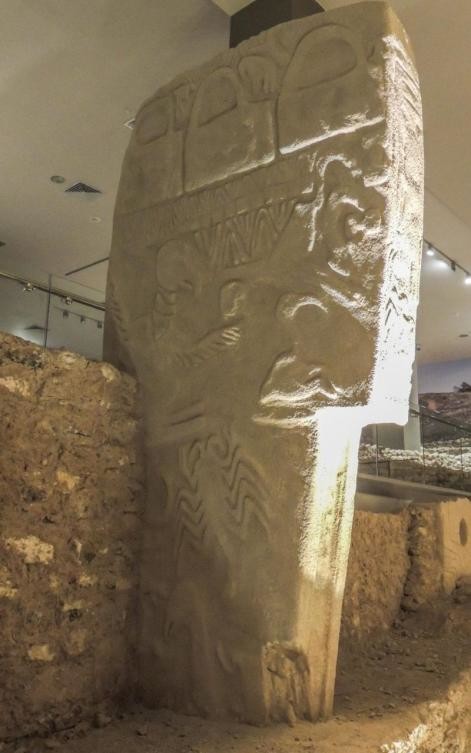
DUBAI: Ancient images carved into stone at an archaeological site in Turkey tell the story of the comet that triggered a small-scale ice age more than 13,000 years ago, scientists at the University of Edinburgh revealed this week in the Mediterranean Archaeology and Archaeometry publication.
The researchers said that carvings on a rock called the Vulture Stone suggest that a collection of comet fragments hit the Earth leading to human disaster around 11000 BC.
The carving of a headless man is believed to symbolize the extensive loss of life and it is reported that the event, which wiped out woolly mammoths, helped to spark the rise of human civilization on Earth.
For decades, scientists speculated that a comet could have caused the drop in temperature that occurred during a period known as the Younger Dryas.
This period is crucial in the history of humanity as it is pinpointed as the era during which agricultural practices began and the first Neolithic civilizations made their mark.
Before the comet strike, vast swathes of wild wheat and barley had allowed nomadic hunters in the Middle East to set up base camps. However, the icy conditions that followed caused communities to work together in the fight to maintain crops which led to the rise of communal farming and the first towns.
The Telegraph reports that experts analyzed symbols carved onto stone at Gobekli Tepe in southern Turkey in a bid to find out if they could be linked to constellations.
The scientists interpreted the animals in the carvings as astronomical symbols and matched their positions to patterns of stars using computer software, leading researchers to date the event to 10,950BC.

Ancient Turkey carvings show how comet struck Earth, sparking rise of civilization
These shy, scaly anteaters are the most trafficked mammals in the world
CAPE TOWN, South Africa: They are hunted for their unique scales, and the demand makes them the most trafficked mammal in the world.
Wildlife conservationists are again raising the plight of pangolins, the shy, scaly anteaters found in parts of Africa and Asia, on World Pangolin Day on Saturday.
Pangolins or pangolin products outstrip any other mammal when it comes to wildlife smuggling, with more than half a million pangolins seized in anti-trafficking operations between 2016 and 2024, according to a report last year by CITES, the global authority on the trading of endangered plant and animal species.
The World Wildlife Fund estimates that over a million pangolins were taken from the wild over the last decade, including those that were never intercepted.
Pangolins meat is a delicacy in places, but the driving force behind the illegal trade is their scales, which are made of keratin, the protein also found in human hair and fingernails. The scales are in high demand in China and other parts of Asia due to the unproven belief that they cure a range of ailments when made into traditional medicine.
There are eight pangolin species, four in Africa and four in Asia. All of them face a high, very high or extremely high risk of extinction.
While they’re sometimes known as scaly anteaters, pangolins are not related in any way to anteaters or armadillos.
They are unique in that they are the only mammals covered completely in keratin scales, which overlap and have sharp edges. They are the perfect defense mechanism, allowing a pangolin to roll up into an armored ball that even lions struggle to get to grip with, leaving the nocturnal ant and termite eaters with few natural predators.
But they have no real defense against human hunters. And in conservation terms, they don’t resonate in the way that elephants, rhinos or tigers do despite their fascinating intricacies — like their sticky insect-nabbing tongues being almost as long as their bodies.
While some reports indicate a downward trend in pangolin trafficking since the COVID-19 pandemic, they are still being poached at an alarming rate across parts of Africa, according to conservationists.
Nigeria is one of the global hot spots. There, Dr. Mark Ofua, a wildlife veterinarian and the West Africa representative for the Wild Africa conservation group, has rescued pangolins for more than a decade, which started with him scouring bushmeat markets for animals he could buy and save. He runs an animal rescue center and a pangolin orphanage in Lagos.
His mission is to raise awareness of pangolins in Nigeria through a wildlife show for kids and a tactic of convincing entertainers, musicians and other celebrities with millions of social media followers to be involved in conservation campaigns — or just be seen with a pangolin.
Nigeria is home to three of the four African pangolin species, but they are not well known among the country’s 240 million people.
Ofua’s drive for pangolin publicity stems from an encounter with a group of well-dressed young men while he was once transporting pangolins he had rescued in a cage. The men pointed at them and asked him what they were, Ofua said.
“Oh, those are baby dragons,” he joked. But it got him thinking.
“There is a dark side to that admission,” Ofua said. “If people do not even know what a pangolin looks like, how do you protect them?”