PARIS: The killing of a policeman on Paris’s Champs Elysees claimed by Daesh rocked France’s presidential race Friday with just two days to go before voting in the closest election for decades.
Bloodshed had long been feared ahead of Sunday’s first round of the election after a string of attacks since 2015, and the shooting propelled the jihadist threat to the fore.
A note praising Daesh was found near the body of the 39-year-old French attacker, who shot dead one officer and wounded two others before being killed by police.
The note bolstered Daesh’s claim that the perpetrator, named as Karim Cheurfi, was one of its “fighters.”
Far-right leader Marine Le Pen — who is locked in a tight four-way contest with centrist Emmanuel Macron, conservative Francois Fillon and Communist-backed firebrand Jean-Luc Melenchon — moved quickly to present herself as the toughest of the four on terrorism.
The 48-year-old National Front leader called for France to “immediately” take back control of its borders from the EU and deport all foreigners on a terror watchlist.
“This war against us is ceaseless and merciless,” she said in a sternly-worded address, accusing the Socialist government of a “cowardly” response to the threat.
Fillon and Macron also hastily convened televised briefings, where they both vowed to protect the French.
“Some have not taken the full measure of the evil,” 63-year-old Fillon said, promising an “iron-fisted” approach.
Macron, a 39-year-old moderate whom other candidates have portrayed as inexperienced, warned against any attempts to use the attack for political gain.
“Let us not give into fear, let us not give into division,” he said, telling voters he would be “unwavering in protecting you.”
The gunman drew up alongside a police van and fired at around 9:00 p.m. (1900 GMT) on Thursday, sending tourists and visitors to the world-renowned boulevard running for their lives.
After opening fire just a few hundred meters from the Arc de Triomphe monument, the gunman was shot dead while trying to flee on foot. A foreign tourist was slightly wounded by shrapnel.
A statement by Daesh’s propaganda agency Amaq said the attacker was one of its “fighters,” identifying him as “Abu Yussef the Belgian.”
But French authorities named him as Karim Cheurfi, a Frenchman living in the Paris suburbs.
Daesh’s claim raised initial concerns that a possible second attacker could be on the loose.
On Friday, French authorities said a man sought by Belgium police, who was suspected of having planned to travel to France on Thursday, had handed himself in at a police station in the Belgian city of Antwerp.
French Interior Ministry spokesman Pierre-Henry Brandet said it was “too early to say” if the man was linked to Thursday’s shooting.
Cheurfi was known to anti-terror police, sources said. He had been arrested in February on suspicion of plotting to kill police officers but released because of a lack of evidence.
He had been convicted in 2005 of three counts of attempted murder, two involving police officers, sources said. Three people known to him were being questioned by police.
It was unclear how the election would be impacted by the shooting, which came days after two men were arrested in Marseille on suspicion of plotting an imminent attack.
The shooting follows a series of strikes around Europe in the last month, targeting Stockholm, London and the underground train system in Saint Petersburg.
Until now, surveys showed voters more concerned about unemployment and the economy than terrorism or security, though analysts warned this could change in the event of violence.
Macron and Le Pen had long led the presidential campaign but Melenchon and Fillon have closed in on them, with Fillon regaining some support lost to an expenses scandal.
Prime Minister Bernard Cazeneuve accused Le Pen of attempting to use the police killing for political gain, saying she was “seeking, as she does after every tragedy, to take advantage of it.”
US President Donald Trump tweeted that the attack “will have a big effect” on the election.
Shop owners and restaurant managers shepherded their customers to backrooms and basements when the shooting began on the bustling Champs Elysees.
France has been under a state of emergency for nearly a year and a half, with more than 230 people killed in radical attacks since the start of 2015.
The offices of Charlie Hebdo magazine were hit in January 2015, Daesh gunmen and suicide bombers killed 130 people in Paris the following November, and a Tunisian man rammed a truck through crowds in Nice last July, killing 86 people.


![]()
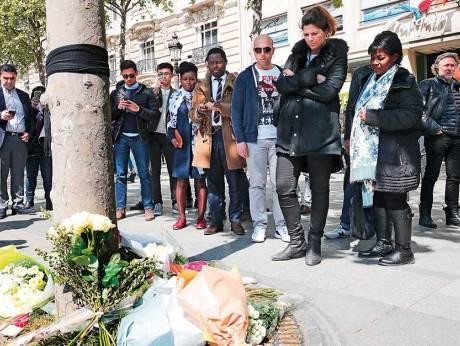
Fears shroud French presidential election after Paris attack
Fears shroud French presidential election after Paris attack

Latest updates



© 2026 SAUDI RESEARCH & PUBLISHING COMPANY, All Rights Reserved And subject to Terms of Use Agreement.