SHANGHAI: Southeast Asia’s potential beckons as global automakers look beyond China’s massive market to extend their sales boom in the region, but executives say they face a struggle to match the explosive Chinese growth.
Chinese passenger-car sales have quadrupled over the past 10 years to 24.38 million last year, having become the world’s biggest market in 2009.
But with Chinese economic growth moderating, one question being asked at the Shanghai Auto Show is: where in Asia can carmakers look for the next boom?
“There is a challenge to seek growth where the growth is. You look at countries that are less equipped and are in the process of growth or acceleration,” said Marc Boilard, industry analyst at the firm Oliver Wyman.
Southeast Asia’s potential remains significant, with more than 600 million people, solid economic growth and just 2.1 million passenger vehicles sold last year in the 10-country Association of Southeast Asian Nations (ASEAN).
But carmakers say issues such as import taxes, regional dominance by Japanese manufacturers and lagging infrastructure work against broad-based growth.
ASEAN “is a market that is closed, where import taxes are very high,” making it necessary to invest in local manufacturing, said Carlos Tavares, chairman of France’s PSA, which produces Peugeot and Citroen.
Indonesia has 250 million people, but US automaker Ford pulled out last year in the face of Japanese firms’ more than 90 percent market share, said David Schoch, CEO of Ford China.
“When I sit back and look at it, and think about electrification, smart mobility, and where the industry is going ... where are you going to place your bet?” Schoch said.
Ford has announced plans to double down on China, where electric-vehicle and SUV sales continue to surge.
“Although Indonesia represents a fairly large market and is growing, again, we couldn’t see a way forward that we could be successful there,” Schoch said.
Vietnam holds potential with more than 90 million people and less than 30 vehicles per 1,000, compared with China’s 120 and 800 in the US.
“The only downside, however, is that these markets have been dominated by the Japanese for a very long time,” said François Jaumain of PwC Autofacts.
Japanese carmakers account for 71 percent of sales in Thailand and 59 percent in Vietnam, according to PwC.
PSA, whose China sales plunged 16 percent last year, plans to target five percent of Vietnam’s passenger-car volume, which reached just 158,000 last year.
It also is pursuing a strategic partnership with Proton, the struggling national carmaker of Malaysia, where half a million cars were sold last year.
Infrastructure development, which helped facilitate China’s private-car boom, has not kept up in Southeast Asia.
Sebastien Amichi of consultancy Roland Berger said: “We’ve been talking a long time about the ‘new dragons’, which have had difficulty taking off.
“When we take these countries together, Southeast Asia could be a good growth area, if the infrastructure and banking networks are set up effectively.”


![]()
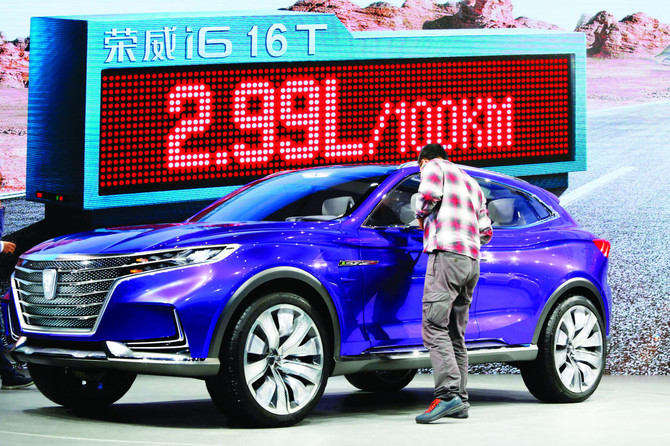
Beyond China, carmakers seek new drivers of Asian growth
Beyond China, carmakers seek new drivers of Asian growth
Latest updates


© 2026 SAUDI RESEARCH & PUBLISHING COMPANY, All Rights Reserved And subject to Terms of Use Agreement.