Tillerson accuses Iran of ‘alarming provocations’ as US reviews policy

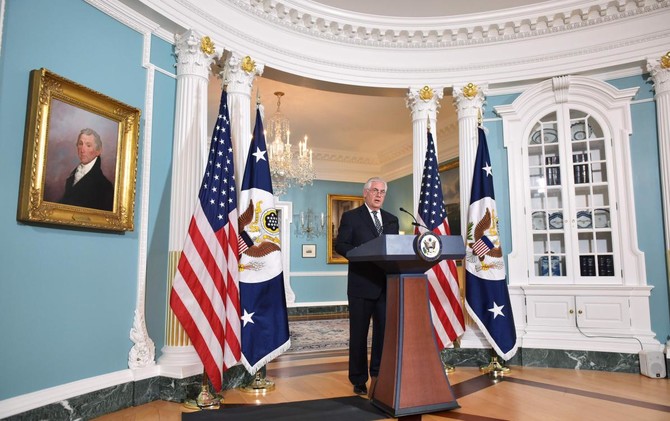
US Secretary of State Rex Tillerson holds a press conference on Iran in the Treaty Room of the State Department in Washington, DC on April 19, 2017. (AFP)
Updated 20 April 2017
Follow

Tillerson accuses Iran of ‘alarming provocations’ as US reviews policy

WASHINGTON: US Secretary of State Rex Tillerson on Wednesday accused Iran of ‘alarming ongoing provocations’ to destabilize countries in the Middle East as the Trump administration launched a review of its policy toward Tehran.
Tillerson told reporters the review, which he announced on Tuesday, would not only look at Tehran’s compliance with a 2015 nuclear deal but also its behavior in the region which he said undermined US interests in Syria, Iraq, Yemen and Lebanon.
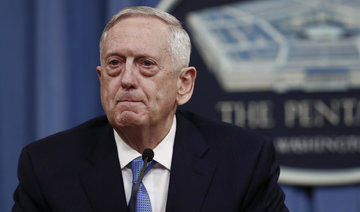
His tough words matched those of US Defense Secretary Jim Mattis, who said in a visit to Saudi Arabia on Wednesday that Iran’s destabilizing influence would have to be overcome to end the conflict in Yemen.
President Donald Trump ordered the review to evaluate whether suspension of sanctions related to the nuclear deal was “vital to the national security interests of the United States,” Tillerson said
Though there was no sign the Trump administration intended to walk away from the deal, Tillerson twice cautioned that if left unchecked Tehran could become a threat like North Korea, which is also under pressure over its nuclear ambitions.
In a letter to US House of Representatives Speaker Paul Ryan released late on Tuesday, Tillerson declared that Iran was meeting its commitments under the 2015 nuclear deal but there were concerns about Tehran’s role as a state sponsor of terrorism.
“A comprehensive Iran policy requires we address all of the threats posed by Iran and it is clear there are many,” Tillerson told reporters at the State Department.

Tillerson said the 2015 nuclear deal between Iran and six world powers failed “to achieve the objective of a non-nuclear Iran and only delays their goal of becoming a nuclear state.”
“FAILED APPROACH“
Iran has yet to comment on the Trump administration’s review, but Iranian Supreme Leader Ayatollah Khamenei warned in November that Tehran would retaliate if the United States breached the nuclear agreement.
Tillerson said one of the mistakes in the way the agreement was put together was that it ignored all the other serious threats Iran posed outside of its nuclear program.
“That is why we have to look at Iran in a very comprehensive way in terms of the threat it poses in all areas of the region and the world,” he added.
“This deal represents the same failed approach of the past that brought us to the current imminent threat we face from North Korea,” Tillerson said of the nuclear deal.
The nuclear agreement, negotiated during Barack Obama’s presidency, placed limitations on Iran’s nuclear program in exchange for lifting economic sanctions against Iran.
Tillerson’s notice to Congress was part of a 90-day process in which the president has to certify that Iran is complying with the nuclear accord. It is the first update under the Trump administration.
The next test of Trump’s attitude toward the nuclear deal will be in May when he must decide whether to extend sanctions waivers for Iran first signed by President Barack Obama.
During his presidential campaign, Trump called the agreement “the worst deal ever negotiated” and said he would review it once he reached office.
The European Union’s foreign policy chief, Frederica Mogherini, said last month after meetings with senior Trump administration officials she was reassured in the talks that the US was committed to fully implementing the deal.
Afghan barbers under pressure as morality police take on short beards

Updated 4 sec ago
Follow

Afghan barbers under pressure as morality police take on short beards

KABUL: Barbers in Afghanistan risk detention for trimming men’s beards too short, they told AFP, as the Taliban authorities enforce their strict interpretation of Islamic law with increasing zeal.
Last month, the Ministry for the Propagation of Virtue and Prevention of Vice said it was now “obligatory” to grow beards longer than a fist, doubling down on an earlier order.
Minister Khalid Hanafi said it was the government’s “responsibility to guide the nation to have an appearance according to sharia,” or Islamic law.
Officials tasked with promoting virtue “are obliged to implement the Islamic system,” he said.
With ministry officials patrolling city streets to ensure the rule is followed, the men interviewed by AFP all spoke on condition of anonymity due to security concerns.
In the southeastern province of Ghazni, a 30-year-old barber said he was detained for three nights after officials found out that one of his employees had given a client a Western-style haircut.
“First, I was held in a cold hall. Later, after I insisted on being released, they transferred me to a cold (shipping) container,” he said.
He was eventually released without charge and continues to work, but usually hides with his clients when the patrols pass by.
“The thing is that no one can argue or question” the ministry officials, the barber said.
“Everyone fears them.”
He added that in some cases where both a barber and clients were detained, “the clients have been let out, but they kept the barber” in custody.
Last year, three barbers in Kunar province were jailed for three to five months for breaching the ministry’s rules, according to a UN report.

‘Personal space’

Alongside the uptick in enforcement, the religious affairs ministry has also issued stricter orders.
In an eight-page guide to imams issued in November, prayer leaders were told to describe shaving beards as a “major sin” in their sermons.
The religious affairs ministry’s arguments against trimming state that by shaving their beards, men were “trying to look like women.”
The orders have also reached universities — where only men study because women have been banned.
A 22-year-old Kabul University student said lecturers “have warned us... that if we don’t have a proper Islamic appearance, which includes beards and head covering, they will deduct our marks.”
In the capital Kabul, a 25-year-old barber lamented that “there are a lot of restrictions” which go against his young clients’ preference for closer shaves.
“Barbers are private businesses, beards and heads are something personal, they should be able to cut the way they want,” he said.
Hanafi, the virtue propagation minister, has dismissed such arguments, saying last month that telling men “to grow a beard according to sharia” cannot be considered “invading the personal space.”

Business slump

In Afghanistan, the majority are practicing Muslims, but before the Taliban authorities returned to power in 2021, residents of major cities could choose their own appearance.
In areas where Taliban fighters were battling US-backed forces, men would grow beards either out of fear or by choice.
As fewer and fewer men opt for a close shave, the 25-year-old Kabul barber said he was already losing business.
Many civil servants, for example, “used to sort their hair a couple of times a week, but now, most of them have grown beards, they don’t show up even in a month,” he said.
A 50-year-old barber in Kabul said morality patrols “visit and check every day.”
In one incident this month, the barber said that an officer came into the shop and asked: “Why did you cut the hair like this?“
“After trying to explain that he is a child, he told us: ‘No, do Islamic hair, not English hair’.”